The Future of Physics is Here
〰️
The Future of Physics is Here 〰️
A Geometric Theory of Everything
Unified Field Dynamics (UFD) is a physically intuitive, field-based framework that reinterprets the established mathematical structures of classical field theory, continuum mechanics, and wave dynamics within a single coherent ontology. Rather than extending existing models through additional mechanisms or hidden parameters, UFD proposes a foundational alternative grounded in minimal assumptions, geometric reasoning, and cross-scale consistency. The universe, in this picture, is not empty space populated by particles and governed by separately postulated laws. It is a structured medium organized into nested field layers, in which particles are stable patterns, forces are pressure-geometry effects, and the constants of physics begin to look like traces of a deeper architecture rather than unrelated inputs.
From two geometric parameters, UFD derives nuclear binding energies (He-3 to 99.98%, He-4 to 99.96%), the fine-structure constant (α⁻¹ ≈ 137.0), the proton-electron mass ratio, and the W/Z boson mass ratio — without free parameters. The framework makes explicit, falsifiable predictions across nuclear, quantum, and cosmological domains, enabling direct empirical adjudication rather than post-hoc accommodation.
We invite you to examine the framework, evaluate its claims, and determine for yourself whether this geometric approach offers a viable path toward unified physics
The Books
UFD is presented in two complementary volumes, each addressed to a different kind of reader. The two books can be read independently or together. The Geometry of Reality establishes the framework. Conversations on the Geometry of Reality puts it to the test.
The Geometry of Reality is a rigorous, foundational scientific monograph. Across twelve chapters, it develops UFD in its full technical form, working through the framework's core principles, its derivations, and its implications for nuclear physics, quantum mechanics, cosmology, and beyond. A free PDF of the book is available below, along with the complete Mathematical Appendices hosted on Zenodo and the Fact Sheets summarizing each appendix (see below). Readers seeking the rigorous version of UFD — the equations, the derivations, the structural arguments — will find them here.
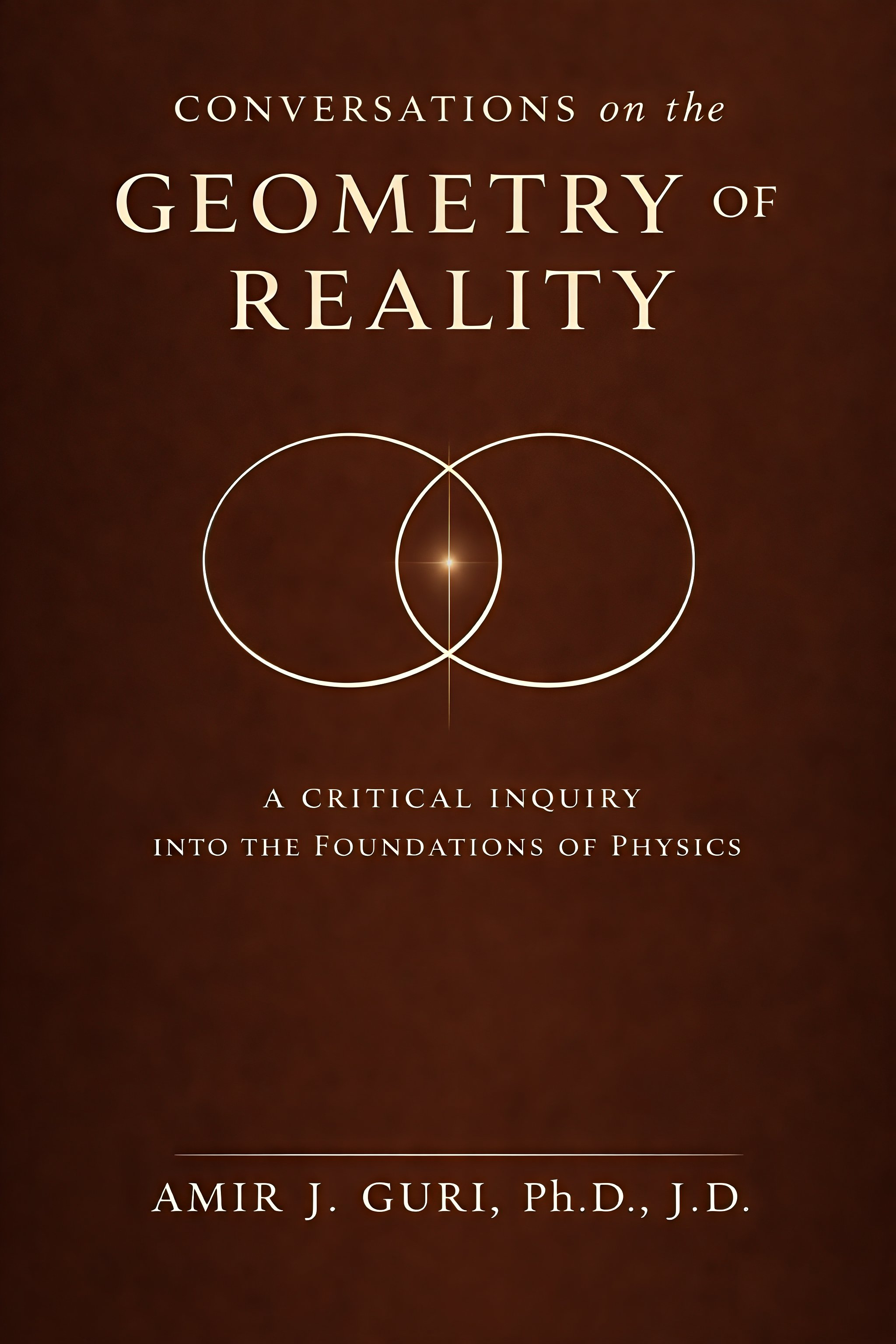
Conversations on the Geometry of Reality is the dialogue-format companion volume. Written in the tradition of Galileo's Dialogue Concerning the Two Chief World Systems, it puts UFD into the mouths of two physicists — Dr. S, a mainstream skeptic, and Dr. U, a defender of the framework — and works through the same questions across twenty-one chapters. From the cosmic microwave background to the nature of consciousness itself, the book tests each reinterpretation against what standard physics already knows. It is not a manifesto. It is a stress test. Readers who want to encounter UFD as a critical conversation rather than a technical exposition will find that here.
Of the two, Conversations is the book that is more suited towards a general audience. The two books can be read independently or together. The Geometry of Reality establishes the framework. Conversations on the Geometry of Reality puts it to the test.

The Future of Physics is Now
〰️
The Future of Physics is Now 〰️

The Mathematical Appendices
This section contains the formal mathematical appendices of Unified Field Dynamics (UFD).
They were developed after The Geometry of Reality to provide technical articulation of the framework presented in the main text.
UFD was constructed conceptually before it was formalized mathematically.
Philosophy First, Then Science, Then Mathematics
The appendices translate the physical and ontological claims of the book into classical field-theoretic language, offering a more detailed and explicit presentation of the model’s structure.
The appendices employ established tools from classical field theory, continuum mechanics, and vector calculus.
No novel mathematical formalisms are introduced; rather, existing mathematical methods are used to express the model precisely.
The derivations were developed with the assistance of contemporary large language models as analytical and editorial tools.
All conceptual structure, physical interpretation, and theoretical claims originate from the author.

Reviewing UFD
We invite readers to evaluate Unified Field Dynamics (UFD) for its philosophical coherence, scientific adequacy, and mathematical consistency.
Because UFD is formulated as a replacement-level framework with a distinct ontology, standard evaluative habits and assumptions drawn from existing models do not always apply directly. To support fair and rigorous assessment, we provide a Reviewer’s Guide that outlines the appropriate criteria, scope, and points of comparison for evaluating the framework on its own terms.
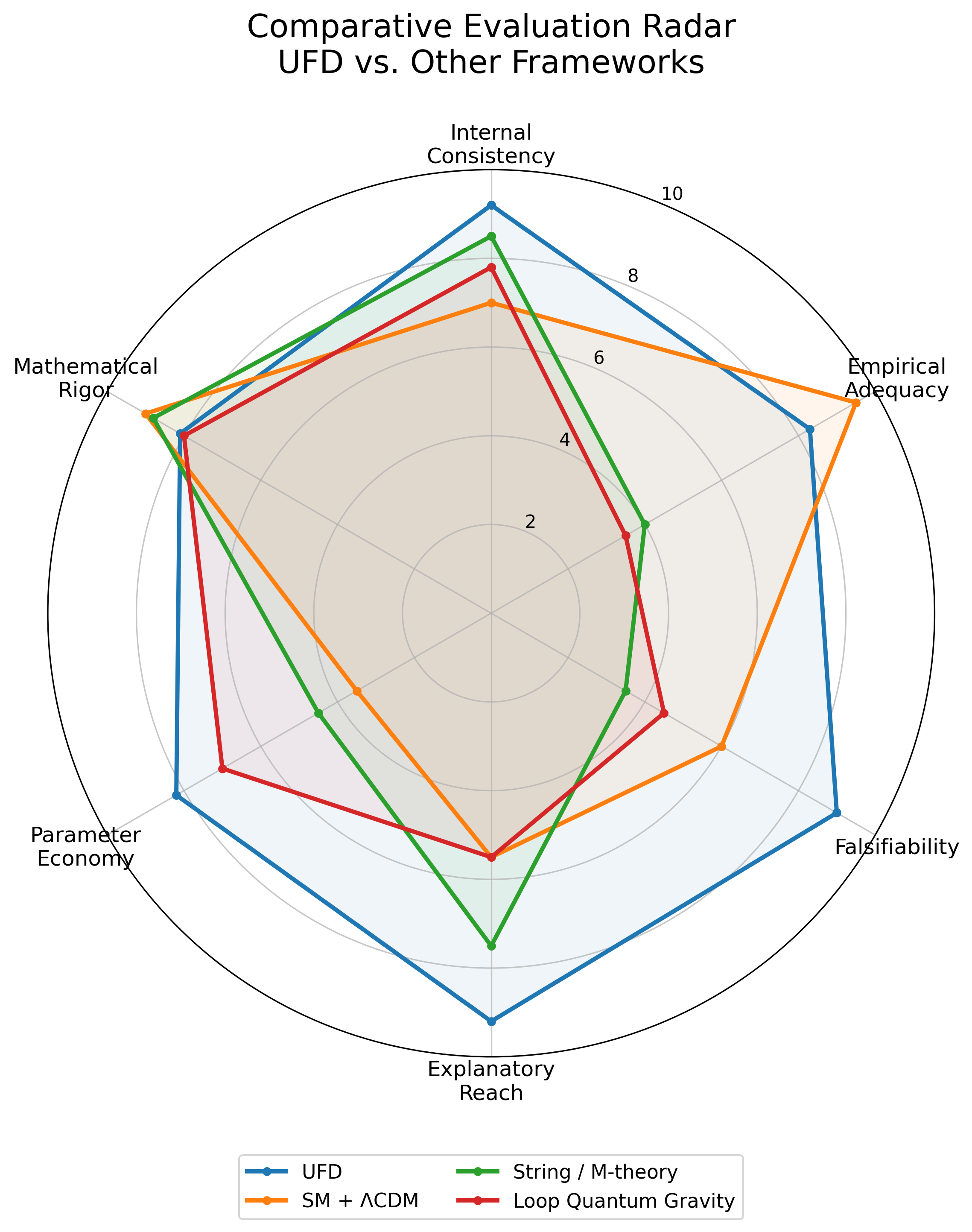
In addition, we include an independent technical assessment produced using Anthropic’s language model (Claude Opus 4.6 and ChatGPT 5.4) under structured evaluation prompts, where UFD displays a balanced high-performance profile, particularly in falsifiability and parameter economy, while other frameworks exhibit characteristic domain-specific trade-offs. This review is provided as a reference point, not as an endorsement, and is intended to illustrate how the framework is interpreted under a neutral, criteria-based analysis.
Critical engagement is welcome.

The Three Pillars of Resonant Engineering
Resonant Engineering is the applied expression of UFD (Appendix E). If UFD describes how coherence shapes matter across scales, Resonant Engineering explores how those same principles can be used deliberately. Across nuclear, chemical, material, and biological systems, three mechanisms repeatedly emerge as universal levers for influencing physical behavior.
1. Resonant Stabilization
Resonant Stabilization is the deliberate reinforcement of coherent field states to prevent decoherence and structural breakdown. Every physical system—from atoms to biological tissues—contains organized modes that naturally resist disorder. When those modes are strengthened rather than disrupted, stability increases without requiring brute-force energy input. By sustaining phase alignment and harmonic structure, resonant stabilization preserves configurations that would otherwise decay. Instead of constantly compensating for loss, the system is guided into a self-reinforcing regime where coherence maintains itself.
The potential value of this principle is far-reaching:
Quantum systems: Extending coherence times in qubits and suppressing environmental noise without extreme cooling or shielding.
Materials science: Stabilizing fragile phases, exotic states of matter, or high-performance configurations that are normally short-lived.
Energy systems: Reducing dissipative losses by maintaining synchronized field behavior rather than compensating for breakdown.
Biological systems: Supporting metabolic or neural coherence where function depends on phase alignment across scales.
Resonant stabilization shifts engineering from force-based control to coherence-based control. Instead of overpowering disorder, it strengthens the organizing modes already present in the system. If successfully implemented, this approach could unlock stable access to regimes that are currently unstable, inefficient, or energetically expensive to maintain.
2. Geometric Catalysis
Geometric Catalysis is the deliberate shaping of the energetic landscape so that particles and fields naturally follow optimal paths. Instead of forcing reactions forward by adding more energy, the geometry of the system is adjusted so that barriers are lowered, redirected, or removed entirely. Because motion follows curvature and pressure gradients, altering the field environment changes what is easy, what is difficult, and what is even possible. When geometry is engineered correctly, desired reactions become the path of least resistance. The practical implications are significant:
Chemical synthesis: Lower activation barriers without extreme temperatures or pressures, improving efficiency and selectivity.
Precision manufacturing: Guide molecular and nanoscale assembly through structured fields rather than mechanical positioning.
Energy systems: Enable cleaner reaction pathways by reshaping energetic bottlenecks instead of overpowering them.
Nuclear processes (long-term): Influence reaction channels through field geometry rather than brute-force confinement.
Geometric Catalysis reframes engineering from energy-intensive intervention to structural guidance. Instead of pushing systems uphill, it reshapes the hill. If successful, this approach could reduce energy consumption, increase reaction precision, and unlock processes that are currently impractical due to instability or inefficiency.
3. Resonant Damping
Resonant Damping is the precise suppression of incoherent or destabilizing modes through tuned counter-phase interactions. Every physical system generates turbulence, random fluctuations, and vibrational noise that gradually erode structure and efficiency. Rather than overpowering this disorder, resonant damping neutralizes it at the level of phase. By selectively canceling disruptive modes, phase dispersion narrows and the dominant coherent structure becomes more stable. The system is not frozen or rigidly constrained. Instead, it is refined — noise is reduced while functional dynamics remain intact. The potential applications are broad:
Superconductivity and advanced materials: Suppress vibrational modes that disrupt long-range coherence, potentially increasing stability and performance.
Thermal management: Reduce unwanted energy dissipation by damping incoherent excitations at their source.
Quantum systems: Counteract environmental noise to extend operational coherence without brute-force isolation.
Complex biological or neural systems: Restore phase alignment in networks where function depends on coordinated oscillation.
Resonant damping shifts control from brute-force stabilization to selective coherence filtering. Instead of shutting systems down to eliminate instability, it preserves what works while silencing what does not. Together with Resonant Stabilization and Geometric Catalysis, it forms a framework for engineering systems through coherence rather than force.

Potential Economic Impact of Resonant Engineering
Replacement-level physical frameworks often enable new classes of technology by changing what is physically achievable. In Unified Field Dynamics, this technological regime is referred to as Resonant Engineering.
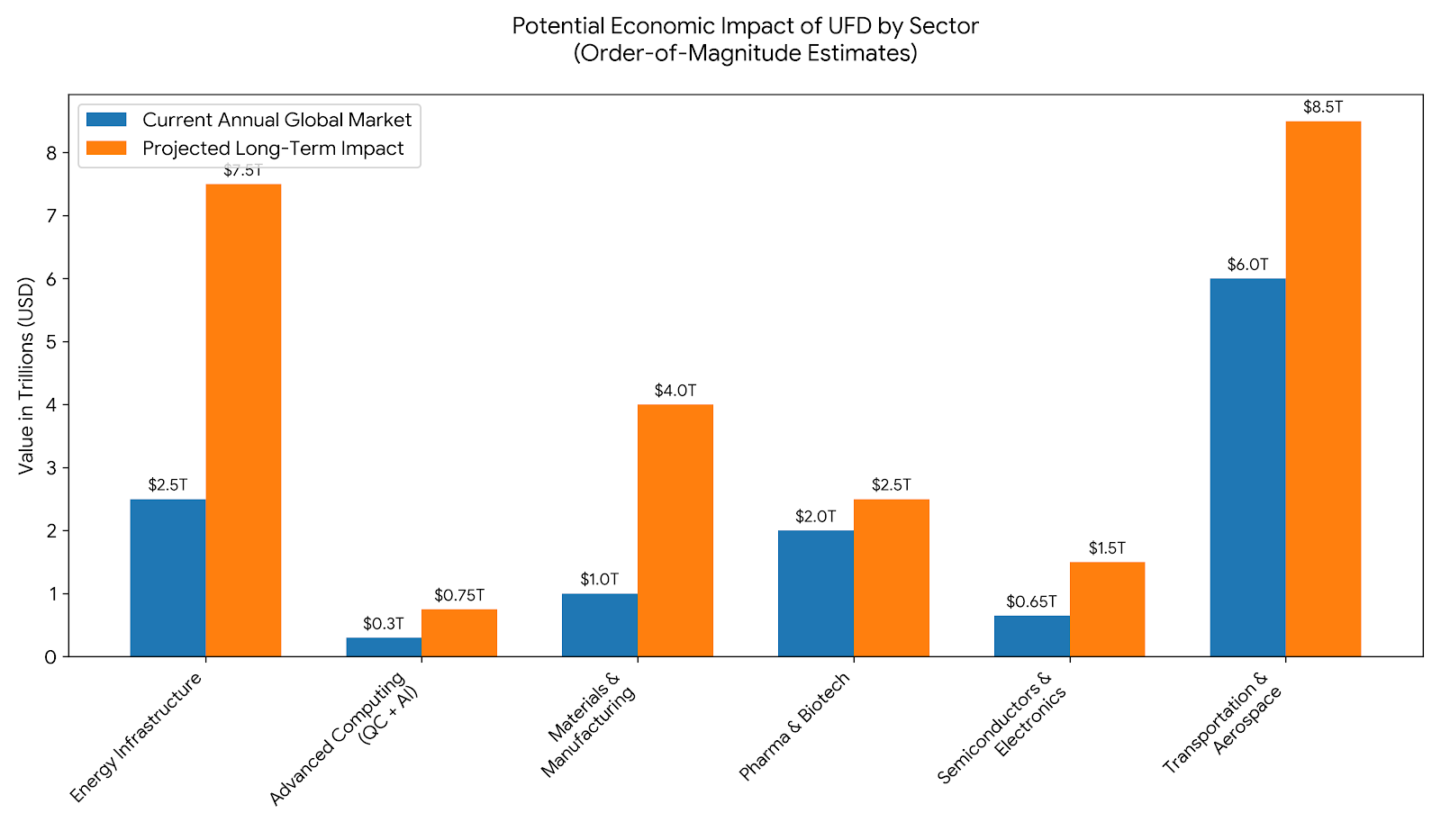
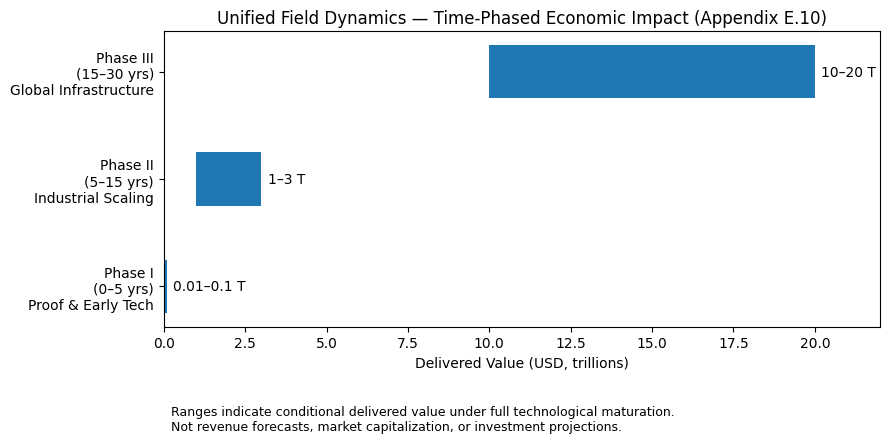
The following charts summarize order-of-magnitude, time-phased estimates of the potential delivered economic value associated with Resonant Engineering, under the assumption that the underlying physical principles are validated and mature, as described in Appendix E.10.
Figure 1 provides a sector-by-sector comparison of current global markets versus the projected long-term value creation of Resonant Engineering. By replacing systems governed by heat loss and material fatigue with perfectly coherent, zero-friction systems, UFD predicts order-of-magnitude expansions in our civilizational infrastructure.
Figure 2 illustrates the macroeconomic evolution predicted by the UFD framework over the next 50 years. As Resonant Engineering scales, human industry transitions from managing scarcity, dissipation, and friction to operating entirely within coherence-governed abundance.
These estimates are conditional, conservative, and not forecasts of revenue, adoption timelines, or investment returns.