Ontology
Every physical theory rests on implicit assumptions about what is real. These assumptions are rarely stated directly. Terms such as “energy,” “mass,” “force,” and even “field” are used operationally—defined by how they behave in equations rather than by what they are. As a result, modern physics is mathematically precise but ontologically diffuse.
Unified Field Dynamics begins by reversing that order. Before asking how nature behaves, it asks what exists.
In UFD, reality is not built from particles, nor from abstract spacetime geometry. It is built from structured fields. Matter, motion, and interaction are not primitive ingredients; they are stable patterns within a continuous medium. The task of ontology, therefore, is to define the fundamental terms in plain physical language before deriving their mathematical behavior.
A field is not an assignment of numbers to points in space. It is a real, continuous substrate capable of supporting motion, tension, and coherence. Energy is not an abstract conserved quantity; it is the motion and geometric configuration of that substrate. Mass is not intrinsic substance; it is resistance to reconfiguration arising from stable circulation. Force is not action at a distance; it is the response of a medium to pressure gradients and geometric constraint.
This ontological grounding matters because many of the paradoxes of modern physics arise from category confusion—treating bookkeeping constructs as physical entities, or treating emergent effects as primitives. By clarifying definitions at the outset, UFD aims to remove ambiguity at the root.
The entries that follow provide concise definitions of the core concepts that structure the framework: field, energy, entropy, light, mass, force, coherence, and related terms. These are not rebranded textbook definitions. They are structural commitments that anchor the entire model.
Fields
Standard Model View
In contemporary physics, fields are mathematical entities defined at every point in space and time. The electromagnetic, weak, strong, and gravitational fields describe how particles interact and evolve. In quantum field theory, particles themselves are excitations of underlying quantum fields. These fields are fundamental, but they are typically defined through equations rather than described as tangible physical substances.
UFD View
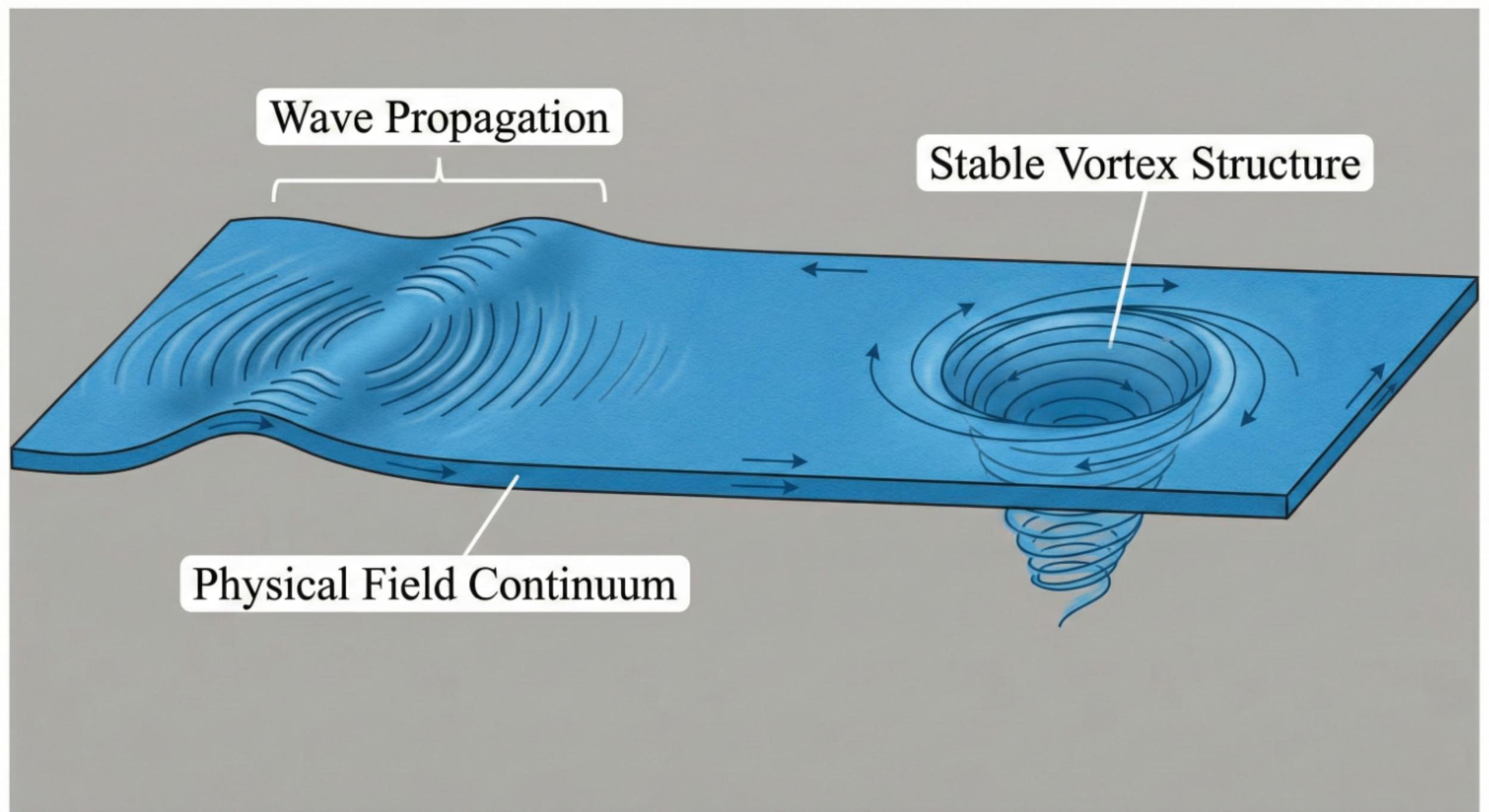
In UFD, fields are not merely mathematical constructs but real physical layers of the universal plenum. Each field represents a different mode of organization and coherence within the same underlying medium. Fields possess tension, support wave propagation, and can form stable vortical structures. Rather than abstract operators, they are physically active continua whose geometry determines observable phenomena.
Plenum
Standard Model View
In modern physics, space is typically treated as a geometric arena rather than a material medium. In general relativity, spacetime is a mathematical manifold whose curvature encodes gravity. In quantum field theory, fields exist on this spacetime background, but the vacuum itself is not usually described as a structured substance in the classical sense. Although the quantum vacuum possesses fluctuations and energy density, it is not presented as a continuous mechanical medium transmitting pressure or supporting vortical circulation. The historical concept of a “plenum” or aether was abandoned because earlier models conflicted with relativity and lacked empirical grounding.
UFD View
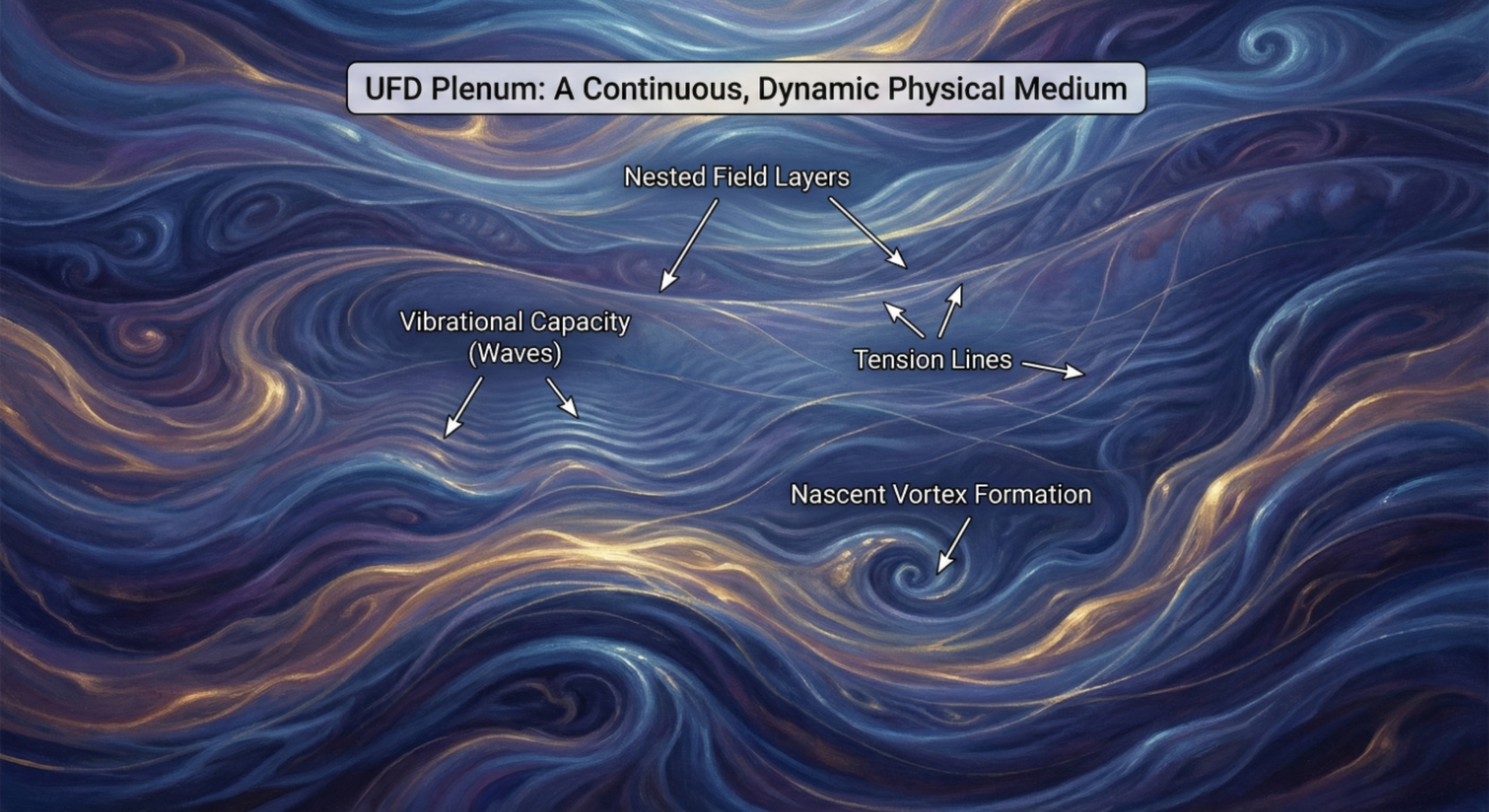
In Unified Field Dynamics, the plenum is the continuous, physically real substrate of the universe. It is not empty space and not merely a coordinate system. It is a structured, dynamic medium capable of sustaining pressure gradients, coherent circulation, resonance, and phase organization.
Because the plenum is continuous, interaction never occurs across emptiness. Forces arise from pressure structure and geometric constraint within the medium itself. Matter is not something moving through the plenum; it is a stable vortex within it. Light is not a disturbance of nothingness; it is a propagating mode of the plenum. Gravity is not curvature of an abstract manifold; it is the pressure geometry of the plenum. The plenum is therefore the ontological foundation of UFD: a real, structured medium whose organized motions give rise to mass, force, light, and coherent structure at every scale.
Energy
Standard Model View
In modern physics, energy is a conserved scalar quantity associated with motion, fields, and mass. It appears in many forms—kinetic, potential, thermal, electromagnetic, and rest energy—and is governed by the Law of Conservation of Energy, which states that energy cannot be created or destroyed, only transformed. Although this conservation law is fundamental and universally observed, energy itself is typically defined operationally through equations rather than through a clear physical ontology. It is treated as a measurable property of systems rather than as a substance or medium.
UFD View
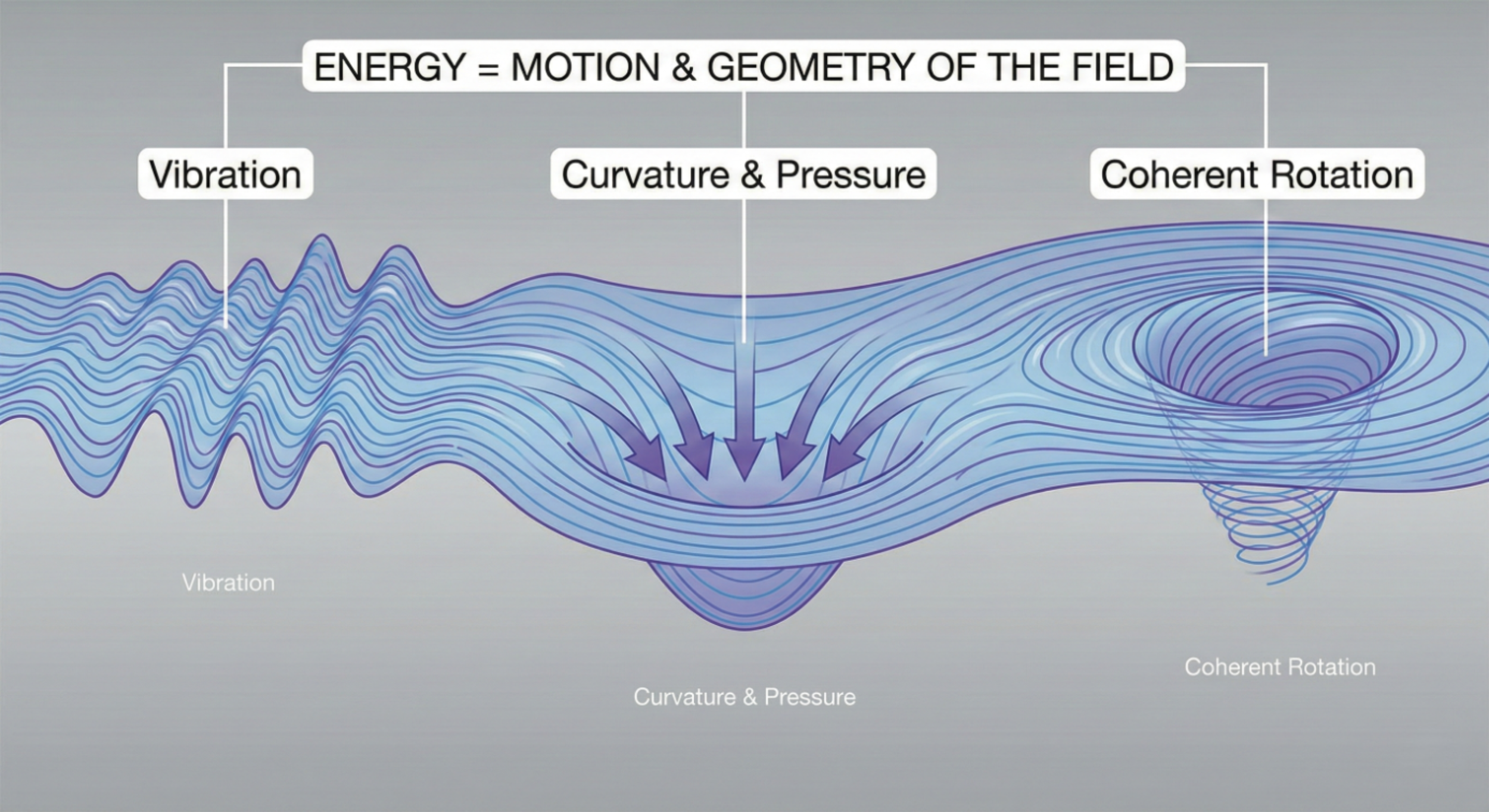
In Unified Field Dynamics, energy is the motion and geometric configuration of a universal field. A field in its quiescent state represents pure potential. Any disturbance within that field—whether a propagating wave, a pressure flow, or a stable self-sustaining vortex—is a manifestation of energy. What we call kinetic energy, mass-energy, radiation, or binding energy are not different substances but different dynamical states of the same continuous medium.
The Law of Conservation of Energy follows directly from this ontology. Energy is conserved because the underlying field is conserved. If energy is the structured motion of the plenum, then it cannot disappear without the medium itself disappearing. Conservation is therefore not an abstract bookkeeping rule but a physical principle of continuity: energy persists because the field that sustains it persists.
Entropy
Standard Model View
In conventional physics, entropy measures disorder. Structured systems — like a sandcastle or unmixed cream and coffee — are considered ordered, while uniform mixtures are considered disordered. The Second Law of Thermodynamics states that entropy increases over time, meaning systems evolve toward greater disorder and uniformity. Entropy is typically defined statistically, in terms of the number of microscopic configurations consistent with a macroscopic state.
UFD View
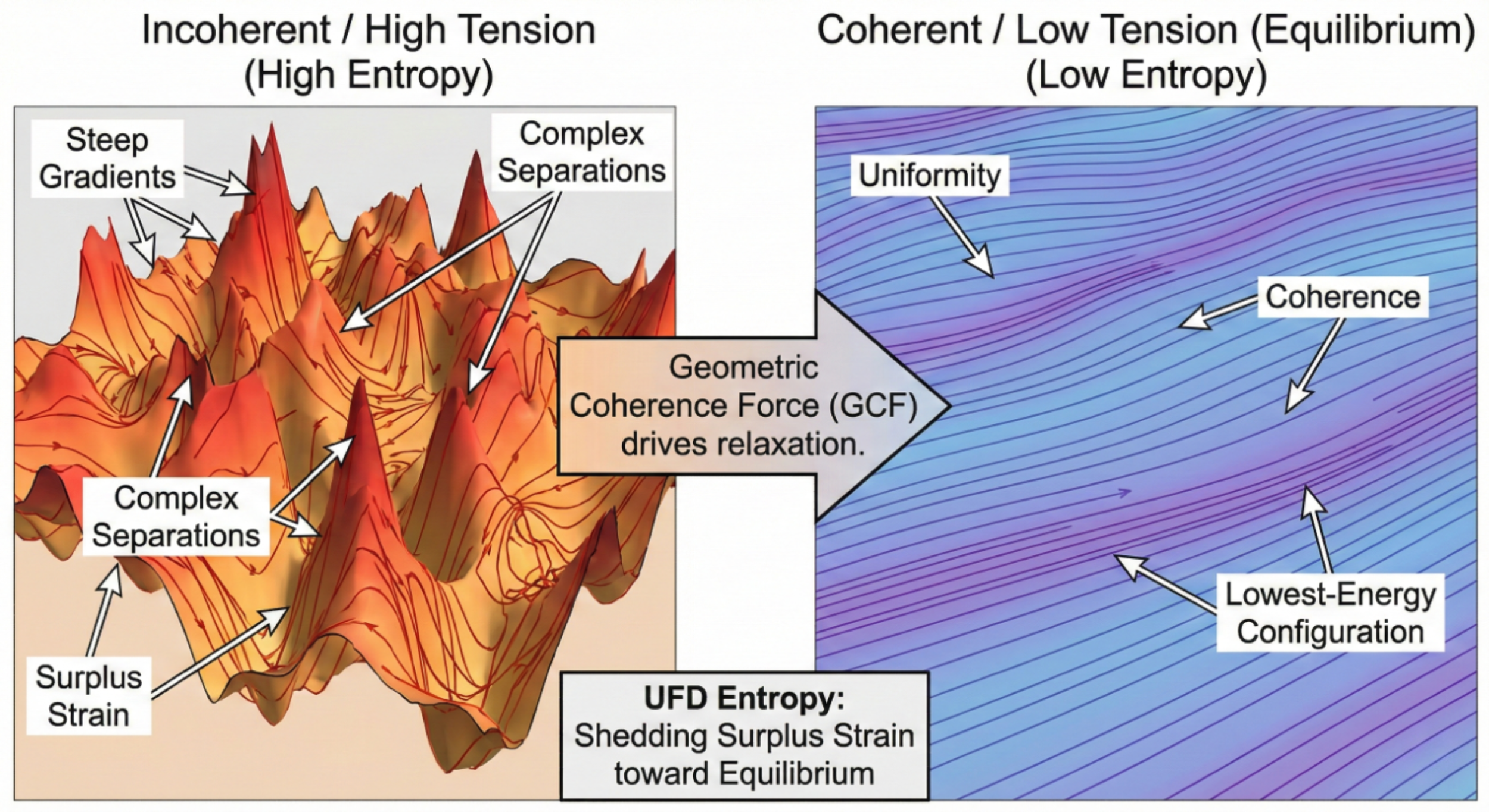
In UFD, entropy is not disorder — it is the relaxation of field tension toward equilibrium. From the perspective of a real physical medium, uniformity and coherence are the most ordered states. Steep gradients, complex separations, and highly strained geometries represent incoherence and internal tension. The Geometric Coherence Force (GCF) is the mechanism that drives this relaxation. At small scales, it can build structure — pulling nucleons into stable, low-tension vortex geometries (USF level). At large scales, it dissolves structure — eroding stars and galaxies back toward uniform equilibrium. Entropy in UFD is the universal tendency of the fields to shed surplus strain and settle into their lowest-energy, most coherent configurations.
Particle
Standard Model View
In quantum field theory, a particle is a quantized excitation of an underlying field. Some particles are elementary, while others are composite states bound by gauge interactions. Their properties — mass, charge, spin — are intrinsic parameters determined by symmetry principles and coupling constants.
UFD View
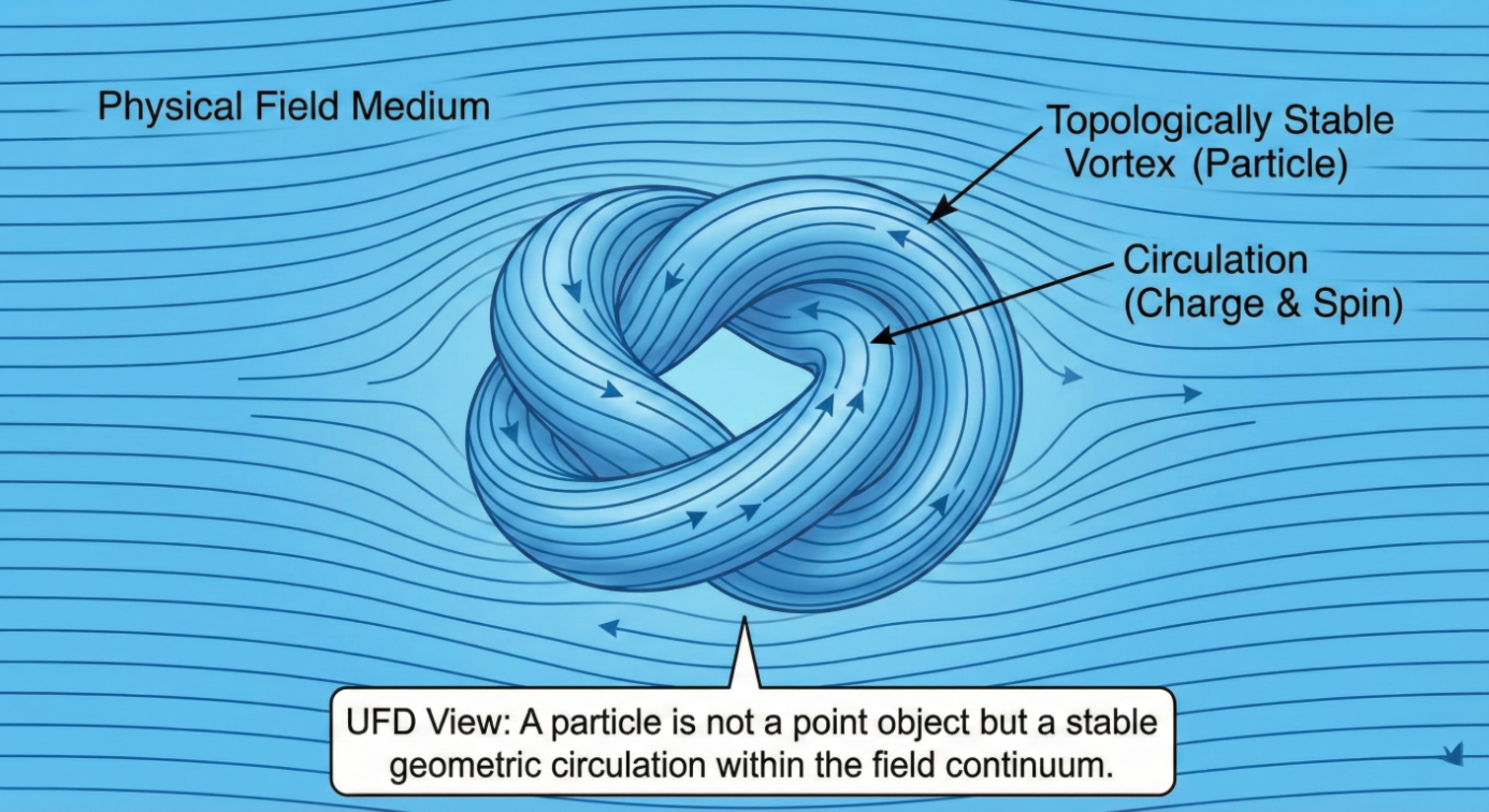
In UFD, a particle is a topologically stable vortex structure within a physical field medium. It is not a point and not a separate object placed into space; it is something the field does. Mass is the energy required to sustain the vortex configuration. Charge and spin arise from the geometry and direction of circulation. Stability is topological: just as a knot cannot be untied without cutting the rope, a coherent vortex cannot unwind without a large-scale reconfiguration of the field.
Force
Standard Model View
In modern physics, interactions are treated as fundamental and distinct. Gravity, electromagnetism, the strong interaction, and the weak interaction are described as separate mechanisms, each governed by its own field equations or exchange particles. A force is defined operationally as something that changes an object’s motion.
UFD View
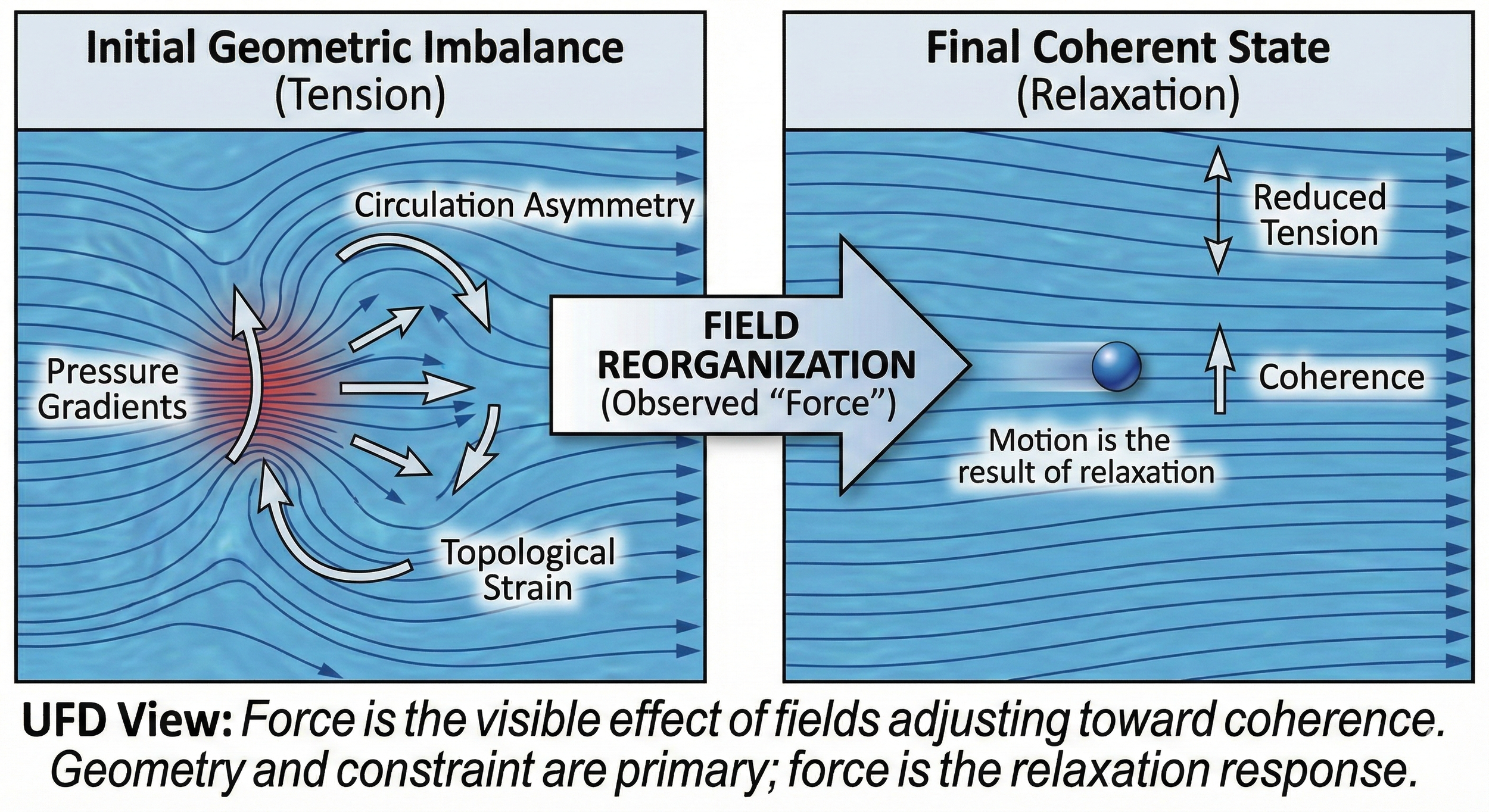
In UFD, forces are not fundamental entities. A force is what we observe when a real field responds to geometric imbalance. When pressure gradients, circulation asymmetries, or topological strain arise within the nested fields, the medium evolves according to its local stress structure. That evolution produces motion.
What we call a force is the visible effect of field reconfiguration under constraint. Geometry and boundary conditions are primary; force is the dynamic response of a tension-bearing medium.
Light
Standard Model View
In modern physics, light is described as an electromagnetic wave governed by Maxwell’s equations and quantized as photons in quantum electrodynamics. It exhibits both wave-like and particle-like behavior, a feature known as wave–particle duality. Photons are massless gauge bosons that mediate the electromagnetic force and propagate at a constant speed in vacuum. Light is therefore treated as an excitation of the electromagnetic field.
UFD View
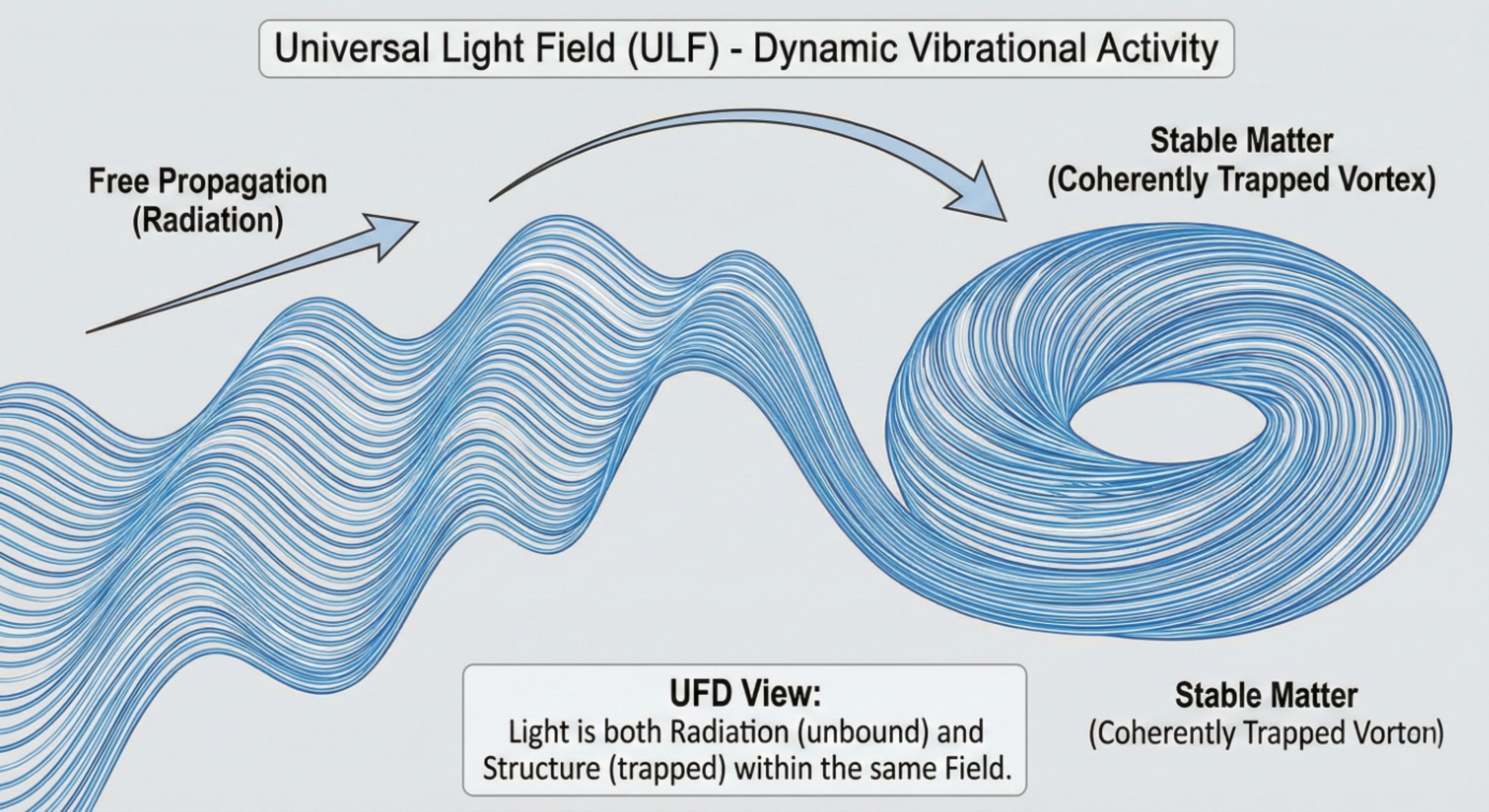
In UFD, light is the dynamic vibrational activity of the Universal Light Field (ULF). It is not merely a messenger between charged particles, but the coherent layer from which matter itself can form. When light circulates stably within the nested field structure, it becomes a vortex — and that vortex becomes a particle. Light is therefore both radiation and structure: free propagation when unbound, and stable matter when coherently trapped.
Mass
Standard Model View
In modern physics, mass arises from interaction with the Higgs field and from binding energy in composite particles. It is treated as an intrinsic property of particles that determines both gravitational attraction and resistance to acceleration. The equivalence of gravitational and inertial mass is a foundational principle, though their origins are described differently in particle physics and relativity.
UFD View
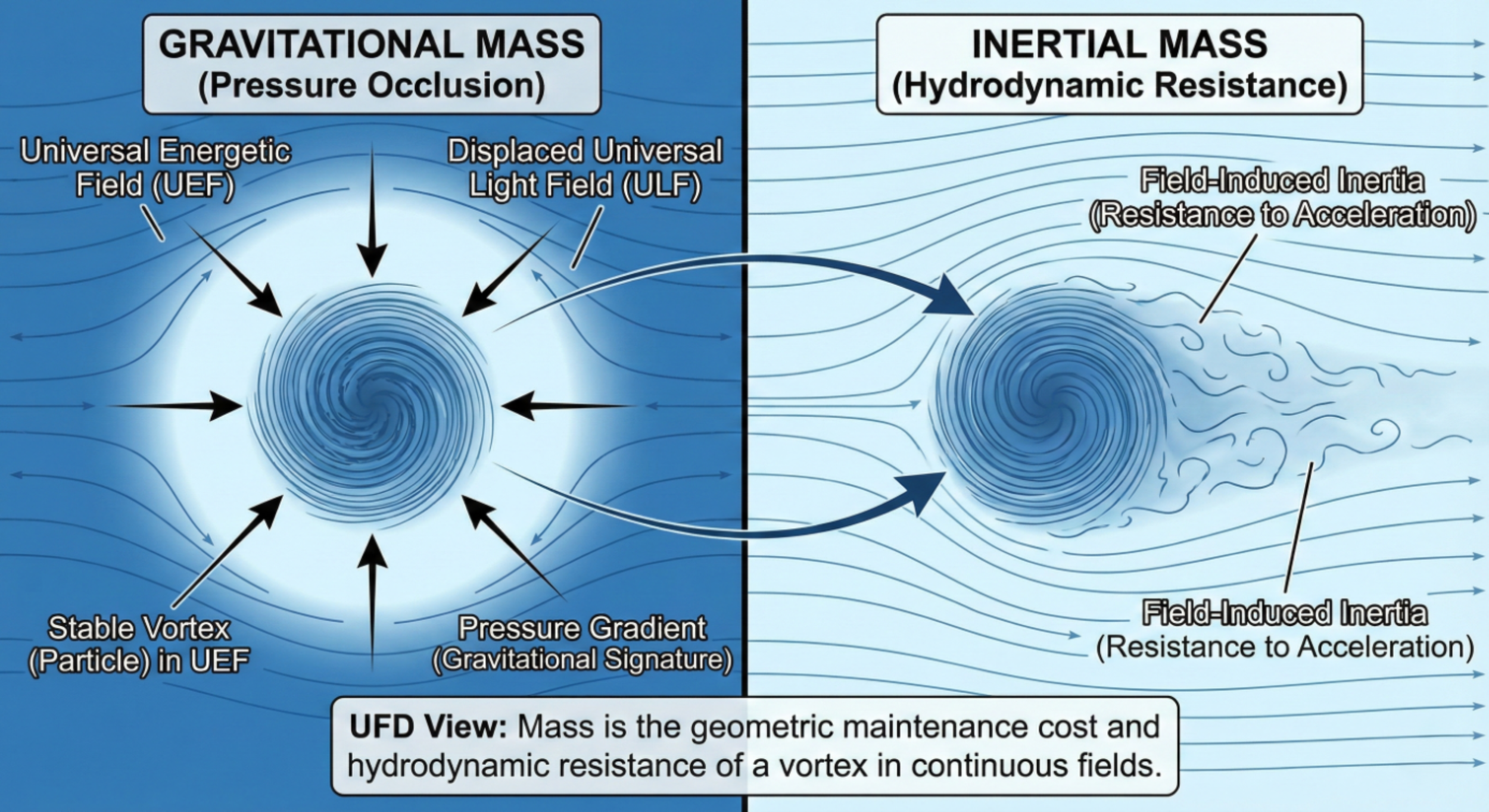
In UFD, mass is the geometric cost of sustaining a stable vortex within real fields. A circulating structure in the Universal Energetic Field (UEF) displaces and reorganizes the surrounding Universal Energetic Field (ULF), establishing a persistent pressure occlusion. That displacement requires energy to maintain and defines the structure’s gravitational signature. When the vortex accelerates, additional surrounding field volume must be rearranged, producing field-induced inertia. Mass is therefore not intrinsic substance — it is the maintenance energy and hydrodynamic resistance of a localized topology embedded in continuous media.
Spin
Standard Model View
Spin is an intrinsic form of angular momentum carried by particles. It does not correspond to classical rotation of a spatial object but arises from quantum symmetry properties described by group theory. Spin determines magnetic behavior and whether a particle obeys Fermi–Dirac or Bose–Einstein statistics.
UFD View
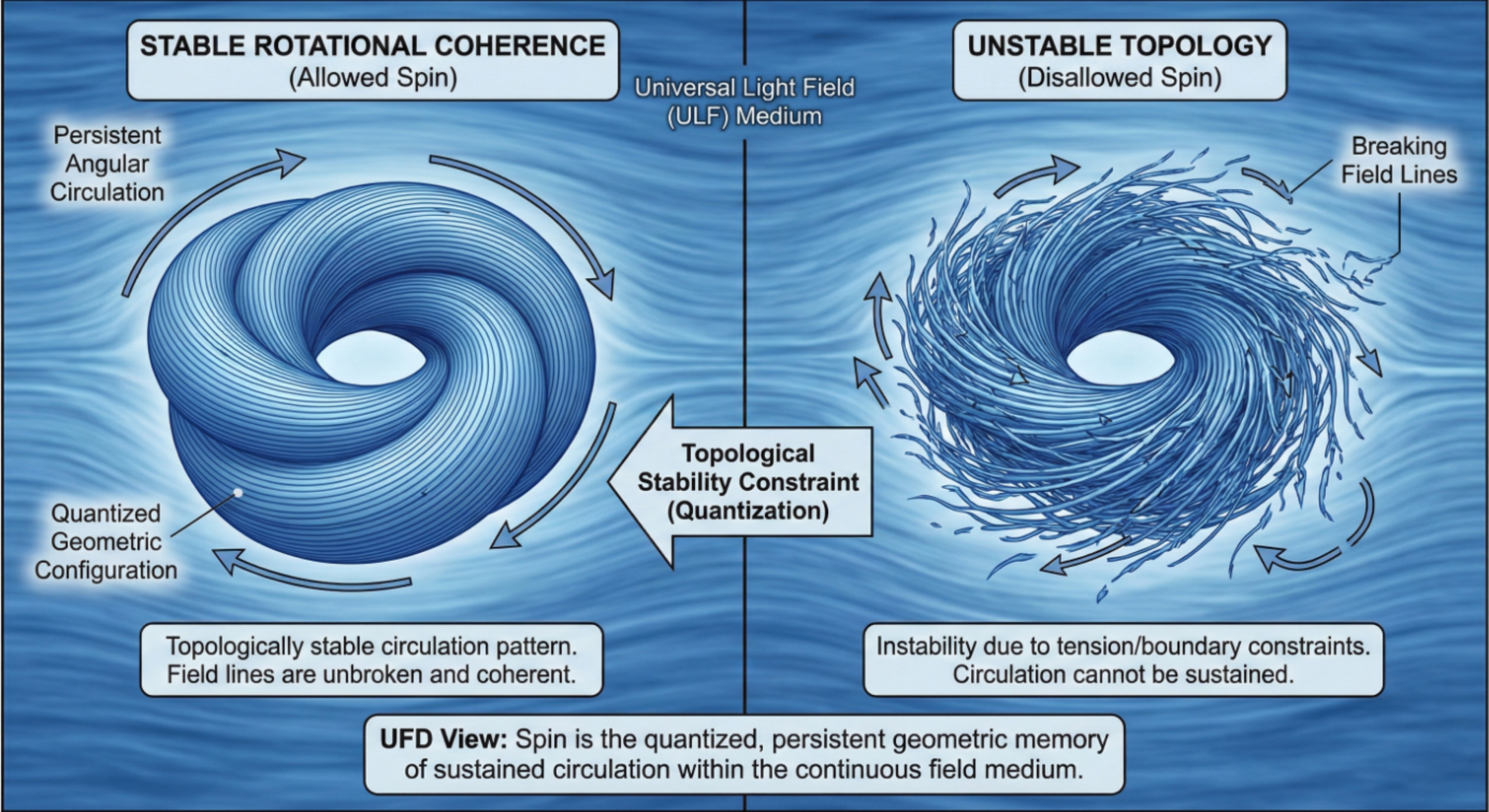
In UFD, spin is the persistent angular circulation of a vortex topology in the Universal Light Field. It is not classical spinning of a rigid body, but stable rotational coherence within the field medium. Because only certain circulation patterns can remain stable under ULF tension and boundary constraints, spin is quantized. The allowed spin values reflect the discrete set of topologically maintainable angular configurations. Spin is therefore the geometric memory of sustained circulation in a continuous medium.
Charge
Standard Model View
Electric charge is a fundamental property of particles. It determines how particles interact through the electromagnetic field. Charges come in discrete units, are conserved in all known interactions, and are treated as intrinsic quantum numbers without deeper physical structure.
UFD View
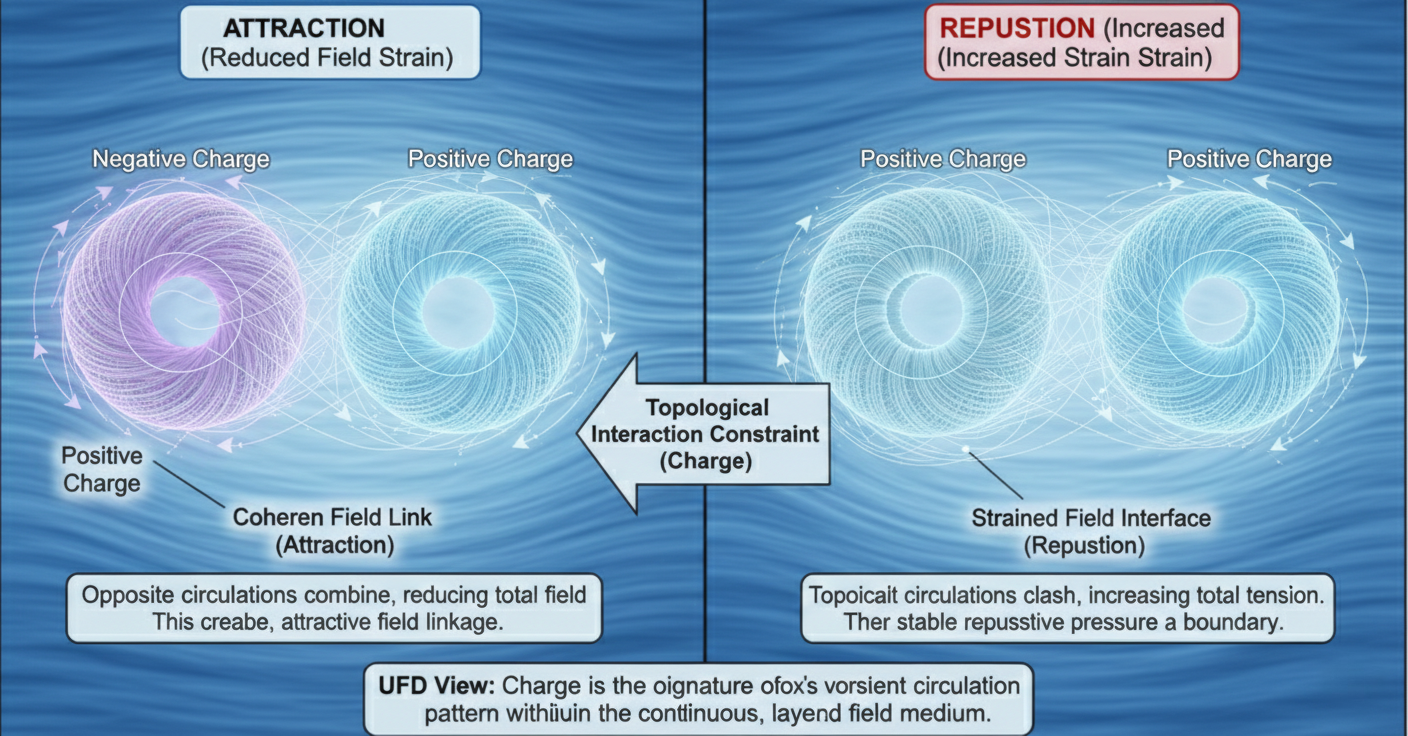
In UFD, charge is the net poloidal circulation pattern of a vortex in the Universal Light Field (ULF). The direction of circulation determines its sign. This circulation establishes a persistent polarization geometry in the surrounding ULF, which the incompressible Universal Energetic Field (UEF) stabilizes through pressure boundary conditions. Opposite circulations combine in a way that reduces total field strain, producing attraction; like circulations increase strain, producing repulsion. Charge is therefore not a label attached to matter — it is the outward signature of how a vortex circulates within layered media.
*Images were created with the assistance of Gemini