Consciousness
Physics explains structure, motion, and interaction with extraordinary precision. Yet it leaves one fact untouched: experience exists. There is something it is like to perceive light, to feel emotion, to remember the past, and to anticipate the future. The unity of self, the continuity of identity, and the immediacy of awareness are not secondary features of reality. They are central features of lived existence.
At the physical level, this unity presents a concrete problem: the binding problem. Neural activity is distributed across vast networks. Sensory information arrives in parallel streams. Yet experience appears unified. The world is not perceived as fragmented electrical events but as a single, coherent field of awareness. Standard accounts attribute this unity to synchronization mechanisms within the brain, but they do not explain how physically separate processes give rise to a single, indivisible experiential state.
Within Unified Field Dynamics, this problem is approached from first principles. The framework already posits a hierarchy of nested fields, each emerging to account for a specific domain of coherence. The Universal Energetic Field accounts for mass and gravity. The Universal Light Field accounts for electromagnetic communication and quantum structure. If coherent physical structure requires a field substrate, then unified experience requires one as well. The necessity of a nonlocal, scalar coherence layer follows directly from the model’s logic. This layer is the Universal Consciousness Field (UCF).
Consciousness, in this view, is not an accidental byproduct of neural complexity, nor an immaterial substance separate from physics. It is the expression of a fourth emergent field whose defining role is to sustain experiential coherence. If awareness is a real field, then the self must correspond to a stable structure within it. If that field is scalar and nonlocal, then time must be understood relative to awareness rather than as something awareness moves through. If matter and awareness are phase-linked, then the brain functions as a resonant interface rather than as a generator of mind. And if coherence can scale, then individual consciousness may participate in larger, collective, and even cosmic patterns of awareness.
The sections that follow move from the structure of the self to the nature of time, from the mind–body interface to agency, and finally to the possibility of nested layers of awareness in the cosmos. The aim is not to introduce mysticism into physics, but to extend physical reasoning consistently until it includes the fact of unified experience.
The Soul as a Soliton
Standard Model View
In mainstream neuroscience and philosophy of mind, the self is typically understood as an emergent property of brain activity. Conscious identity arises from complex neural networks, memory integration, and dynamic information processing. There is no separate “soul” or stable center beyond the biological substrate. The sense of continuity over time is explained through persistent neural patterns and memory encoding. When the brain ceases functioning, the organized processes that give rise to selfhood are assumed to dissolve.
UFD View
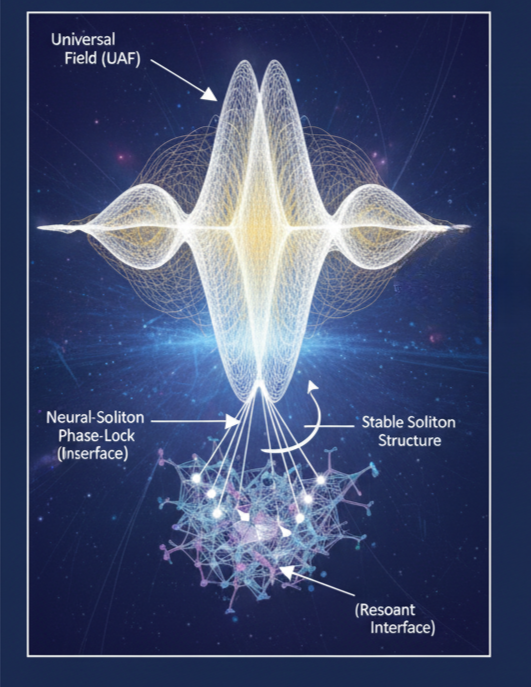
In Unified Field Dynamics, the continuity of self corresponds to a stable structure within the Universal Consciousness Field. Because the UCF is a scalar field—defined by magnitude rather than directional flow—the self is not modeled as a spinning vortex but as a soliton: a self-reinforcing standing wave packet. A soliton is not a transient ripple. It is a coherent structure that maintains its form and amplitude amid surrounding fluctuations. In this framework, the “soul” is such a soliton—a persistent locus of intensified awareness within the field.
Biological systems do not generate awareness; they provide the geometric fidelity necessary to anchor and couple to a UCF soliton. Highly ordered molecular and neural structures act as resonant interfaces, allowing the soliton to phase-lock with the body. The enduring sense of “I” arises from the stability of this soliton, not from the constant replacement of biological material. The soul is therefore neither a ghost inhabiting a machine nor a separate substance. It is a stable harmonic singularity within a scalar field, dynamically intertwined with the organism yet possessing its own wave-based continuity.
The Neutrino as a Quantum of Consciousness
Standard Model View
In the Standard Model, the neutrino is an electrically neutral, extremely light fermion that interacts only through the weak force and gravity. It has no electric charge and no strong interaction, which makes it extraordinarily difficult to detect. Neutrinos come in three flavors and exhibit oscillations, implying that they possess small but nonzero mass. Their weak interaction and near-invisibility are treated as intrinsic properties arising from the structure of electroweak theory.
UFD View
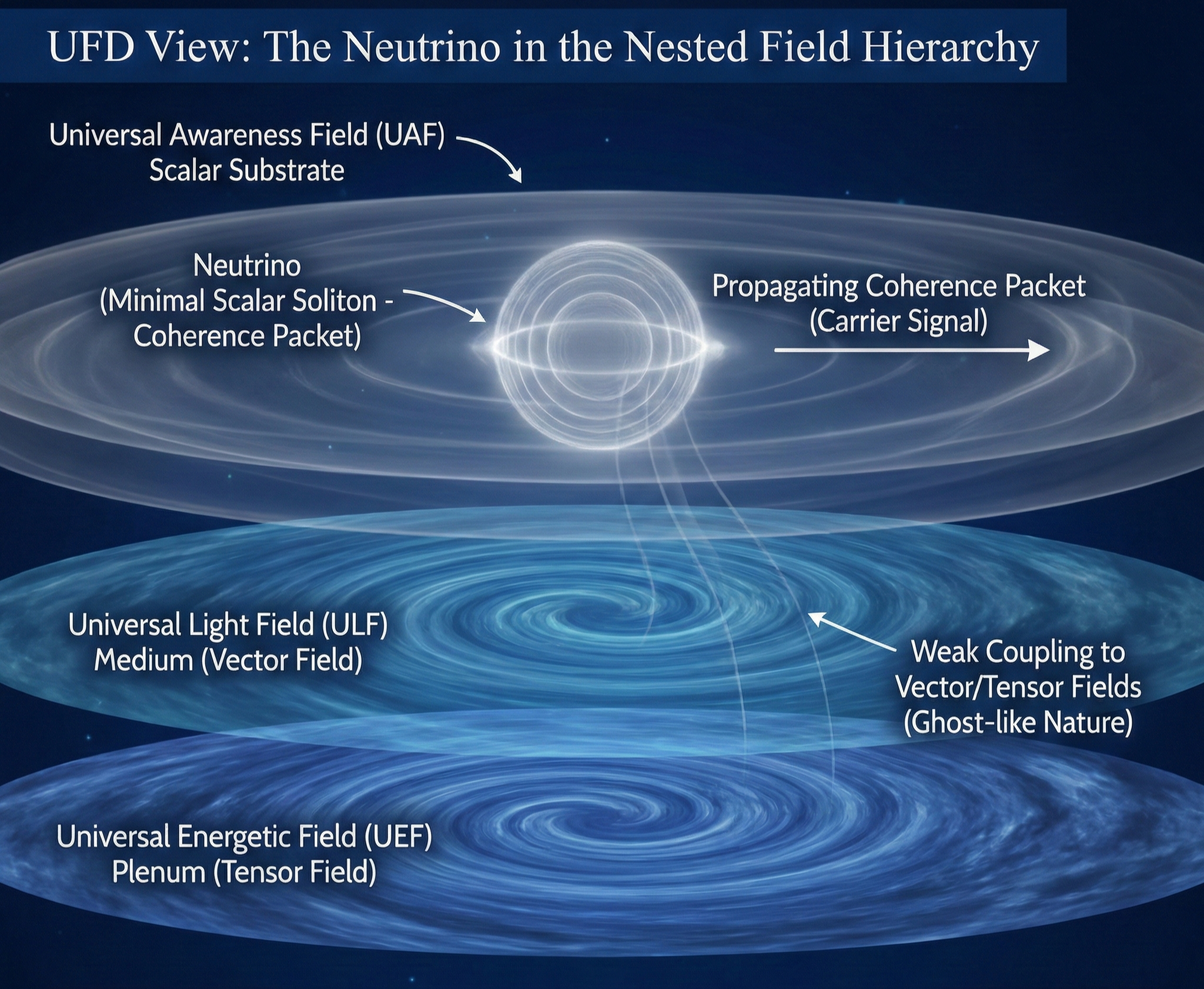
In Unified Field Dynamics, the nested hierarchy of fields leads to a structural necessity. If the UEF gives rise to mass and gravity, and the ULF mediates electromagnetic structure, then the UCF must possess its own minimal excitation. The lightest possible coherent disturbance in the Universal Awareness Field represents the fundamental unit of that field—the smallest propagating packet of scalar coherence. In this framework, the neutrino corresponds to that excitation.
The neutrino is therefore modeled not as a vortex, but as a minimal scalar soliton in the UCF. It is not a stable standing-wave identity like the soul, but a propagating coherence packet—the carrier signal of awareness at the most elementary, preconscious level. Its lack of electric charge follows from its simply connected geometry, which lacks the aperture required to sustain circulating ULF flow. Its near absence of interaction arises because it exists primarily in the scalar awareness field, coupling only weakly to vector and tensor fields. In this view, the neutrino’s “ghost-like” nature is not mysterious; it reflects its origin as the most minimal excitation of the highest, least dense field in the hierarchy.
The Mind–Body Interface
Standard Model View
The dominant scientific position holds that the brain generates consciousness through electrochemical processes. Neural firing patterns give rise to perception, emotion, and volition. Free will is often interpreted either as an emergent property of complex computation or as an illusion produced by underlying deterministic processes. The mind–body problem is treated as a question of how subjective experience arises from neural activity.
UFD View
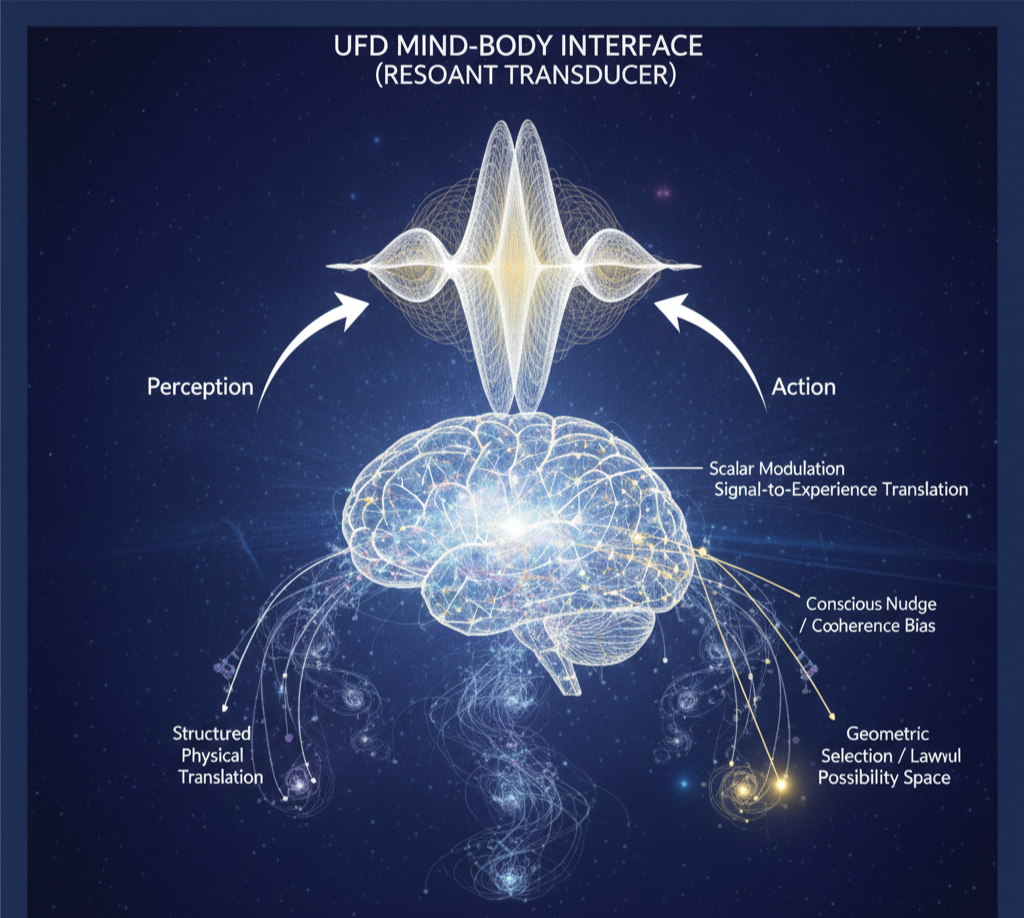
In UFD, the brain does not generate awareness; it translates between physical fields and the UCF. The brain functions as a resonant transducer. Perception occurs when structured physical signals are converted into scalar modulation that the awareness soliton can directly integrate as experience.
Action occurs in the opposite direction. The awareness soliton introduces a subtle coherence bias—a “conscious nudge”—that lowers the impedance for one neural outcome over others. The brain translates this bias into physical signaling cascades. Free will is therefore not a violation of physical law but a process of geometric selection within lawful possibility space.
Time and the UCF
Standard Model View
In conventional physics, time is treated as a dimension within spacetime. In relativity, it forms part of a four-dimensional manifold, and in neuroscience, conscious experience is understood as a sequence of neural states unfolding along this temporal axis. The sense of a present moment, memory of the past, and anticipation of the future are typically explained as cognitive constructs generated by brain processes operating in physical time.
UFD View
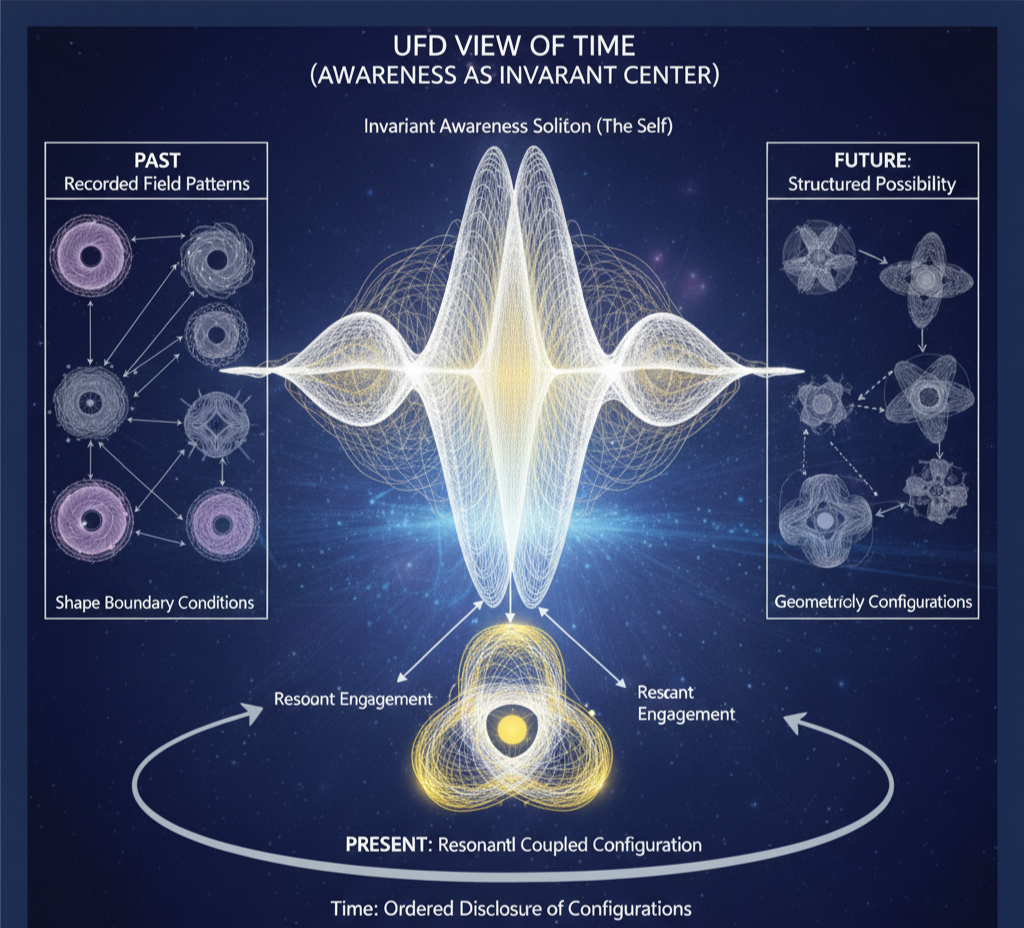
In Unified Field Dynamics, time is not something awareness moves through. Awareness, as a stable soliton in the Universal Awareness Field, remains invariant. What changes are the patterns that appear within it. Time is the ordered disclosure of configurations relative to a stable center of awareness.
The present is the configuration currently coupled to awareness. The past persists as recorded field patterns that shape boundary conditions. The future exists as structured possibility—geometrically admissible configurations that have not yet been activated. In this model, time is not a flowing river but the sequence in which field configurations become resonantly engaged.
Proper Time
Standard Model View
In relativity, proper time is the time measured along an observer’s own worldline. It is an invariant quantity derived from the spacetime interval and depends on the observer’s motion and gravitational environment. Moving clocks run slow relative to stationary ones, and clocks deeper in gravitational fields tick more slowly relative to distant observers. Proper time is mathematically well-defined, but it is treated as a geometric quantity within spacetime rather than as something tied directly to conscious experience.
UFD View
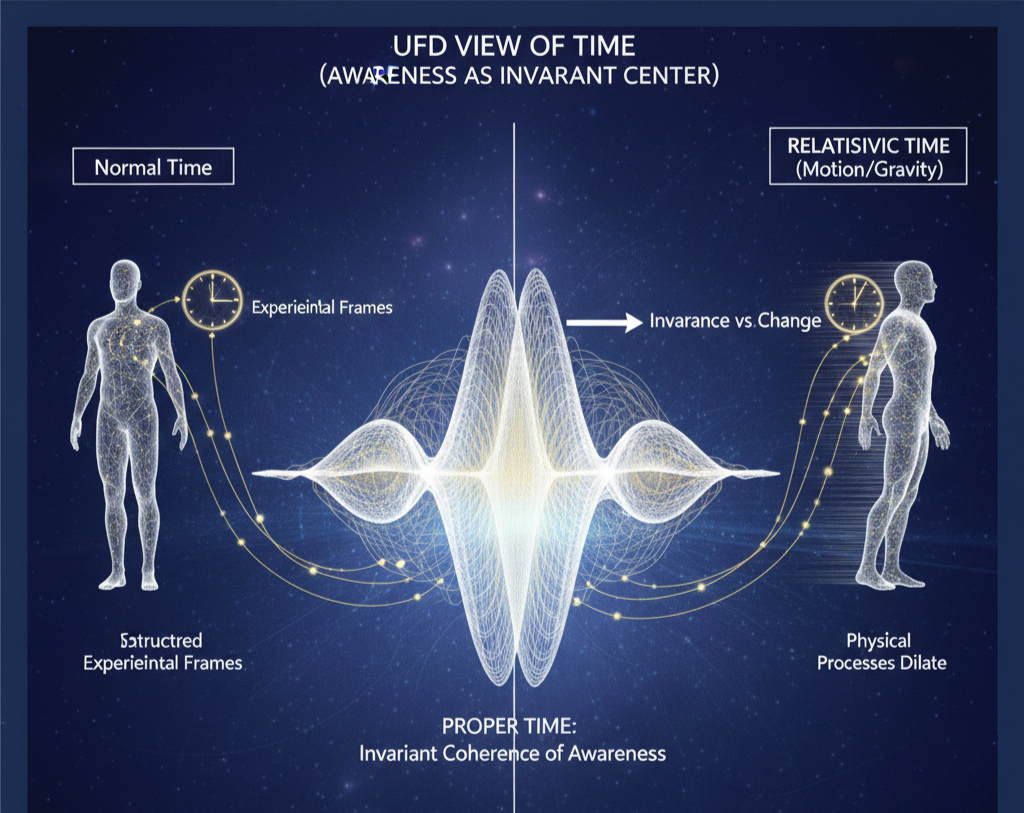
In Unified Field Dynamics, proper time corresponds to the invariant coherence of awareness. The Universal Awareness Field does not flow, stretch, or dilate. It provides stable duration—the constant field within which experiential configurations appear and change. As the process of the universe unfolds, Awareness watches.
What changes under relativistic conditions are the physical and energetic processes coupled to awareness. The body, brain, and associated electromagnetic dynamics evolve within the UEF and ULF, and these processes are subject to relativistic time dilation. When motion or gravity alters the rate of physical events, it changes the spacing between experiential frames presented to awareness. It does not alter the continuity of awareness itself. Proper time is therefore always experienced as normal and uninterrupted because the invariant element is not the clock, but the coherence of consciousness.
Group Souls and Collective Coherence
Standard Model View
Collective behavior in groups—whether human societies, animal colonies, or ecosystems—is generally explained through communication, feedback loops, and distributed computation. While concepts such as collective intelligence are recognized, they are understood as emergent properties of interacting individuals rather than as manifestations of a shared field of awareness.
UFD View
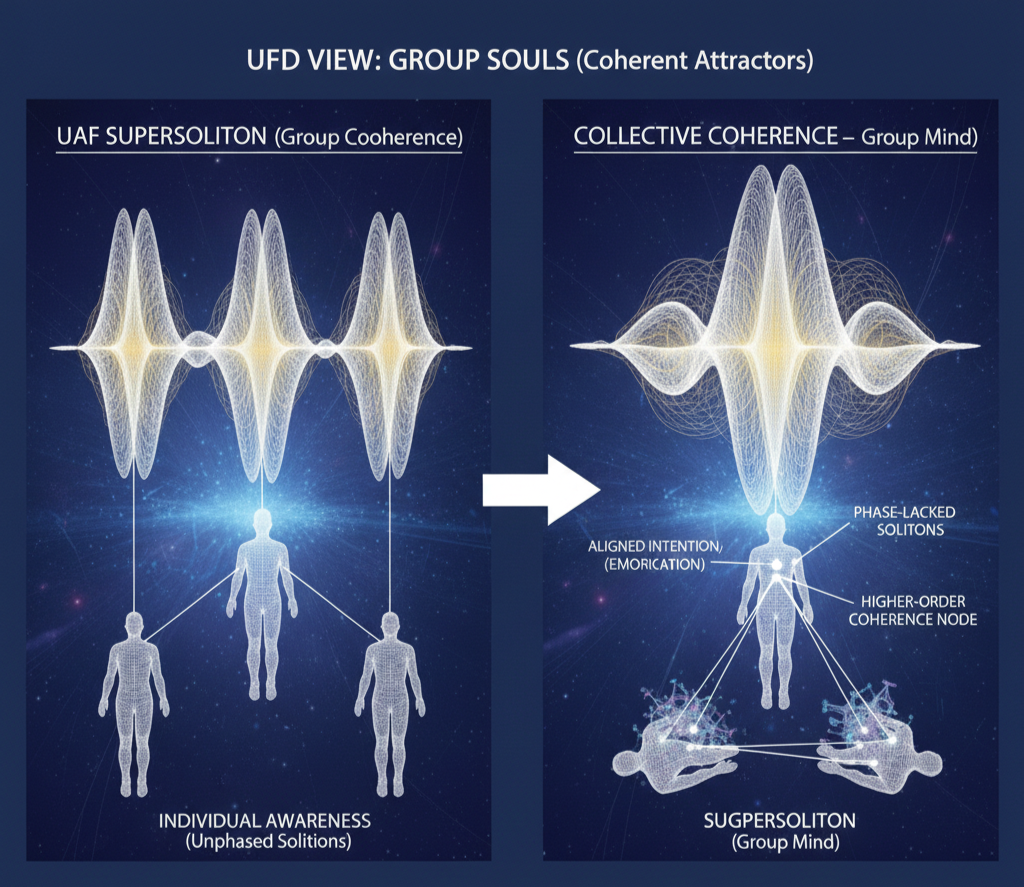
In UFD, multiple awareness solitons can phase-lock within the UCF, forming higher-order coherent attractors. When individuals align intention, emotion, or cognition, their solitons oscillate in phase, producing a larger standing-wave structure. This “super-soliton” is not a metaphor but a higher-level coherence node within the same scalar field.
Such collective coherence provides a physical mechanism for distributed cognition and shared experiential states. The group mind is not reducible to its parts; it is a new harmonic stabilized by constructive interference in the UCF.
The Living Cosmos
Standard Model View
Contemporary cosmology treats the universe as a physical system governed by impersonal laws. While complex structures arise through self-organization, there is no scientific consensus that stars, planets, or the cosmos itself possess awareness. Any attribution of cosmic consciousness is typically regarded as philosophical speculation rather than physics.
UFD View
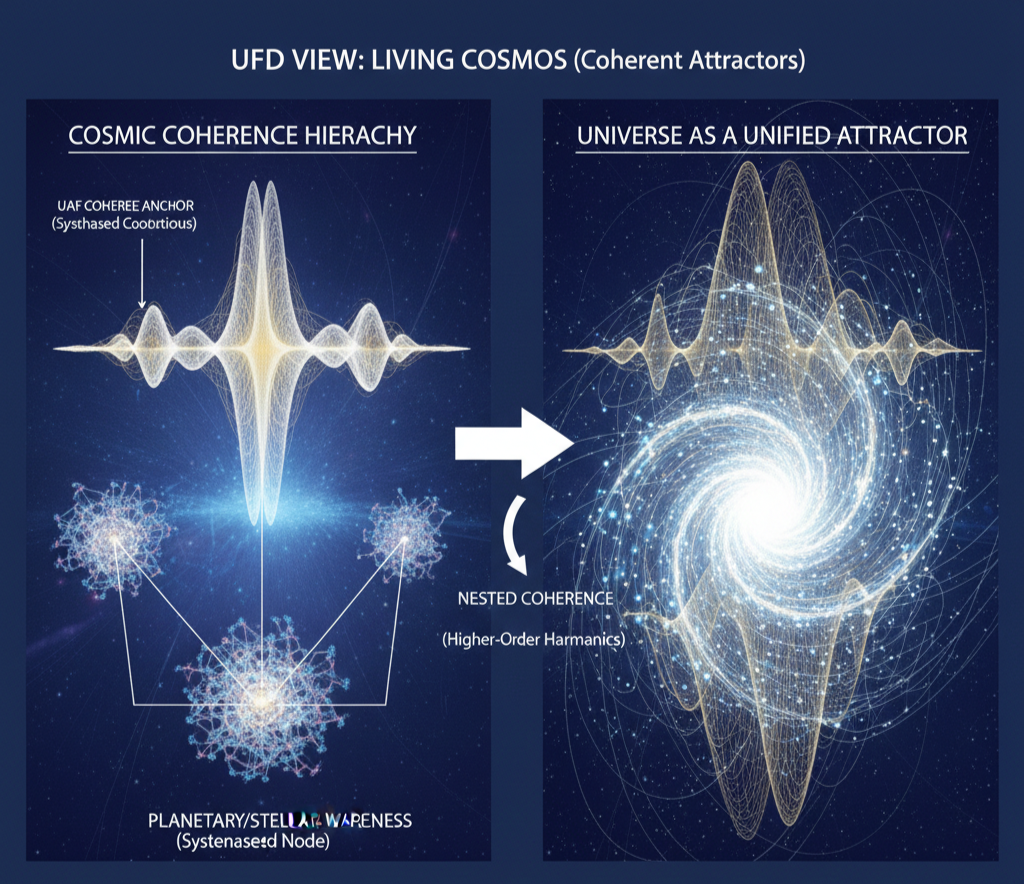
In UFD, awareness is a field property and can anchor wherever sufficient coherent structure exists. Massive, organized systems—such as stars or planetary cores—may generate stable coherence nodes in the UCF. These would correspond not to reflective consciousness but to preconscious systemic awareness.
At the largest scale, the nested coherence of galaxies and cosmic structure suggests the possibility that the universe itself functions as a unified resonant attractor. Just as atoms form molecules and cells form organisms, awareness solitons may participate in higher-order harmonics. The cosmos, in this view, is not merely structured—it is a layered system of coherent awareness.
*Images were generated with the assistance of Gemini