Topology
Long before modern particle physics, thinkers attempted to understand matter not as tiny solid beads, but as patterns in a continuous medium. In the 17th century, René Descartes proposed that nature might be built from vortices in a subtle fluid filling space. Two centuries later, Lord Kelvin revived this idea in a more mathematical form, suggesting that atoms could be stable knots in an all-pervading ether. Although the ether concept was later discarded, Kelvin’s deeper intuition—that stability might arise from topology rather than substance—remains profound.
Kelvin’s vortex-atom program ultimately failed because the medium he proposed lacked a clear physical basis. Yet the mathematical study it inspired—knot theory—became a rigorous branch of topology. Knot theory studies how loops can be embedded in three-dimensional space, how they can twist, link, and interlock, and how certain configurations cannot be undone without cutting. These topological distinctions are not cosmetic; they are structural. A trefoil knot is fundamentally different from a simple loop, even if both are made from the same material.
Topology differs from geometry in an important way. Geometry measures size and shape; topology concerns continuity and connectivity. A coffee mug and a doughnut are geometrically different but topologically identical because each has one hole. A sphere has no holes. A trefoil knot cannot be smoothly deformed into an unknotted loop. These differences are preserved under continuous transformation and therefore represent structural invariants.
Unified Field Dynamics builds on this topological insight. If matter is not made of solid particles but of stable vortices in a continuous field, then the defining feature of a particle is not its material composition but its topology. Stability arises not from rigid substance, but from self-consistent geometric circulation. In this view, knots, loops, and simply connected structures are not metaphors—they are candidates for physical identity.
The following section introduces the topological structures that underlie the UFD framework. These forms are not assumed arbitrarily. They are the minimal stable configurations permitted by the coherence constraints of a real medium.
Topological Descent
Standard Model View
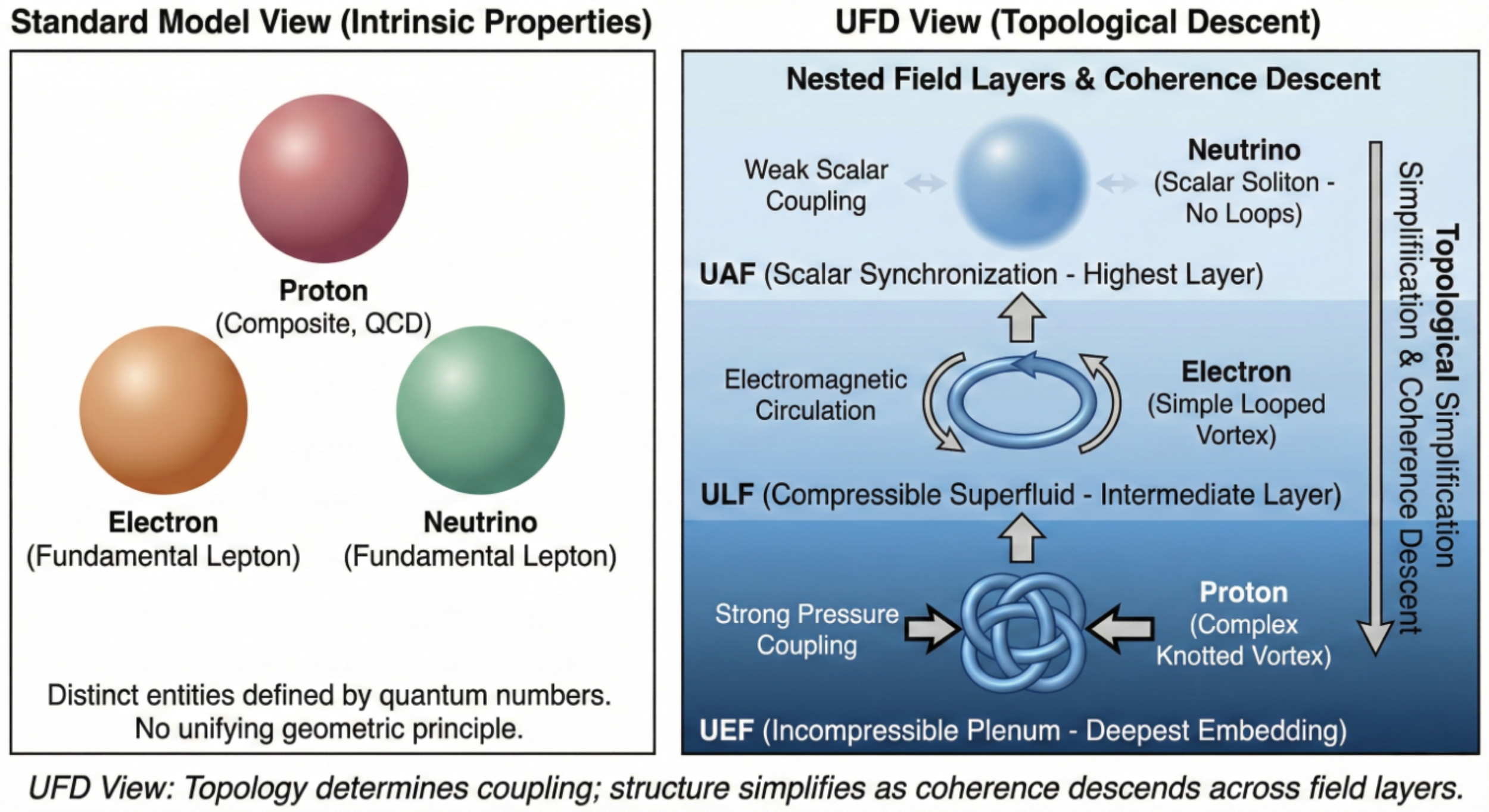
In the Standard Model, particles such as the proton, electron, and neutrino are distinct entities defined by quantum numbers. Their masses, charges, and interaction strengths are treated as intrinsic properties determined by gauge symmetries and coupling constants. The proton is a composite state governed by QCD, while the electron and neutrino are fundamental leptons. There is no unifying geometric principle linking their structure across scales; differences in interaction strength arise from charge assignments, not topology.
UFD View
In UFD, particle identity follows from topological descent across nested field layers. As coherence descends from deeper to higher fields (UEF → ULF → UAF), stable excitations exhibit progressively simpler topology. Deep embedding in the incompressible UEF supports complex knotted vortices with strong pressure coupling (proton). The ULF supports simpler looped vortices with electromagnetic circulation (electron). The UAF supports scalar solitons with no non-contractible loops (neutrino). Topology determines coupling; coupling determines observable interaction strength. Structure simplifies as coherence descends.
The Proton
Standard Model View
In the Standard Model, the proton is made of three quarks bound together by gluons through the strong force. Most of its mass comes from the energy of this binding, not from the quarks themselves. Its positive charge arises from the combined fractional charges of its constituents.
UFD View
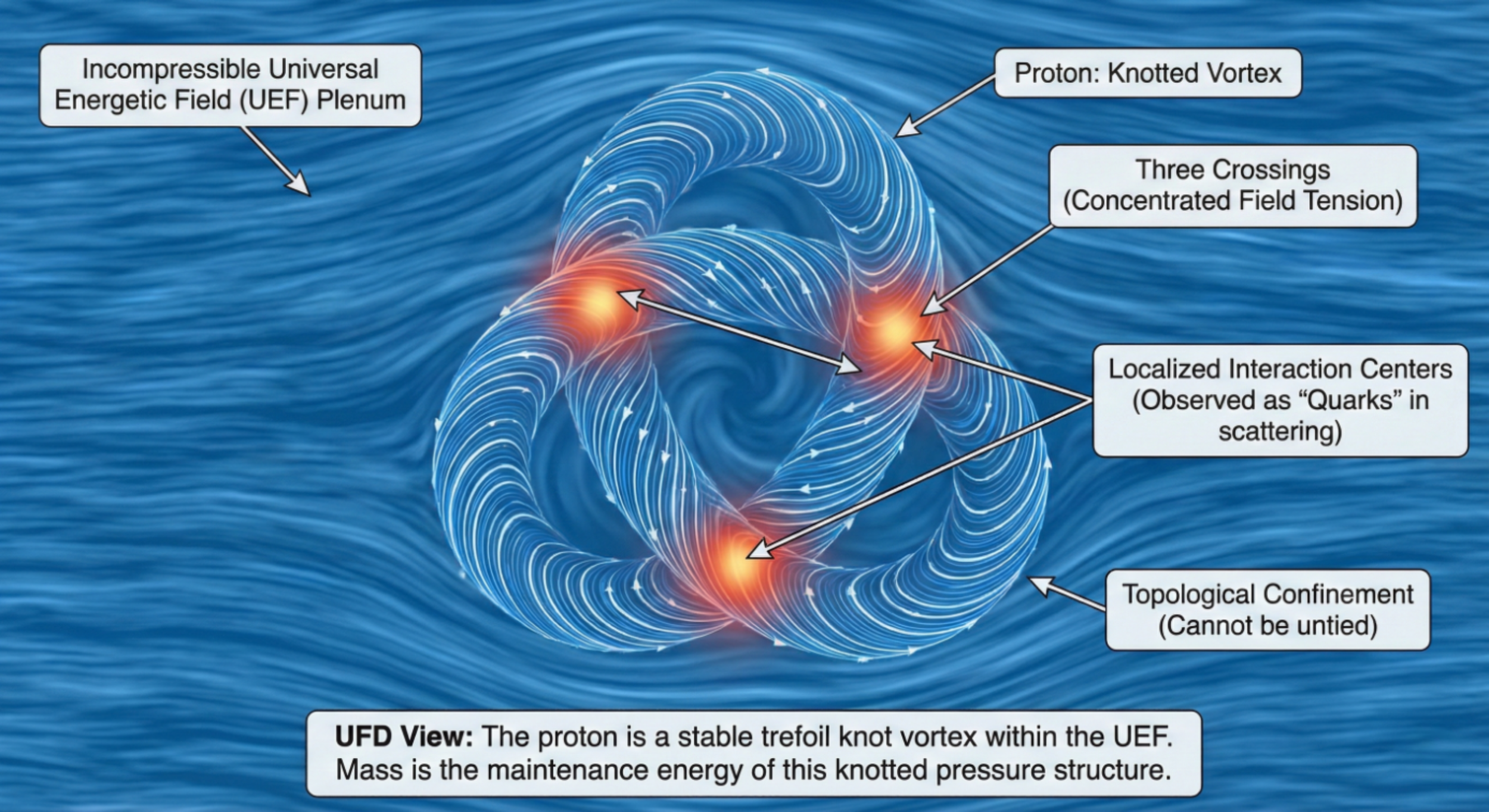
In UFD, the proton is a knotted vortex in the Universal Energetic Field (UEF). The UEF is an incompressible energetic plenum, and the proton is a stable circulation pattern embedded within it. Its trefoil-like knot structure contains three crossings, and those crossings concentrate field tension — which is why high-energy scattering experiments detect three localized interaction centers. The knot cannot be untied without cutting the field configuration, so confinement follows from topology rather than particle exchange. Its mass reflects the energy required to maintain this knotted pressure structure within the incompressible medium. The proton is stable because this is the simplest nontrivial knot that can persist under UEF tension constraints.
The Neutron
Standard Model View
In the Standard Model, the neutron is composed of three quarks bound by gluons. Although electrically neutral overall, it contains internal charge structure and participates in strong and weak interactions. A free neutron is unstable and decays into a proton, electron, and antineutrino.
UFD View
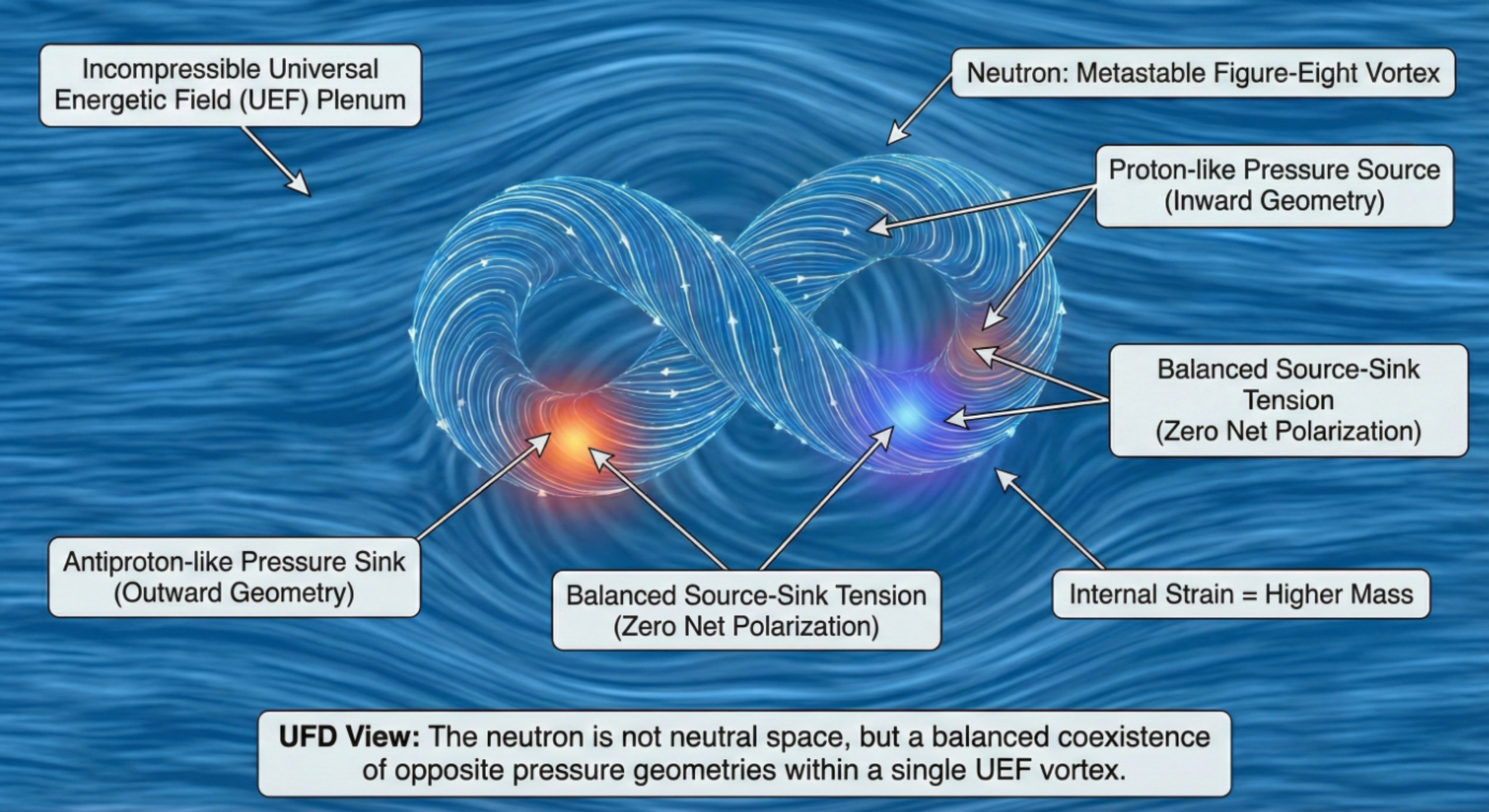
In UFD, the neutron is a metastable knotted vortex in the Universal Energetic Field (UEF). Unlike the proton’s trefoil topology, the neutron’s figure-eight–like structure contains alternating regions of inward and outward pressure geometry. This produces no net electric polarization, but it creates an internal source–sink configuration: one lobe behaves like a proton-like pressure source, the other like an antiproton-like pressure sink. The two regions are geometrically bound within a single vortex.
Because this configuration balances opposing pressure tendencies, it carries internal strain. Inside a nucleus, surrounding vortices stabilize this balance through shared boundary geometry. In isolation, the source–sink tension can relax toward the simpler proton topology. The neutron is therefore not a neutral absence of charge, but a balanced coexistence of opposite pressure geometries within a single UEF vortex.
The Electron
Standard Model View
In the Standard Model, the electron is an elementary particle with negative electric charge and intrinsic spin ½. It is treated as point-like, with no internal structure, and its properties are defined by quantum numbers. Its magnetic moment and interactions are described by quantum electrodynamics.
UFD View
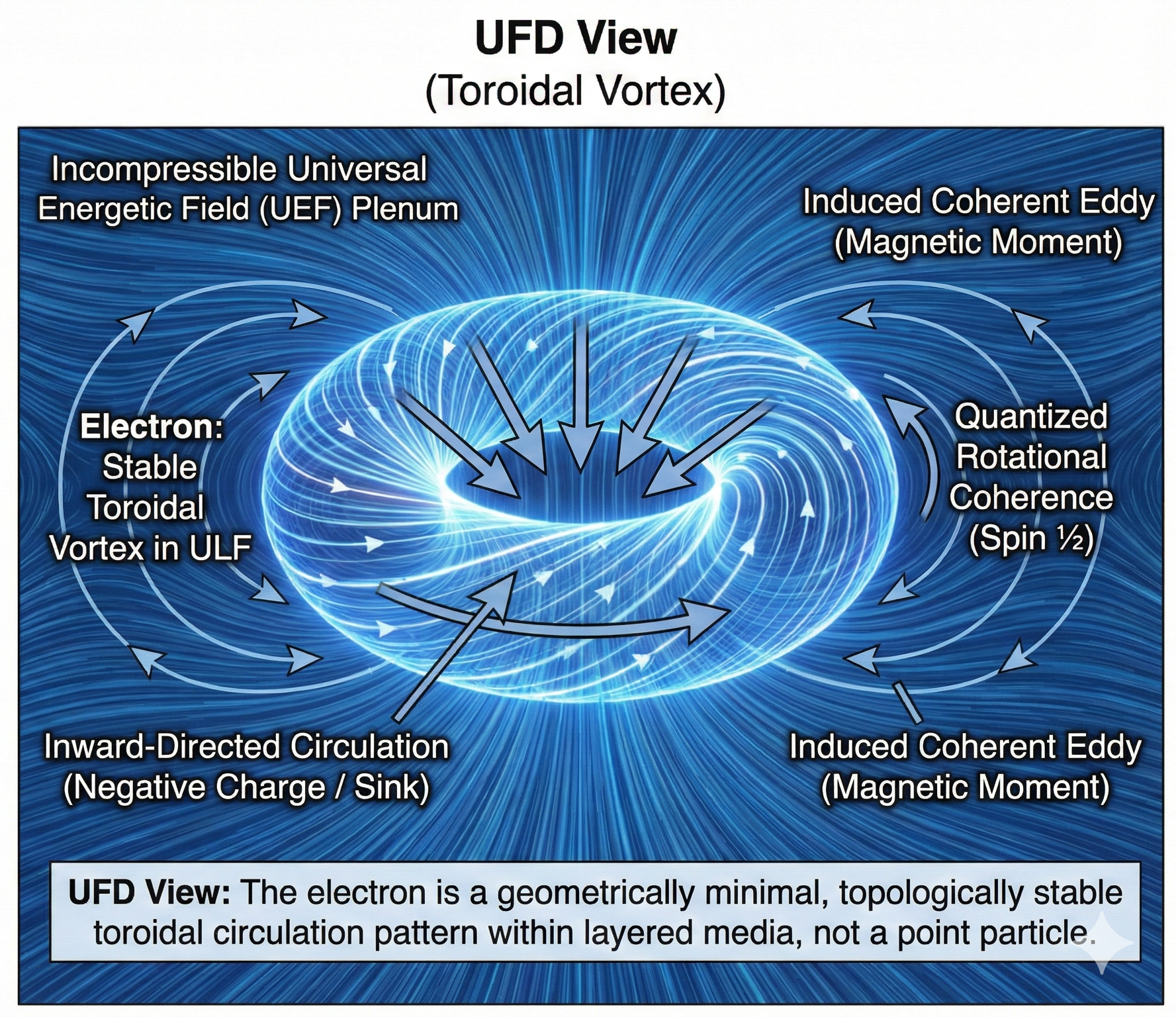
In UFD, the electron is a stable, self-sustaining toroidal vortex in the Universal Light Field (ULF), embedded within the incompressible Universal Energetic Field (UEF). Its properties arise directly from its geometry. The torus supports a persistent rotational circulation. Because this circulation has a specific chirality, it establishes a pressure orientation in the surrounding field that acts as a sink — drawing the ULF inward. This inward-directed circulation defines its negative electric charge.
Its spin ½ reflects the quantized rotational coherence of this vortex under ULF stability constraints. As the toroidal vortex rotates, it induces a coherent eddy in the surrounding field, which manifests as its intrinsic magnetic moment. The electron is therefore not a point particle but a geometrically minimal, topologically stable circulation pattern within layered media.
The Neutrino
Standard Model View
In the Standard Model, the neutrino is an elementary particle with extremely small mass and no electric charge. It interacts only through the weak force and gravity. Neutrinos exhibit oscillations between flavors, indicating that they have nonzero mass. They are treated as fundamental point-like fermions.
UFD View
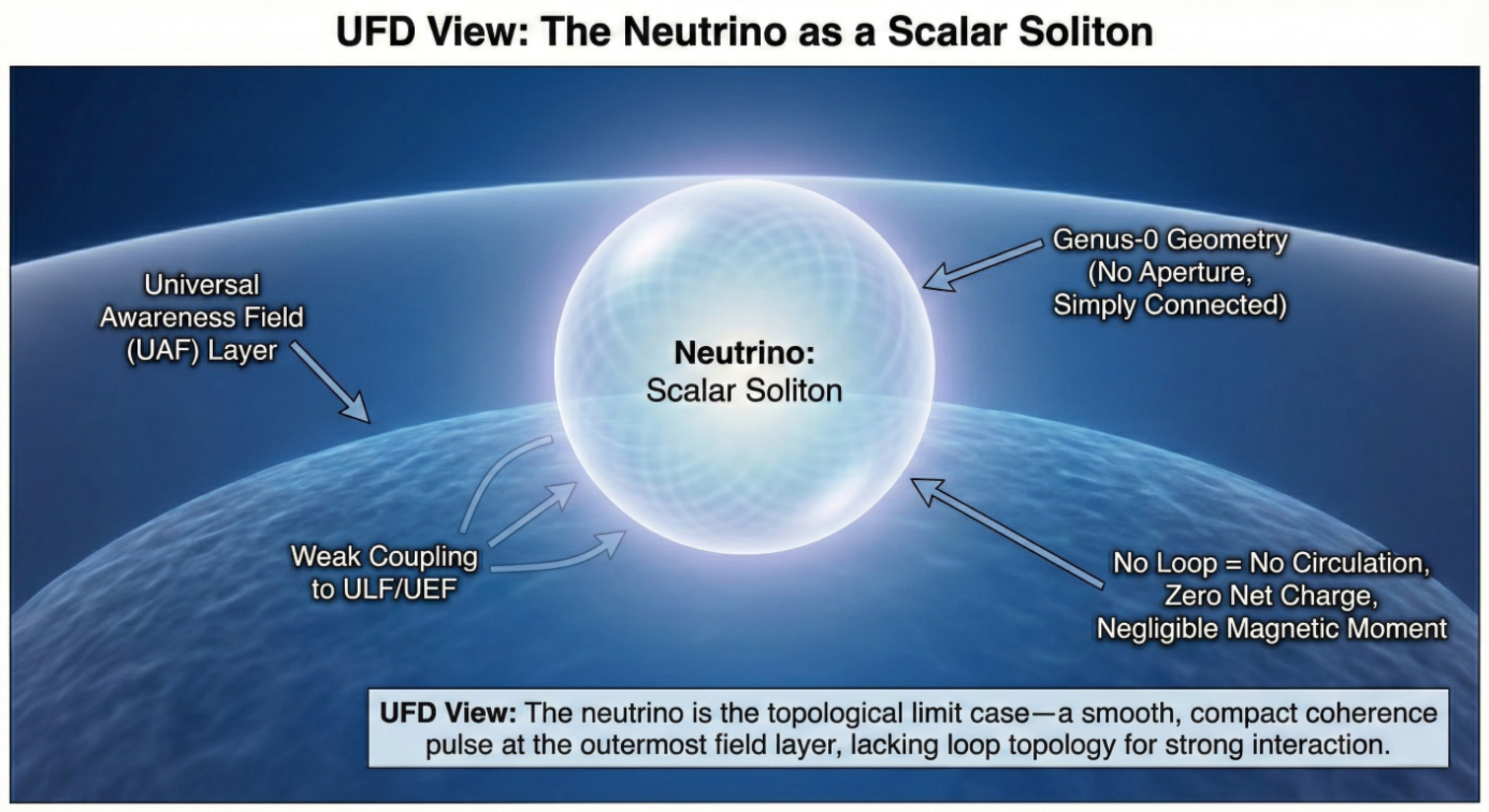
In UFD, the neutrino is the terminal excitation of Topological Descent. It is not a vortex but a scalar soliton in the Universal Awareness Field (UAF). Unlike the toroidal electron, which has a central aperture, the neutrino is simply connected (genus-0). It has no hole, no loop, and no non-contractible circulation.
Because it lacks an aperture, magnetic flux cannot thread through it, and no sustained circulating current can form. This geometry accounts for its electric neutrality and negligible magnetic response. With no loop topology to couple strongly to the ULF and minimal disturbance to the UEF, the neutrino interacts only weakly with matter. It is not a smaller version of other particles, but the topological limit case — a smooth, compact coherence pulse at the outermost layer of the nested fields.
*Images were created with the assistance of Gemini