The Fundamental Forces
In modern physics, forces are typically presented as fundamental interactions. Gravity, electromagnetism, the strong force, and the weak force are treated as distinct agencies, each mediated by its own carrier particles and governed by its own equations. These forces are extraordinarily successful in prediction, yet their physical origin remains abstract. They are described mathematically as interactions, but rarely explained mechanistically.
Unified Field Dynamics approaches the problem differently. Rather than beginning with four independent forces, it begins with one continuous medium. In this framework, force is not a primitive ingredient of nature. It is an emergent response of a structured field to pressure gradients, geometric strain, and coherence imbalance.
When a vortex forms, the surrounding field must reorganize. When pressure is uneven, the medium responds. When geometry is strained, the system seeks a lower-energy configuration. These responses are what we observe as forces. Gravity is the large-scale pressure structure of the energetic plenum. Electromagnetism is the flow and circulation dynamics of the light field. Nuclear binding arises from surface coherence effects. Even the weak interaction is reinterpreted as a geometric phase transition within strained vortical structures.
In this view, forces are not separate substances acting across empty space. They are different expressions of the same underlying continuity operating at different coherence scales.
The sections that follow reinterpret each fundamental force in this unified, pressure-based framework, replacing abstract mediation with concrete field dynamics.
Gravity
Standard Model View
In modern physics, gravity is described as the curvature of spacetime caused by mass and energy. Objects follow geodesic paths through curved geometry, and gravitational attraction results from this curvature rather than from a force in a medium.
UFD View
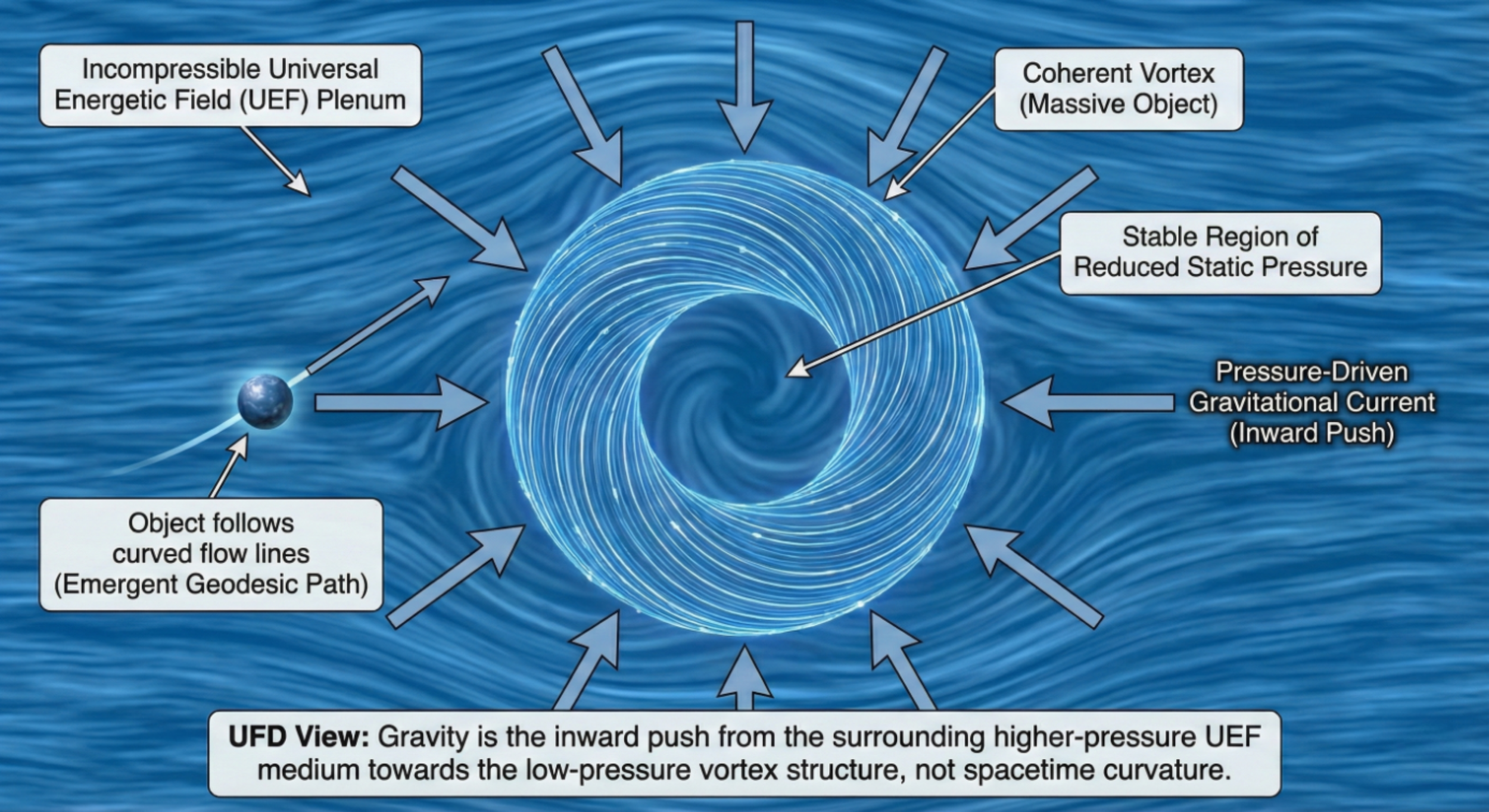
In UFD, gravity is a pressure-driven current within the Universal Energetic Field (UEF). The UEF is a real, incompressible plenum. A massive object is a coherent vortex structure embedded within it. That embedded vortex establishes a stable region of reduced static pressure in the surrounding UEF — similar to the low-pressure core of a tornado. Because the ambient UEF remains at higher pressure, it pushes inward toward this deficit. This organized inward push forms a steady gravitational current.
Objects move along the curved paths of that current. What General Relativity calls geodesics emerge naturally as flow lines within the pressure field. There is no action at a distance and no spacetime curvature required. Gravity is the push from the surrounding medium toward regions where pressure has been lowered by coherent vortex structure.
Electromagnetism
Standard Model View
In modern physics, electromagnetism is a fundamental force mediated by photons. Electric charge is treated as an intrinsic property of particles, and magnetic fields arise from moving charges or intrinsic magnetic moments. The mechanism is described mathematically through field equations, while the physical carrier of force is understood in terms of particle exchange.
UFD View
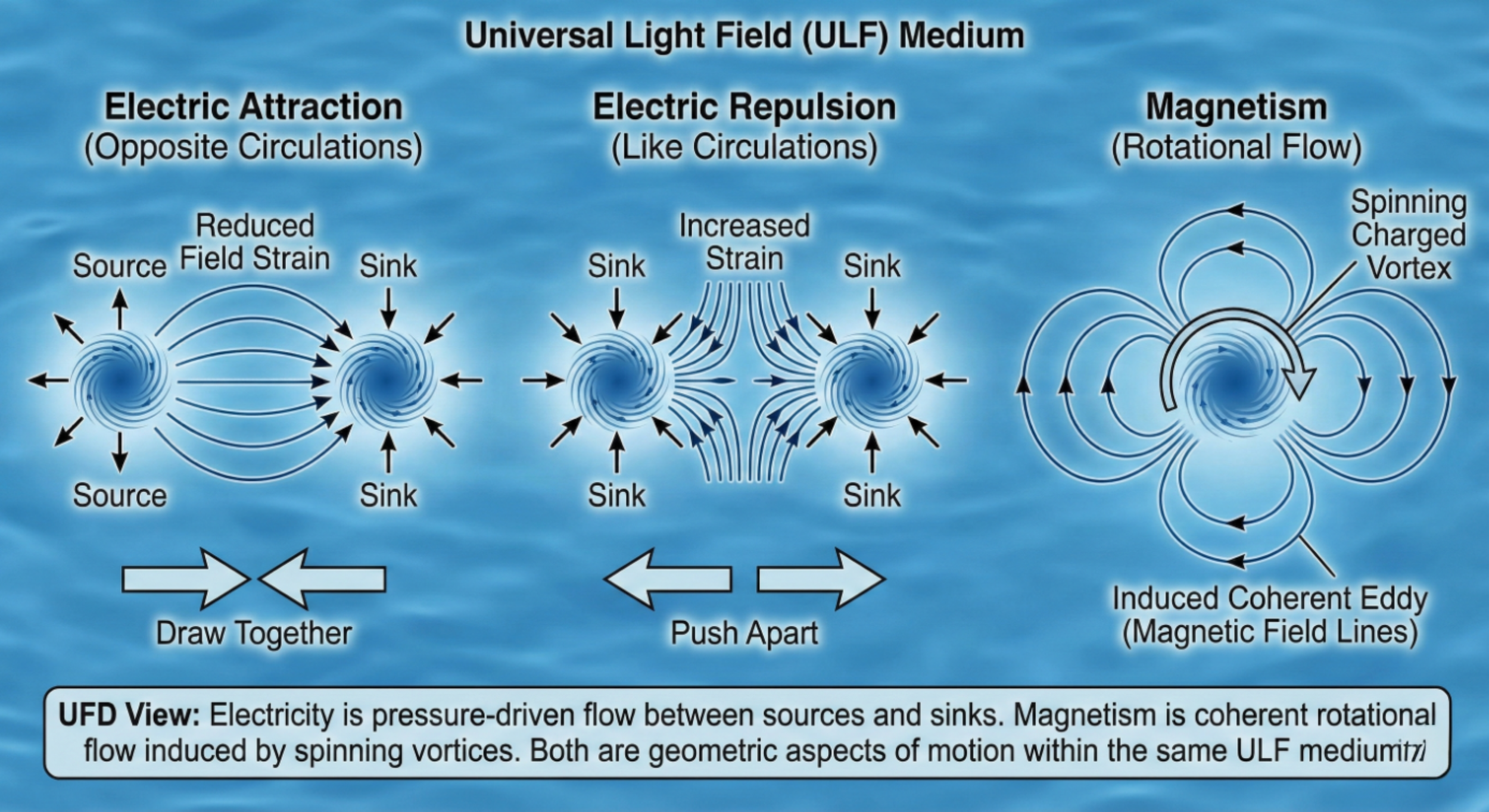
In UFD, electromagnetism is the hydrodynamic behavior of the Universal Light Field (ULF). A charged particle is a vortex in this medium whose chirality makes it act as a stable source (outward flow) or sink (inward flow) of the ULF. Electric attraction and repulsion arise from pressure gradients created as the field flows between these sources and sinks. Opposite circulations reduce overall field strain and draw together; like circulations increase strain and push apart. Electricity is therefore pressure-driven flow within a real medium.
Magnetism emerges from coherent rotational flow induced by spinning charged vortices. As a vortex rotates, it drags the surrounding ULF into a stable circulating eddy. What are called magnetic field lines are maps of these closed streamlines in the medium. The magnetic force is the physical pressure and momentum of this rotational flow interacting with other vortices. Electricity and magnetism are not separate forces — they are different geometric aspects of motion within the same field.
The Strong Force
Standard Model View
In conventional nuclear physics, the strong force is a fundamental interaction mediated by gluons. It binds quarks inside protons and neutrons and also binds protons and neutrons together in atomic nuclei. This force is extremely strong at short range and overcomes the electrostatic repulsion between positively charged protons.
UFD View
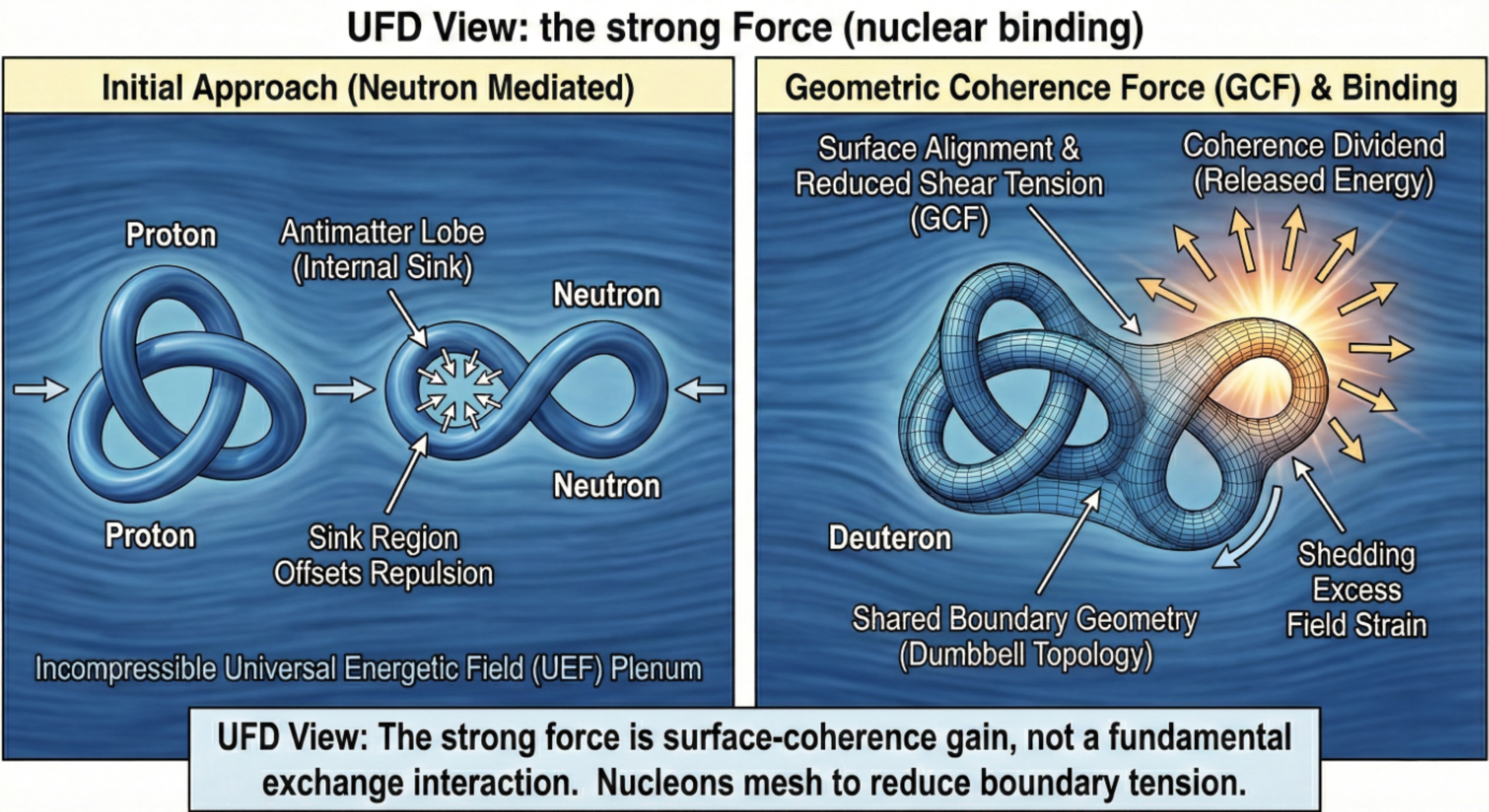
In UFD, nuclear binding is not caused by gluon exchange. It is an emergent, surface-based effect driven by the Geometric Coherence Force (GCF). When nucleon vortices in the Universal Energetic Field (UEF) approach one another in the correct geometric orientation, their boundary surfaces can align and reduce shared shear tension. Like surface tension snapping droplets together, the system sheds excess field strain and settles into a more coherent configuration. The released energy is the Coherence Dividend.
The neutron plays a crucial role in this process. Its internal source–sink geometry allows it to act as a docking mediator between protons. The neutron’s internal sink region locally offsets proton–proton repulsion, allowing vortices to approach closely enough for their surfaces to mesh. Once geometric alignment is achieved, the GCF activates and locks the configuration into a stable nucleus. The strong force is therefore surface-coherence gain, not a fundamental exchange interaction.
The Weak Force
Standard Model View
In the Standard Model, the weak force is a fundamental interaction mediated by massive W and Z bosons. It is responsible for processes such as beta decay, where a neutron transforms into a proton, electron, and antineutrino. These mediators were detected in high-energy collisions and are treated as elementary force-carrying particles.
UFD View
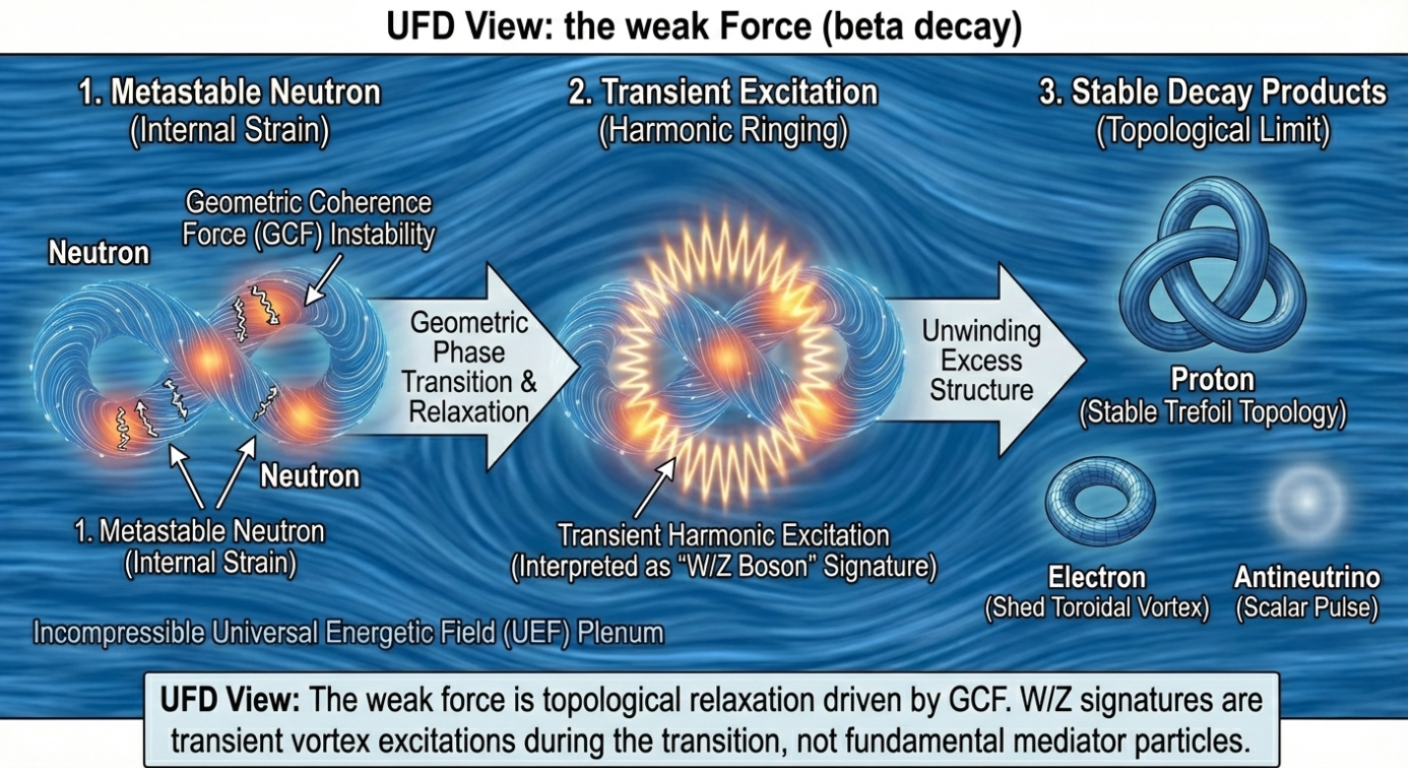
In UFD, the weak force is not a separate fundamental interaction. It is an emergent effect of the Geometric Coherence Force (GCF) — the universal drive of vortices to shed excess strain and settle into more stable configurations. A free neutron is a metastable vortex in the Universal Energetic Field. When its internal source–sink strain exceeds stability limits, it undergoes a geometric phase transition, relaxing into the simpler proton topology. The excess geometric structure unwinds across field layers, appearing as an electron and a neutrino.
High-energy “W” and “Z” signatures are interpreted not as new fundamental particles, but as transient, high-frequency excitations of nucleon vortices. When a nucleon is violently disturbed, it can ring in short-lived harmonic overtones before damping back to its stable form. The weak interaction is therefore topological relaxation under coherence constraints, not exchange of massive mediators.
*Images were created with the assistance of Gemini