The Constants of Nature
Modern physics rests on a small set of numerical constants that define force strengths, mass structure, and cosmic evolution. In the Standard Model and ΛCDM cosmology, these values are measured inputs — known to extraordinary precision, but with no explanation for why they take the values they do.
Unified Field Dynamics (UFD) proposes that these constants are emergent properties of geometric field structure rather than irreducible primitives. Several — including the fine-structure constant, the proton-electron mass ratio, and nuclear binding energies — are derived from two geometric parameters with no additional fitting. Others, such as the speed of light, Planck's constant, and Newton's gravitational constant, receive new physical interpretations as properties of the field media from which matter and forces emerge.
Below is a focused comparison of key constants: their standard status, their UFD derivation or reinterpretation, and the quantitative accuracy achieved.
Newton’s Gravitational Constant (G)
Standard View
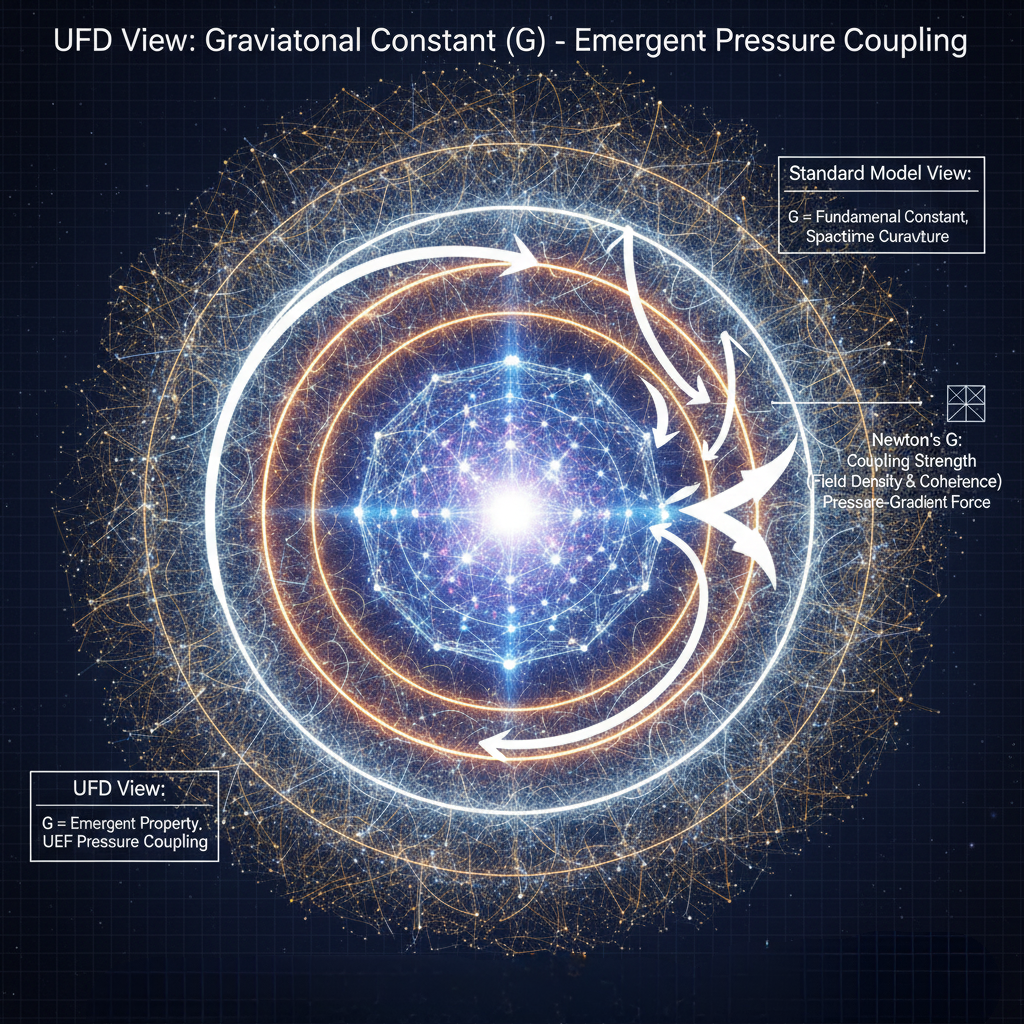
G sets the strength of gravity. It tells us how strongly mass curves spacetime. It is measured experimentally and not derived from deeper principles.
UFD View
Gravity is not spacetime bending but a pressure effect within a universal energetic medium (the UEF). G reflects how strongly pressure differences in that medium pull coherent structures together. In this view, G is not a fundamental building block — it expresses how the underlying field behaves.
Fine-Structure Constant (α ≈ 1/137)
Standard Model View
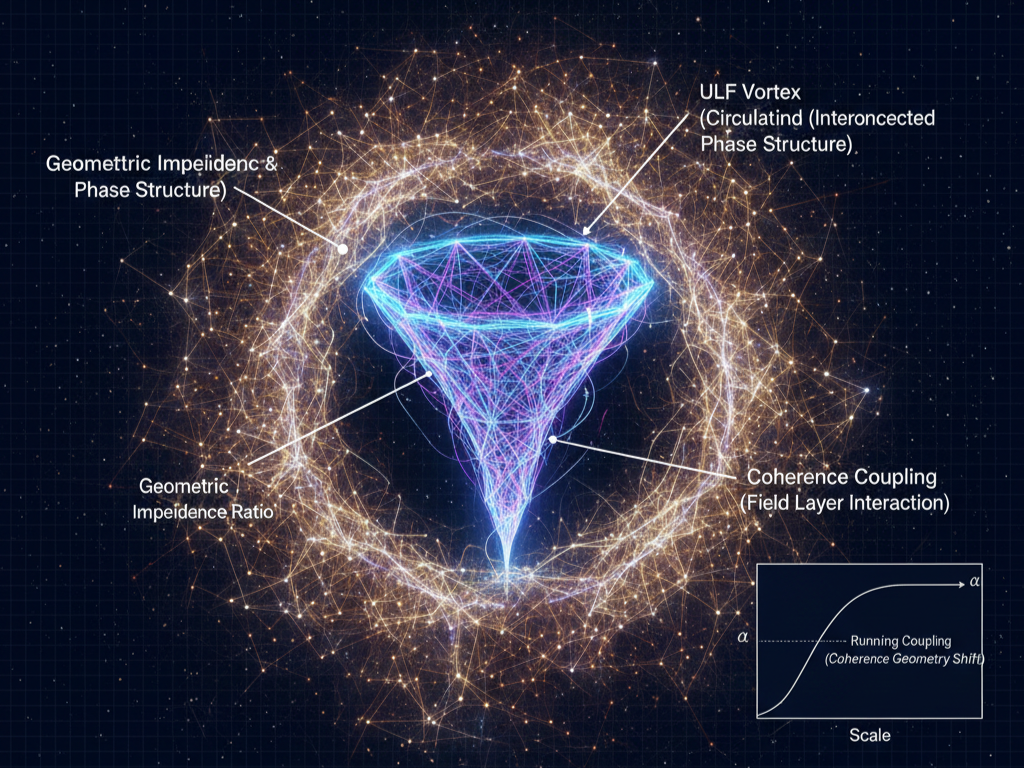
α determines the strength of electromagnetic interactions. It is a dimensionless coupling constant inserted into quantum electrodynamics. Its value is measured, not derived.
UFD View
α reflects how efficiently circulating field structures (like electrons) interact with their surrounding field environment. Rather than being a basic “charge strength,” it measures how well two layers of reality couple to each other — like an impedance match in physics or engineering.
Proton–Electron Mass Ratio (~1836)
Standard Model View
The proton mass arises largely from QCD binding energy, while the electron mass is set by Higgs Yukawa coupling. The ratio between them is not explained by a unifying principle.
UFD View
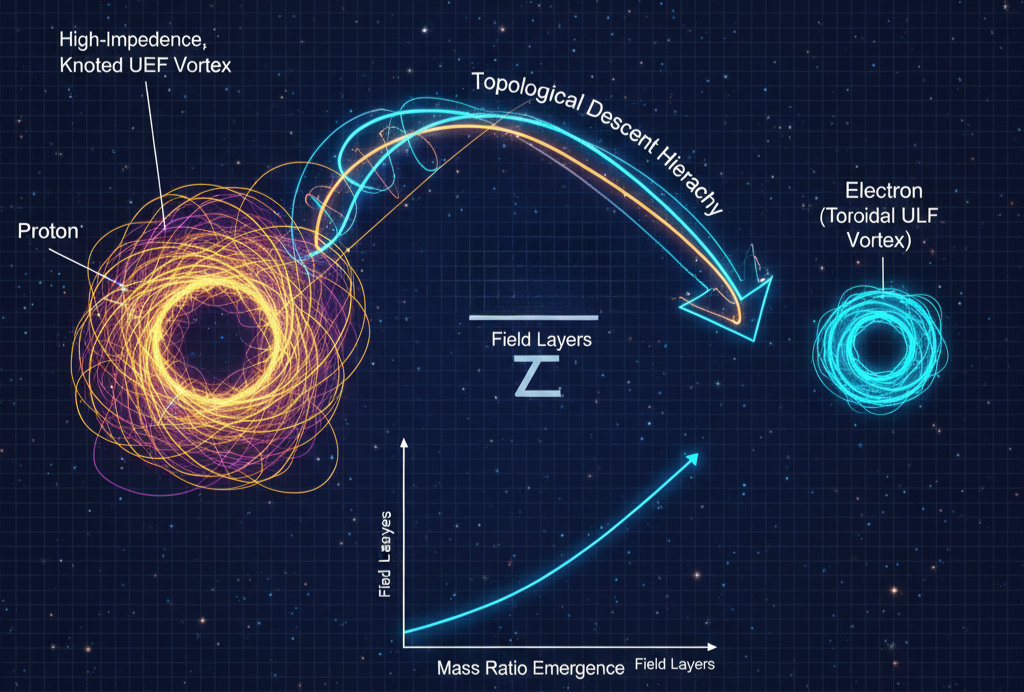
The mass ratio reflects a topological descent hierarchy. The proton corresponds to a high-impedance, knotted UEF vortex configuration, while the electron corresponds to a simpler toroidal ULF vortex. The ratio emerges from geometric impedance separation across field layers rather than independent sectors. The large mass ratio thus reflects this difference in geometric complexity, not two unrelated mechanisms.
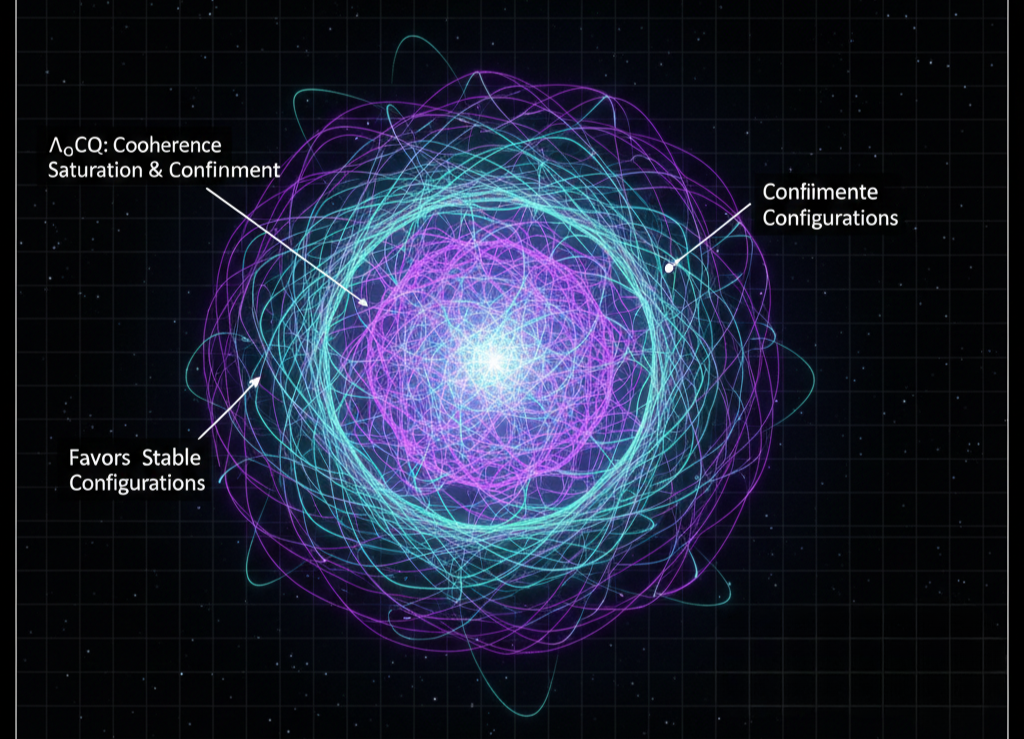
Strong Interaction Scale (Λ_QCD ≈ 200 MeV)
Standard Model View
Λ_QCD marks the energy scale where the strong force becomes non-perturbative and confinement occurs. In other words, it marks where the strong force becomes dominant and confines quarks inside protons and neutrons.
UFD View
This scale represents the point where field structures become stable and self-contained. Instead of quarks being confined by force carriers, geometric strain settles into a stable configuration. It is a threshold where coherence “locks in.”
Cosmological Constant (Λ)
Standard View
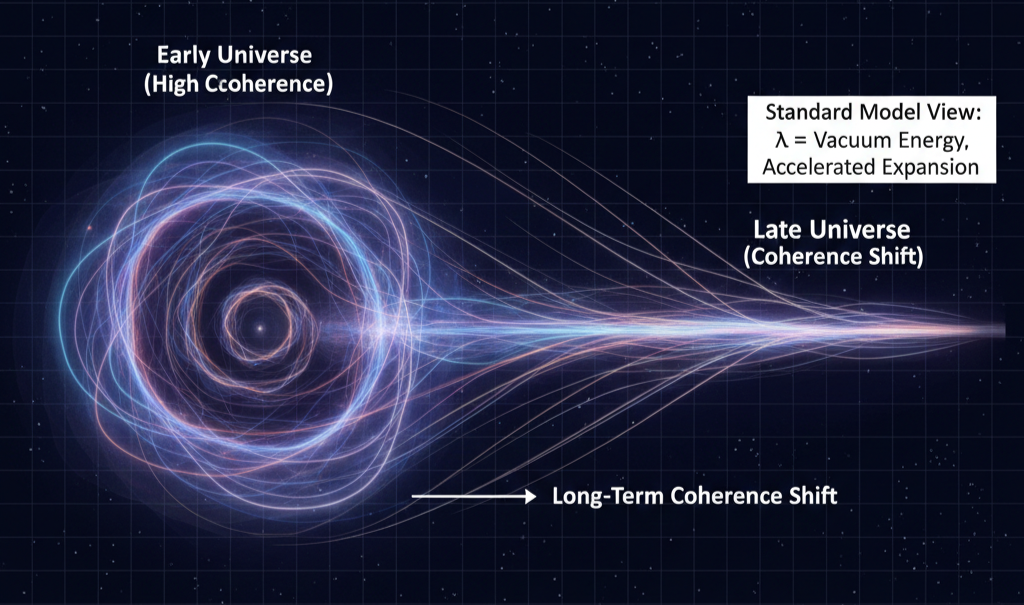
Λ represents vacuum energy that drives the accelerated expansion of the universe.
Its physical origin remains unclear.
UFD View
No vacuum energy term is required. What looks like cosmic acceleration is interpreted as a long-term shift in coherence between layers of the universal field.
Instead of space stretching, the structure of the field slowly evolves.
Planck Constant (ħ)
Standard View
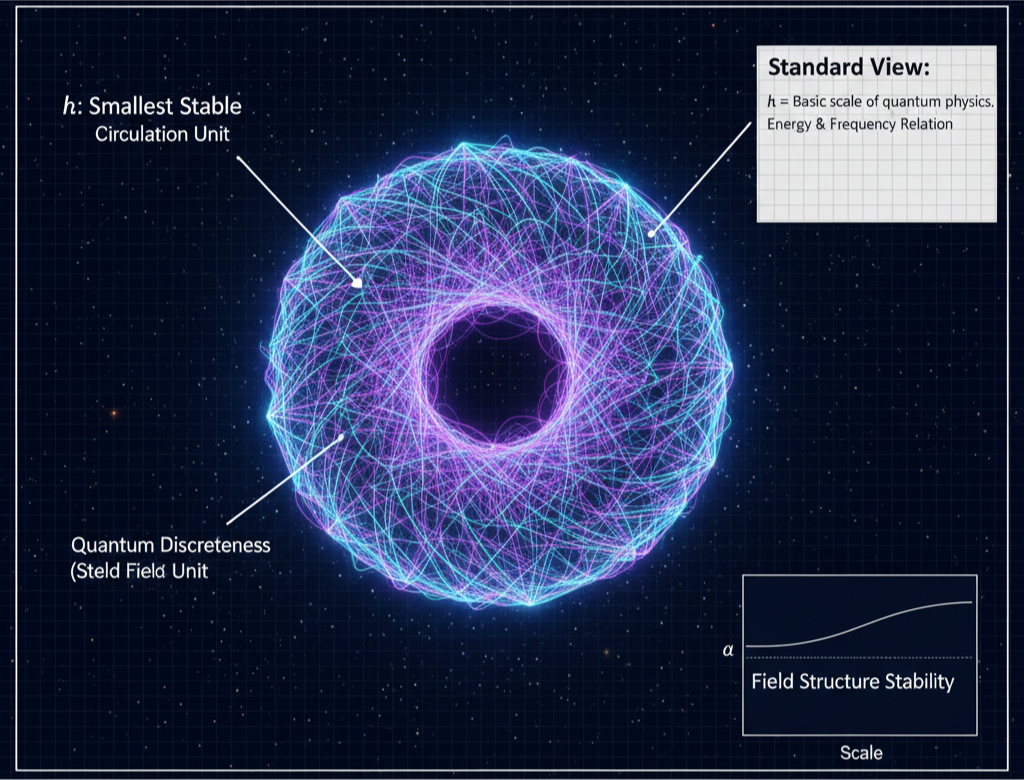
ħ sets the basic scale of quantum physics. It defines how energy and frequency relate and why physical quantities come in discrete units.
UFD View
ħ reflects the smallest stable “circulation unit” in field structure. Quantum discreteness arises because field configurations can only form in certain stable patterns — not because reality is fundamentally random.
Speed of Light (c)
Standard Model View
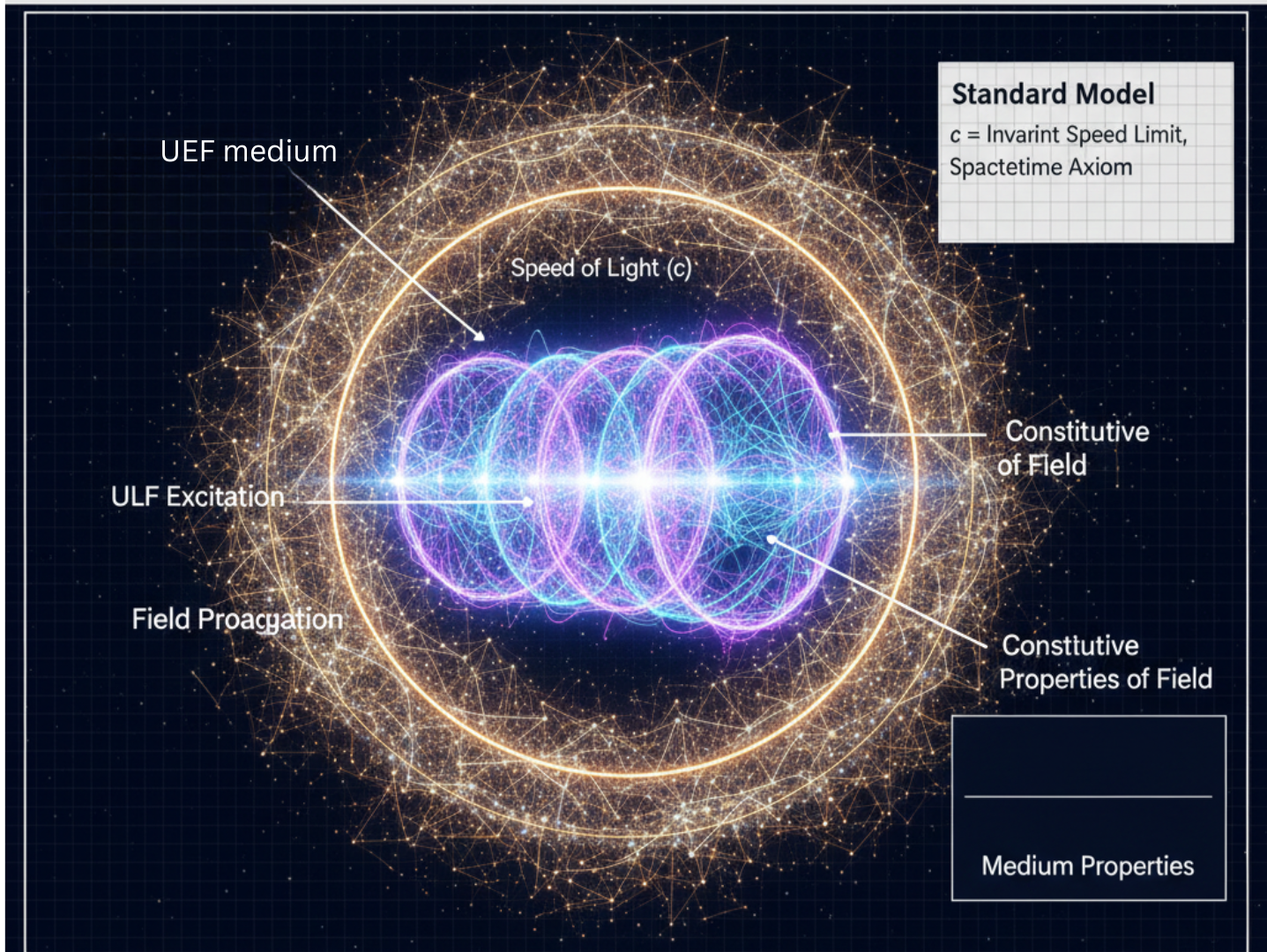
c is the universal invariant speed limit and a foundational constant of spacetime structure.
UFD View
c is the propagation speed of ULF excitations within the UEF medium.
It reflects constitutive properties of the field rather than a purely geometric axiom.
*Images were generated with the assistance of Gemini