Cosmology
Cosmology asks the largest possible question: what is the structure and history of the universe as a whole? In the prevailing model, the universe began in an extremely hot, dense state and has been expanding ever since. Spacetime itself stretches, galaxies recede, and phenomena such as dark matter, dark energy, and the cosmic microwave background are interpreted within that expanding metric framework. The model is mathematically sophisticated and empirically calibrated, yet it relies on components whose physical nature remains unknown and on extrapolations pushed to conceptual extremes.
Unified Field Dynamics approaches cosmology from a different starting point. Instead of beginning with expanding spacetime, it begins with a continuous, structured plenum governed by coherence limits. Large-scale cosmic behavior is not driven by geometric expansion of empty space, but by the dynamics of nested fields and their saturation boundaries.
In this framework, galaxies are not random condensations in an expanding void; they are coherent domains formed during structured genesis events. Black holes are not singularities in spacetime but maximally coherent super-vortices of the energetic field. Dark matter is not an unseen particle species but the gravitationally active organization of the plenum itself. Cosmological redshift arises not from metric stretching but from photon interaction with an expanding light field. Even the cosmic microwave background is reinterpreted as an ambient equilibrium signal modulated by local boundary structure.
The result is not a patchwork of independent fixes, but a cosmology derived from the same ontological commitments that govern matter and force. Large-scale structure, galactic dynamics, and cosmic evolution follow from the same principles of pressure geometry, resonance, and coherence that operate at smaller scales.
The sections that follow develop this alternative cosmology step by step, beginning with the genesis of structure and extending outward to the architecture of the cosmic web.
The Genesis Event
Standard Model View
In standard cosmology, the universe begins with the Big Bang — a hot, dense state that expands and cools over time. Matter forms as the universe expands, and gravity gradually pulls this matter together into stars, galaxies, and black holes. Structure is a late product of expansion and gravitational collapse.
UFD View
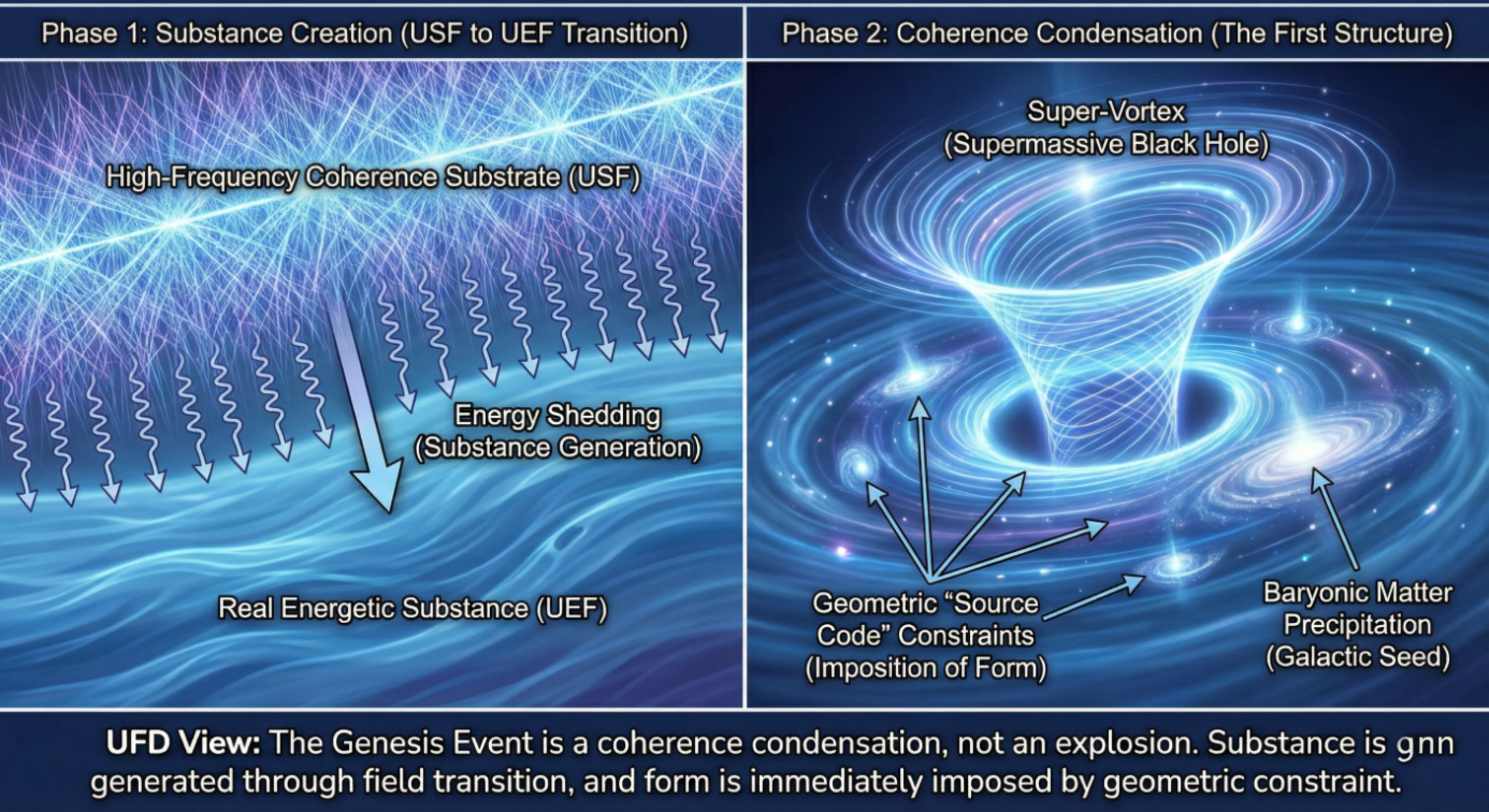
In UFD, the Genesis Event is a two-step process: first the creation of substance, then the imposition of form. The Universal String Field (USF), a high-frequency coherence substrate, continually sheds energy into a lower-energy state — the Universal Energetic Field (UEF). This shedding produces real energetic substance. Immediately, however, that substance is governed by the geometric “source code” of the USF’s underlying harmonic structure. Under these boundary constraints, a local region of the newly formed UEF condenses into its most stable configuration: a super-vortex. This first coherent structure is what we observe as a supermassive black hole.
From this central vortex, baryonic matter precipitates into a surrounding accretion structure, forming the seed of a galaxy. The universe therefore begins not as an explosion into emptiness, but as a coherence condensation event — substance generated through field transition, and form imposed through geometric constraint.
The Galactic Boundary
Standard Model View
In conventional astrophysics, a galaxy does not have a sharply defined outer boundary. Its visible matter gradually thins into intergalactic space, while dark matter halos extend well beyond the luminous disk. The transition from galaxy to surrounding space is treated as a smooth decline in density rather than a structural edge.
UFD View
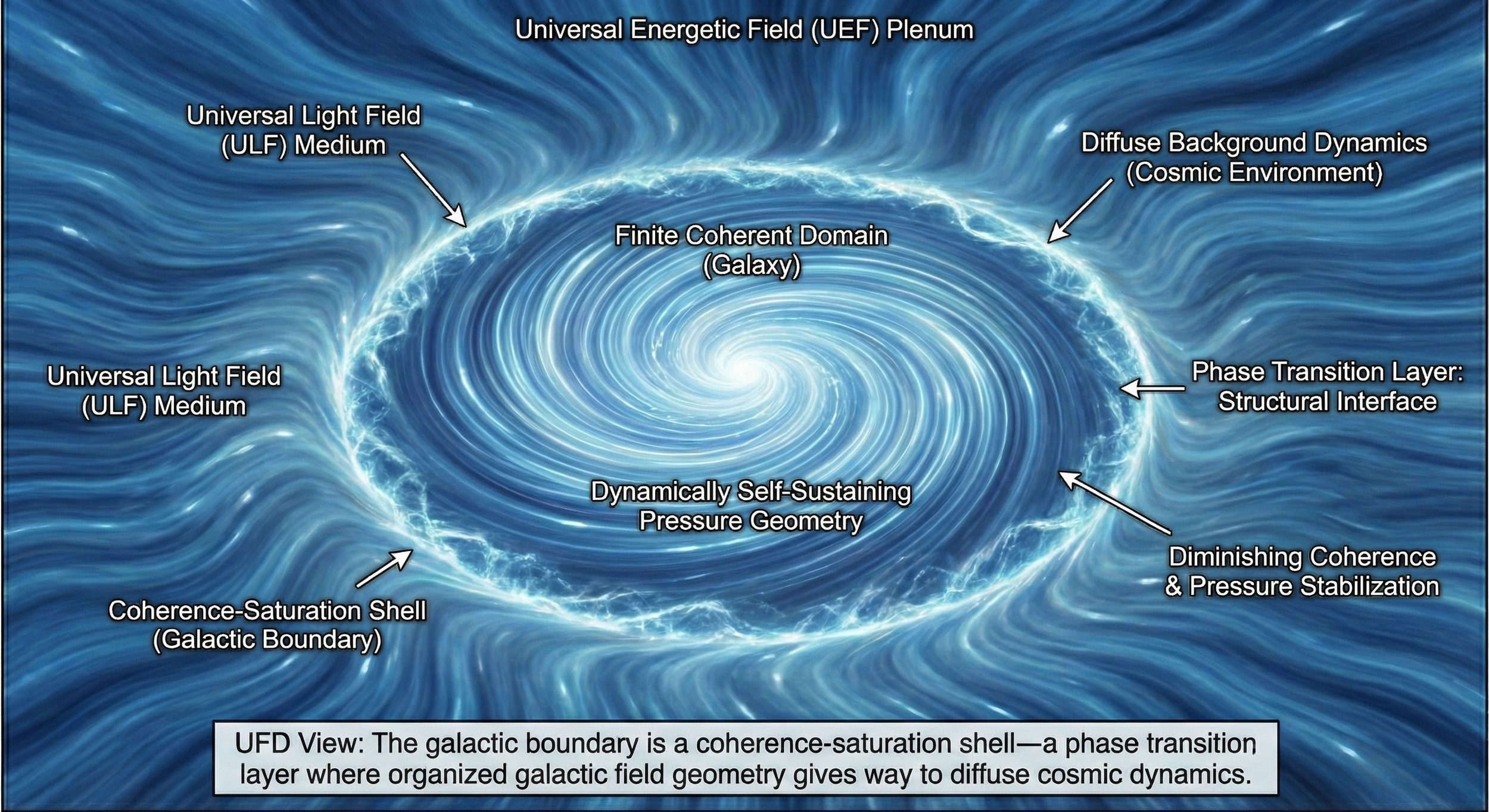
In UFD, a galaxy is a finite coherent domain formed during the Genesis Event. The galactic boundary is the outer limit of that coherence. It is not a wall of matter or a gravitational cutoff, but a phase transition layer in the Universal Energetic Field (UEF) and Universal Light Field (ULF). Inside this radius, large-scale pressure geometry and vortical organization are dynamically self-sustaining. At the boundary, coherence reaches saturation. The medium can no longer support the same organized structure beyond that shell.
The boundary is therefore a coherence-saturation shell — a structural interface where organized galactic field geometry transitions continuously into the broader cosmic environment. The field remains continuous beyond it, but large-scale tangential coherence and pressure stabilization diminish. Like the outer ring of a whirlpool, it marks where structured motion gives way to diffuse background dynamics.
Black Holes
Standard Model View
In General Relativity, a black hole forms when gravitational collapse drives matter into a singularity — a point of infinite density where spacetime curvature diverges and known physics breaks down. The event horizon marks a boundary beyond which information cannot escape. This leads to deep paradoxes, including the problem of information loss and the idea that black holes have no internal structure beyond mass, spin, and charge.
UFD View
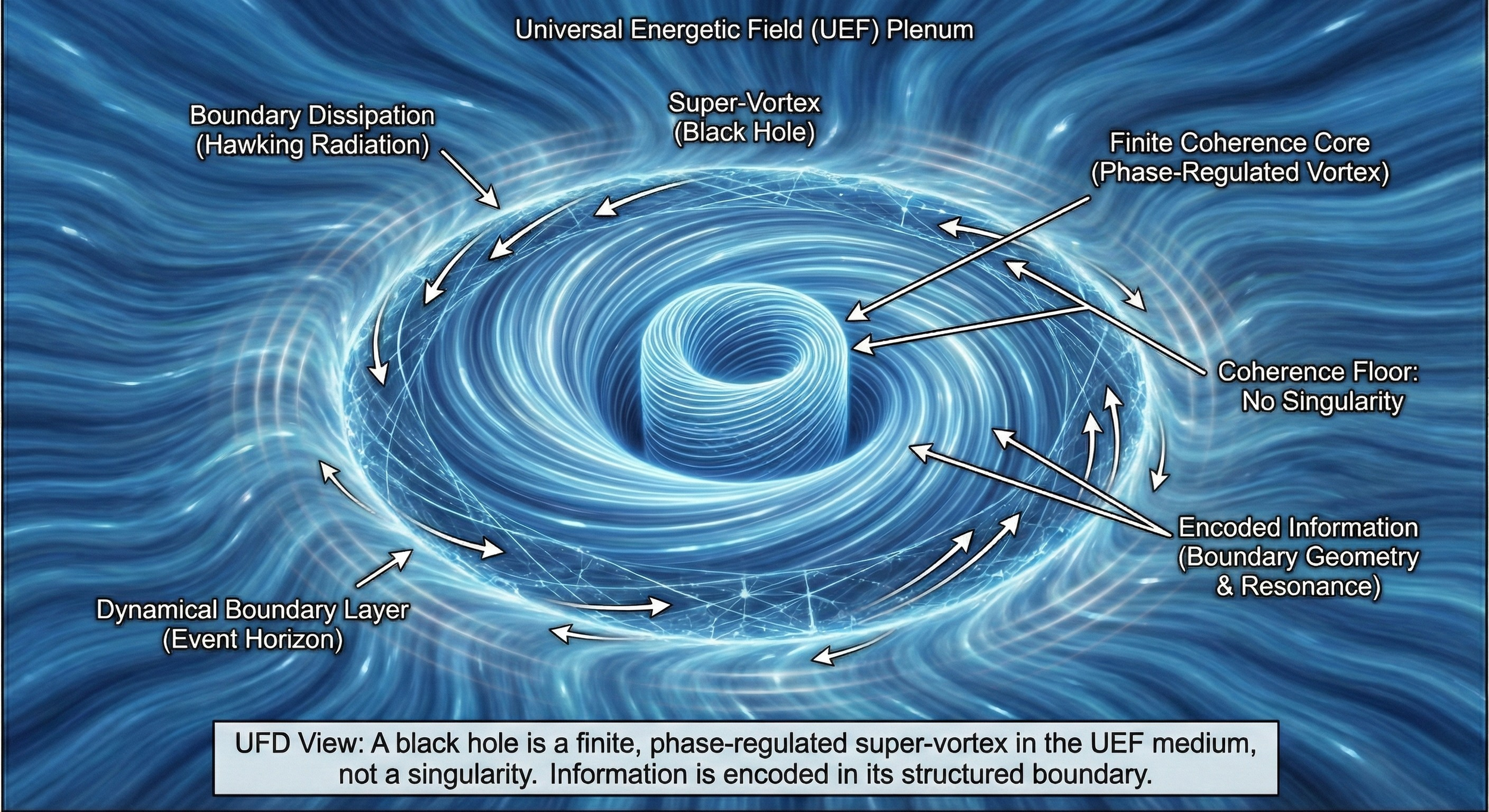
In UFD, a black hole is not a singularity but a finite, maximally coherent super-vortex in the Universal Energetic Field (UEF). The UEF is a real, structured medium with a minimum coherence scale. As collapse intensifies, the system reaches a coherence floor where further compression is dynamically forbidden. Instead of forming an infinite point, the interior stabilizes into a phase-regulated vortex configuration with finite density and finite extent. Collapse terminates naturally because the medium’s effective impedance rises sharply at extreme strain.
There is no metaphysical separation between inside and outside. The event horizon is a dynamical boundary layer defined by competing propagation speeds in the surrounding field. Information is not destroyed; it is encoded in the precise geometric and resonant state of the super-vortex and its boundary structure. What appears as Hawking radiation is boundary dissipation — a slow leakage of coherence back into the surrounding field. Black holes are not bald, featureless objects, but highly organized vortex systems whose internal symmetry and boundary geometry carry information.
The Formation of Matter
Standard Model View
In conventional cosmology, matter formed shortly after the Big Bang as the universe cooled from an extremely hot and dense state. Energy condensed into particles and antiparticles in pairs. Most of these annihilated back into radiation, but for reasons that are still not fully understood, a small excess of matter remained. This leftover matter eventually formed atoms, stars, and galaxies. The imbalance between matter and antimatter requires additional theoretical mechanisms, collectively referred to as baryogenesis.
UFD View
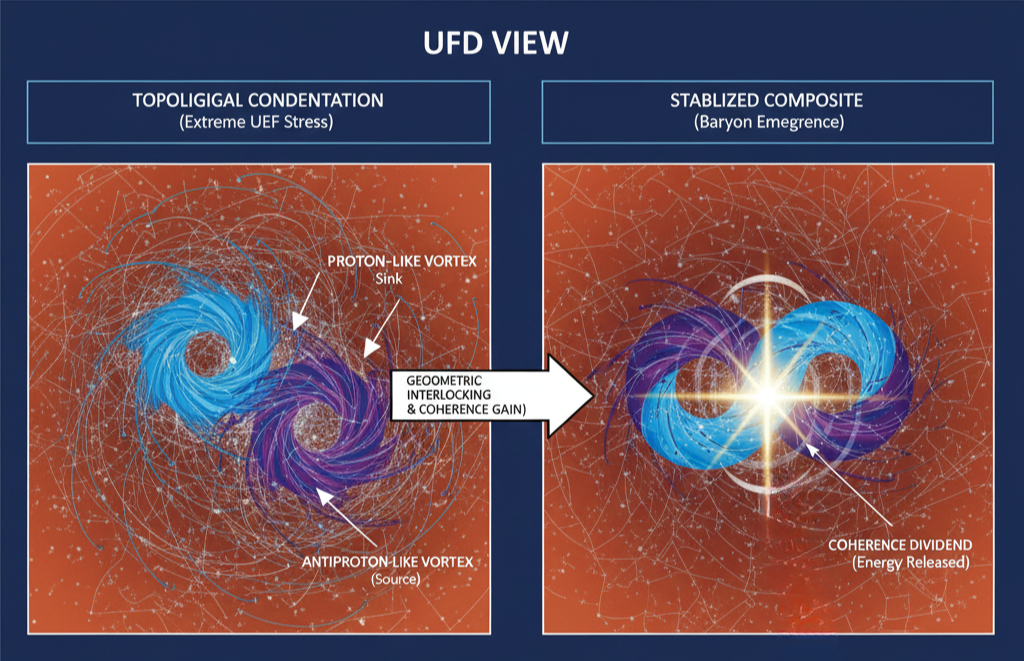
In Unified Field Dynamics, matter forms during violent, high-energy reorganization events in the Universal Energetic Field. When a supermassive vortex condenses, the surrounding field becomes intensely turbulent and pressurized. Under these extreme conditions, the continuous field does not create particles from nothing. Instead, it reorganizes into stable vortical structures. These appear in complementary pairs: outward-flowing “source” vortices (protons) and inward-flowing “sink” vortices (antiprotons). Because both arise from the same field, they are created in perfect balance.
At sufficiently high pressure, these complementary vortices do not simply annihilate into radiation. Instead, they interlock into a more stable configuration. In this transition, a vast amount of energy is released as the system sheds excess strain—this release is the Coherence Dividend. The resulting stable structure becomes the neutron, and from this point forward, the stable topologies of the field establish the baseline for baryonic matter. In this view, matter is not leftover debris from an explosion. It is the stabilized outcome of a geometric phase transition in a continuous medium.
Quasars
Standard Model View
In conventional astrophysics, quasars are extremely luminous objects powered by matter falling into supermassive black holes at the centers of young galaxies. As gas spirals inward, gravitational energy is converted into radiation, producing enormous brightness that can outshine entire galaxies. Quasars are therefore interpreted as an early phase in galactic evolution, fueled by accretion and gravitational heating.
UFD View
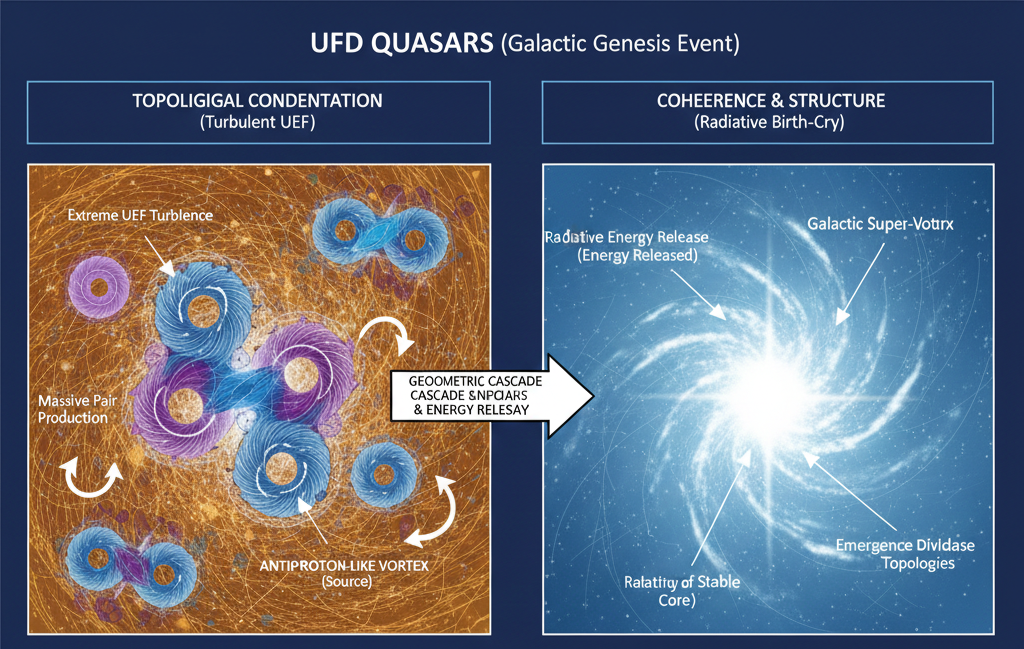
In Unified Field Dynamics, a quasar marks the birth of a galaxy. It is not merely matter falling inward, but the visible signature of a profound geometric transition in the Universal Energetic Field.
During the Genesis Event, when a supermassive vortex condenses, the surrounding field becomes violently turbulent. Massive pair production of complementary vortices occurs, and these source–sink structures interlock into stable neutron configurations. In this process, an immense amount of strain energy is released as the system sheds excess shear and reorganizes into coherent form. This released energy—the Coherence Dividend—is what powers the quasar.
The brilliance of a quasar is therefore the radiative expression of matter formation itself. It is the energetic byproduct of the field settling into stable topologies. Once this turbulent phase subsides and coherence stabilizes, the galaxy transitions from its quasar state into a mature, self-organized system.
In this view, quasars are not anomalies in an already-existing universe. They are the luminous birth-cries of galactic structure emerging from the plenum.
Dark Matter
Standard Model View
Dark matter is proposed as an invisible form of matter that surrounds galaxies in large halos. It does not emit light but exerts gravitational influence, explaining galaxy rotation curves and gravitational lensing. It is typically modeled as a new type of particle that interacts weakly with ordinary matter.
UFD View
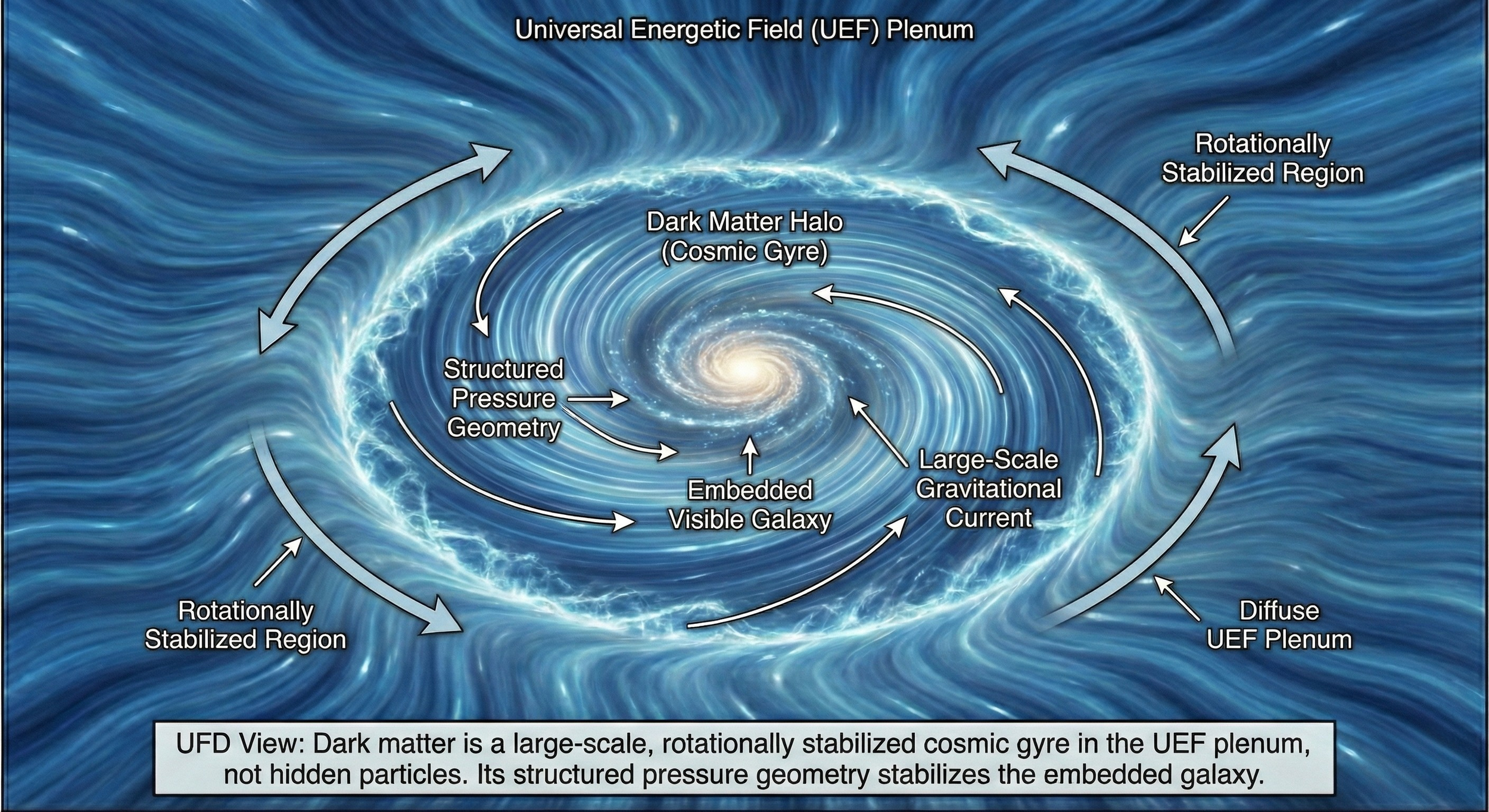
In UFD, dark matter is not a hidden particle species. It is a large-scale, organized state of the Universal Energetic Field (UEF). During the Genesis Event, the formation of the central super-vortex induces a vast, slowly rotating structure in the surrounding UEF — a cosmic gyre. This rotationally stabilized region forms the dark matter halo.
The halo is gravitationally active because it consists of structured pressure geometry in the incompressible UEF. Its flattened shape follows from systemic rotation, and its large-scale gravitational current stabilizes the visible galaxy embedded within it. Dark matter is therefore not additional mass, but organized field dynamics enveloping the galaxy.
Cosmic Microwave Background
Standard Model View
In the standard cosmological model, the Cosmic Microwave Background is relic radiation from the early universe, emitted approximately 380,000 years after the Big Bang during the epoch of recombination. As the universe expanded, this radiation was stretched to microwave wavelengths, producing the observed 2.7 Kelvin blackbody spectrum. The small anisotropies and acoustic peaks in the CMB are interpreted as fossilized sound waves in the primordial plasma, encoding information about early density fluctuations. Polarization patterns, including E-modes and B-modes, are attributed to scattering processes and possibly inflationary gravitational waves. Large-scale anomalies are generally treated as statistical fluctuations within an otherwise isotropic universe.
UFD View
In Unified Field Dynamics, the CMB is not a relic of a primordial explosion, nor evidence of expanding spacetime. Its near-perfect 2.7 Kelvin blackbody spectrum is the intrinsic equilibrium temperature of the Universal Light Field itself—the ambient thermal ground state of the cosmic medium. The background “glow” is not cooling radiation from a distant past, but the present resting state of the ULF ocean.
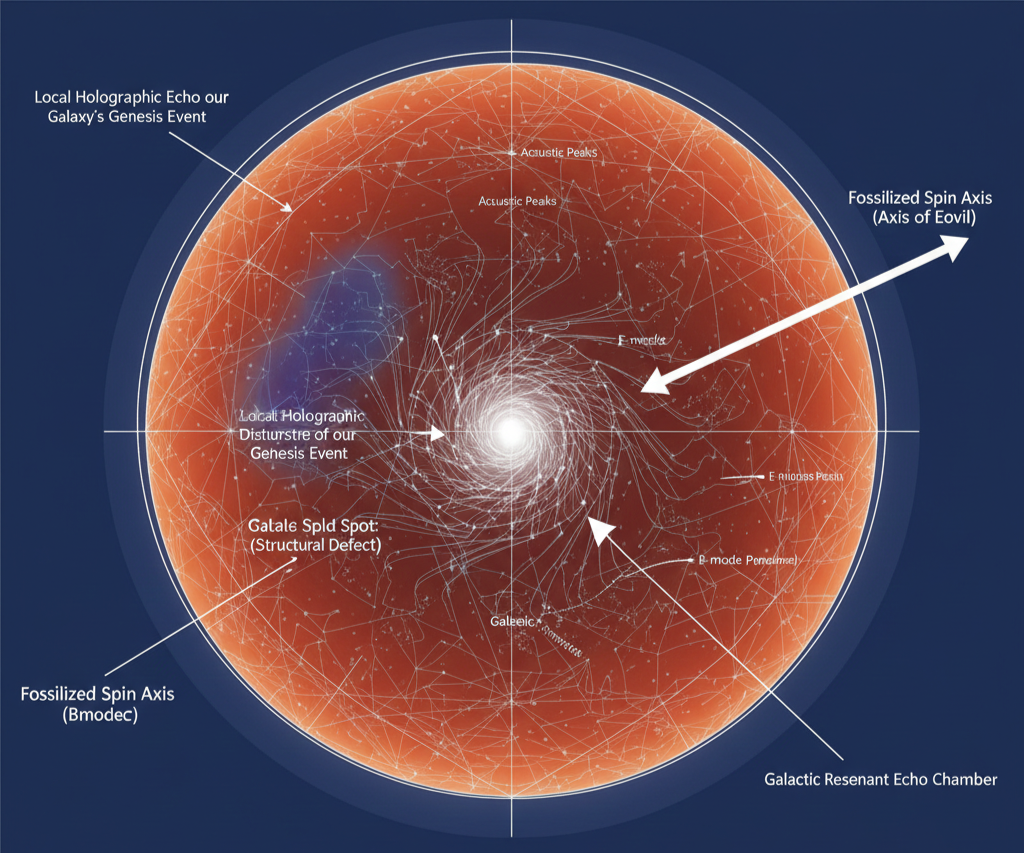
The intricate acoustic peaks, polarization modes, and large-angle anomalies are not fossilized plasma oscillations from the early universe. They are the local holographic echo of our own galaxy’s Genesis Event. During that event, the violent condensation and rotation that formed the galactic super-vortex launched compressional and shear disturbances into the surrounding field. These disturbances became permanently imprinted onto the ambient ULF background and are sustained by the galactic boundary, which acts as a resonant echo chamber. In this interpretation, E-mode polarization reflects compressional waves from the initial collapse, while B-mode polarization reflects transverse shear generated by primordial rotation. Large-scale anomalies are not statistical accidents but architectural features of this imprint. The so-called Axis of Evil corresponds to the fossilized spin axis of our galaxy’s birth, and the Cold Spot represents a structural defect within the local echo pattern.
In this framework, the CMB is an imprinted medium: a global equilibrium background modulated by a local structural signature. Its temperature is universal, but its pattern is local.
Cosmological Redshift
Standard Model View
In conventional cosmology, redshift is explained by the expansion of spacetime. As the universe expands, the fabric of space stretches, and light waves traveling through it are stretched as well. The greater the distance, the greater the stretching. This produces the observed relationship between redshift and distance known as the Hubble–Lemaître law, with deviations at large distances attributed to dark energy.
UFD View
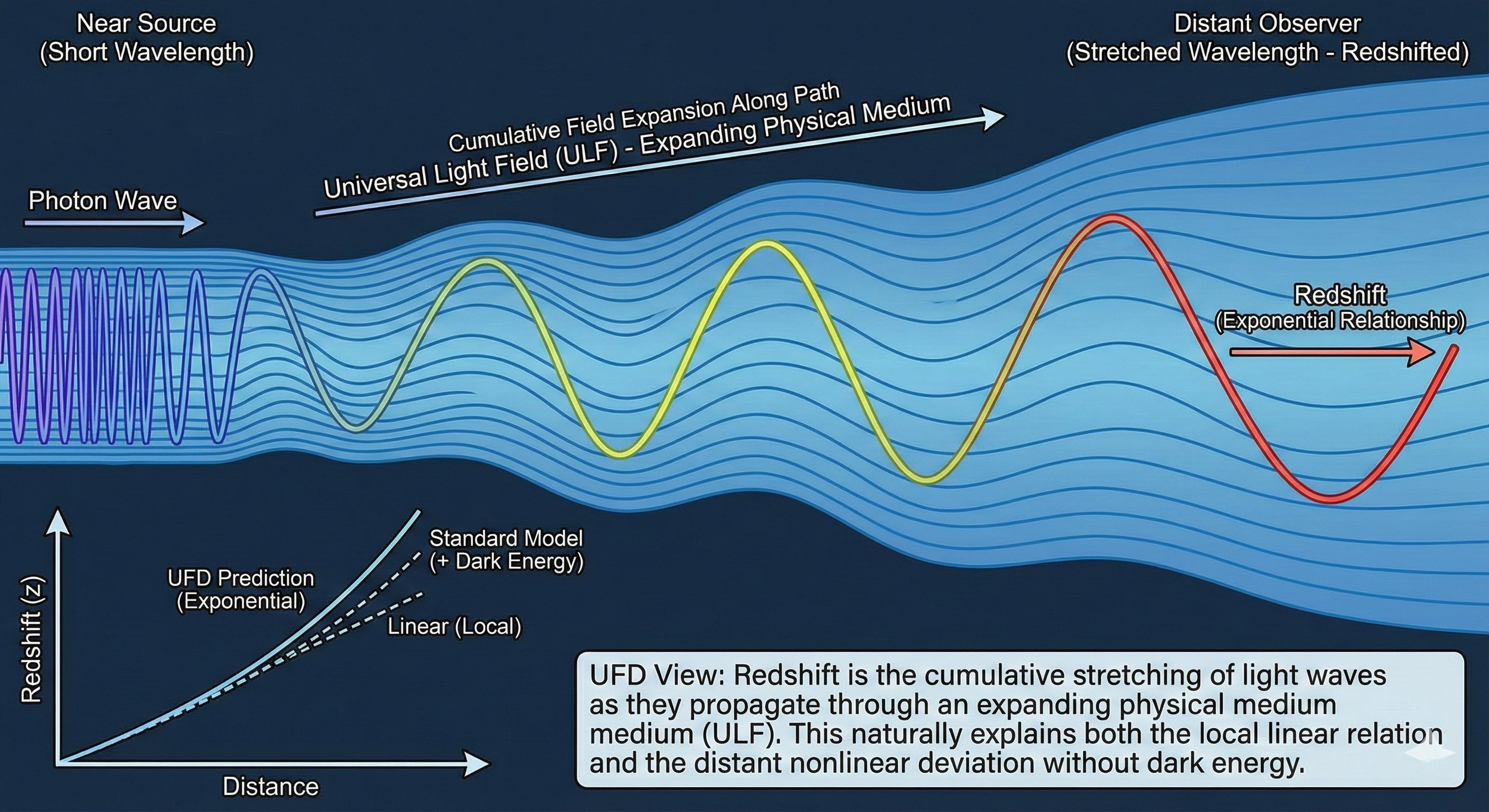
In UFD, redshift is not caused by expanding spacetime, but by light propagating through an expanding physical medium — the Universal Light Field (ULF). As a photon travels, its wavelength gradually stretches because the supporting field slowly changes scale along its path. The fractional stretching at each point accumulates continuously over distance. This produces an exponential relationship between redshift and distance: small distances appear linear, while large distances show nonlinear growth.
Locally, this naturally reproduces the observed near-linear redshift–distance relation. At cosmological scales, the same mechanism generates the accelerated-looking deviation without requiring dark energy. Redshift is therefore a geometric interaction between light and an evolving field, not a Doppler effect and not metric expansion.
Dark Energy
Standard Model View
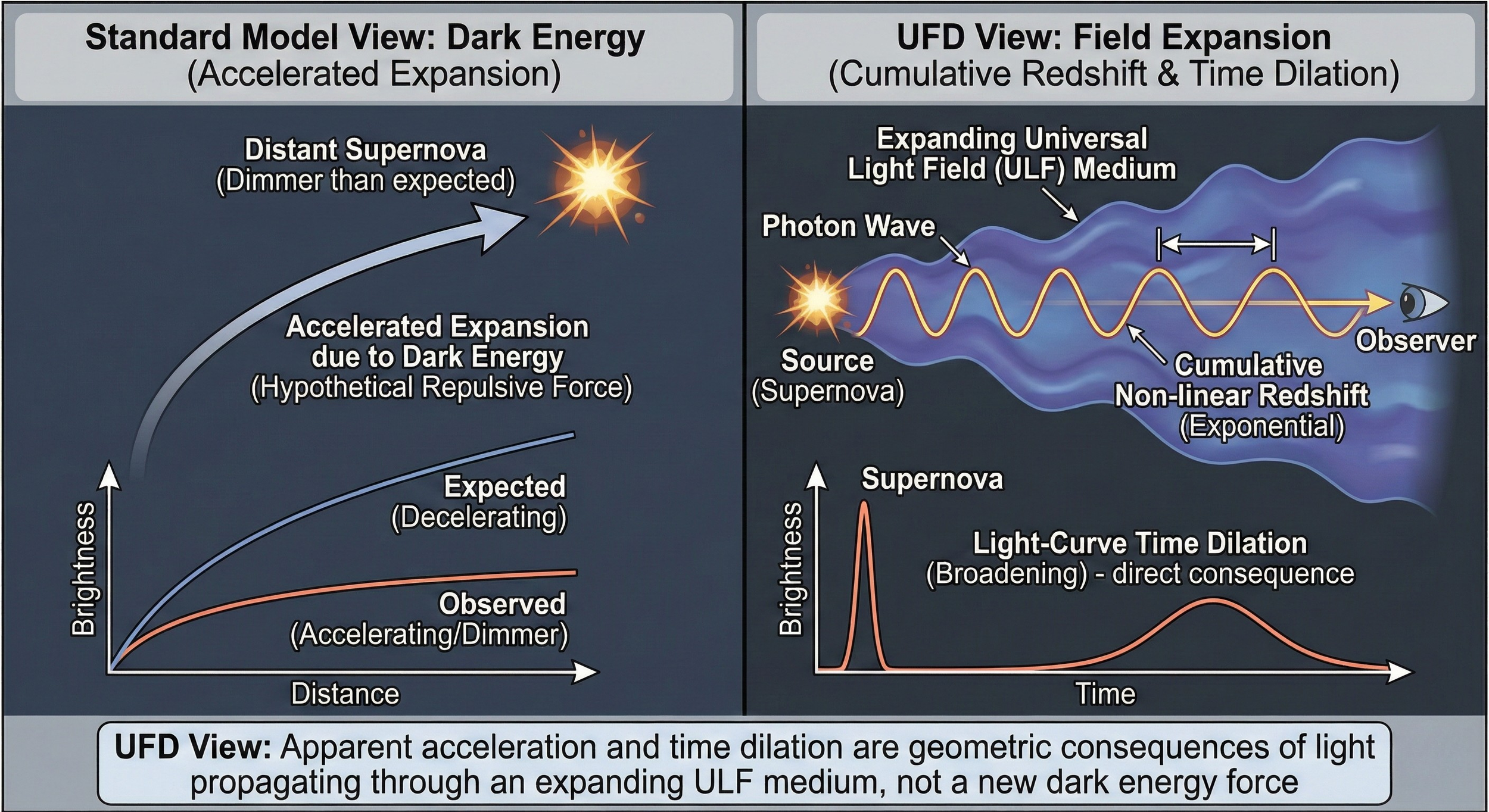
Observations of distant Type Ia supernovae show that they appear dimmer than expected in a decelerating universe. This led to the conclusion that cosmic expansion is accelerating. To explain this effect, cosmology introduces dark energy — a hypothetical repulsive component that now dominates the energy budget of the universe, though its physical nature remains unknown.
UFD View
In UFD, no additional substance is required. The apparent acceleration arises naturally from the exponential redshift produced by light traveling through an expanding Universal Light Field (ULF). As wavelength stretching accumulates over distance, the redshift–distance curve bends upward. At large distances, small increases in distance produce disproportionately large increases in redshift. What appears as acceleration is therefore a geometric consequence of photon propagation through a changing medium.
The same mechanism explains observed time dilation in distant supernova light curves. Because all processes unfold within the expanding ULF, the interval between emitted photons is stretched by the same factor that stretches wavelength. Light-curve broadening is therefore a direct consequence of field expansion. Dark energy is not a new force or fluid, but a reinterpretation of this intrinsic geometric nonlinearity.
The Cosmic Crystal
Standard Model View
In conventional cosmology, the large-scale structure of the universe — the cosmic web — is understood as a foam-like network formed by gravitational amplification of early density fluctuations. Filaments, voids, and galaxy clusters arise from dark matter collapse over time. The resulting pattern appears complex and irregular, without an underlying global geometric order.
UFD View
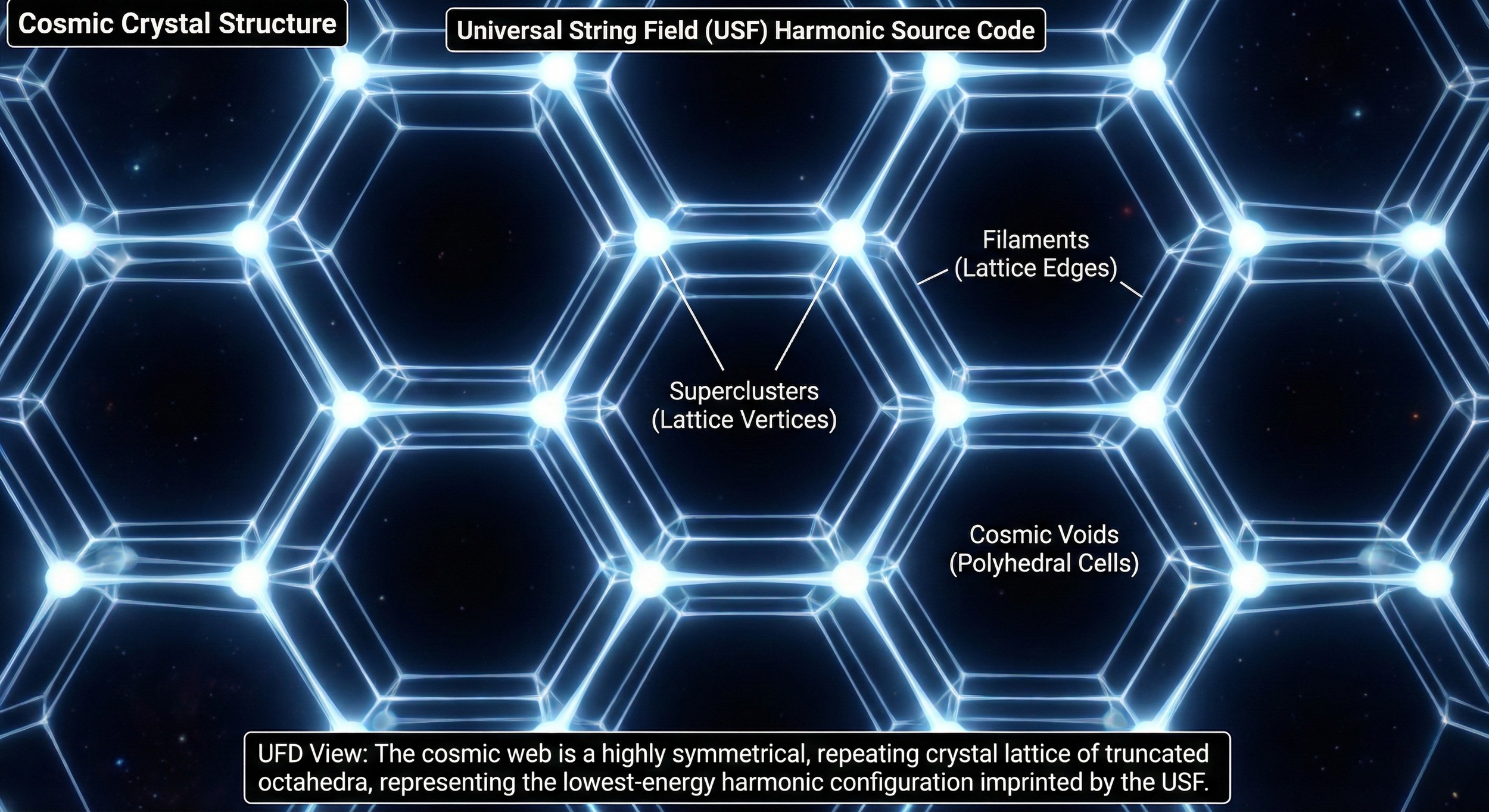
In UFD, the cosmic web is not random. It is a repeating, crystal-like lattice imprinted at creation. The most efficient way to partition three-dimensional space is a honeycomb of truncated octahedra — a highly symmetrical space-filling geometry. This lattice represents the lowest-energy harmonic configuration of the Universal String Field (USF), and its geometry is transferred to the Universal Energetic Field (UEF) during the Genesis Event.
In this Cosmic Crystal, superclusters occupy the lattice vertices, each anchored by a central supermassive super-vortex. Filaments form along the lattice edges, and the great cosmic voids correspond to the polyhedral cells. At the immense density of the UEF, the medium behaves like a hyper-pressurized superfluid that naturally stabilizes into this minimal-energy structure. The universe is therefore not a debris field but a saturated plenum organized into a coherent spatial lattice. Because the lowest-energy state of this medium is one of persistent, non-dissipative motion, the lattice supports continual, stable flow — making the cosmos a spatiotemporal crystal rather than a static structure.
*Images were generated with the assistance of Gemini