Quantum Mechanics
Quantum mechanics is the most successful predictive framework in the history of physics. It accurately describes atomic structure, chemical bonding, semiconductor behavior, nuclear processes, and much of modern technology. Yet despite its mathematical precision, its physical interpretation remains unsettled. The wavefunction, superposition, measurement, entanglement, and probability are handled with formal rigor but with ongoing disagreement about what they mean.
In standard formulations, quantum theory is often presented as a set of rules for calculating outcomes rather than as a description of underlying physical mechanisms. Competing interpretations—Copenhagen, Many Worlds, pilot wave, objective collapse—retain the same mathematics while differing on ontology. The result is a theory that works extraordinarily well yet appears conceptually fragmented.
The Resonant Field Interpretation (RFI) within Unified Field Dynamics approaches quantum mechanics from first principles. It begins with the commitment that fields are real and continuous. Quantum phenomena are not primitive mysteries but emergent consequences of resonance, coherence limits, and geometric constraint within the Universal Light Field and its coupling to deeper layers of the plenum.
In this view, the wavefunction describes a real standing-wave structure in a physical medium. Quantization arises from harmonic admissibility within a finite-coherence field. Measurement corresponds to boundary reconfiguration rather than probabilistic magic. Entanglement reflects shared resonance rather than signal transmission. Uncertainty expresses geometric constraint rather than epistemic limitation.
The sections that follow reinterpret the core features of quantum mechanics—wavefunction, quantization, measurement, decoherence, uncertainty, entanglement, and tunneling—within this unified, field-based ontology. The aim is not to replace the mathematics of quantum theory, but to provide a coherent physical picture beneath it.
The Wavefunction
Standard Model View
In standard quantum mechanics, the wavefunction is a complex-valued mathematical object whose squared magnitude gives the probability density of finding a particle in a particular state. It evolves deterministically according to the Schrödinger equation but does not directly correspond to a physical substance in space. Different interpretations disagree about whether the wavefunction is real or merely a calculational tool, yet operationally it functions as a probability amplitude whose collapse during measurement yields definite outcomes.
UFD View
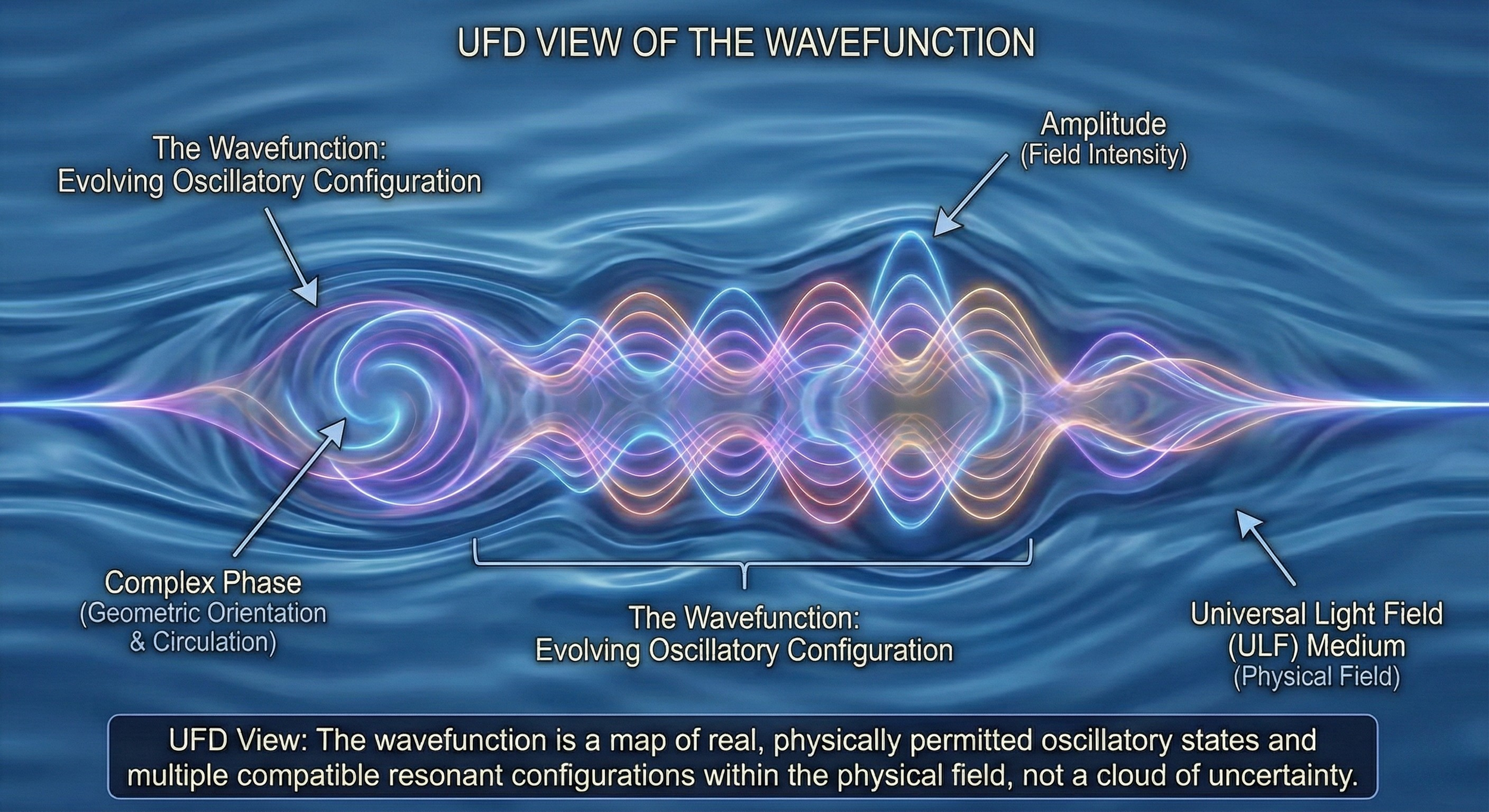
In Unified Field Dynamics, the wavefunction represents a real oscillatory configuration within a physical field. Its amplitude reflects the intensity of the underlying field disturbance, and its complex phase encodes geometric orientation and circulation within the medium. The mathematical formalism captures the harmonic structure of admissible field patterns rather than abstract probability amplitudes.
Before stabilization, a system may admit multiple compatible resonant configurations. The wavefunction describes this dynamically evolving structure. It is therefore not a cloud of uncertainty but a map of real, physically permitted oscillatory states that remain viable until coherence selection resolves them into a stable configuration.
Quantization
Standard Model View
The blackbody radiation problem revealed that classical physics predicted an unphysical divergence of energy at high frequencies. Max Planck resolved this by proposing that energy is emitted and absorbed in discrete quanta proportional to frequency, introducing Planck’s constant as a new fundamental parameter. Quantization thus entered physics as a postulate: energy exchanges occur in discrete units rather than continuously.
UFD View
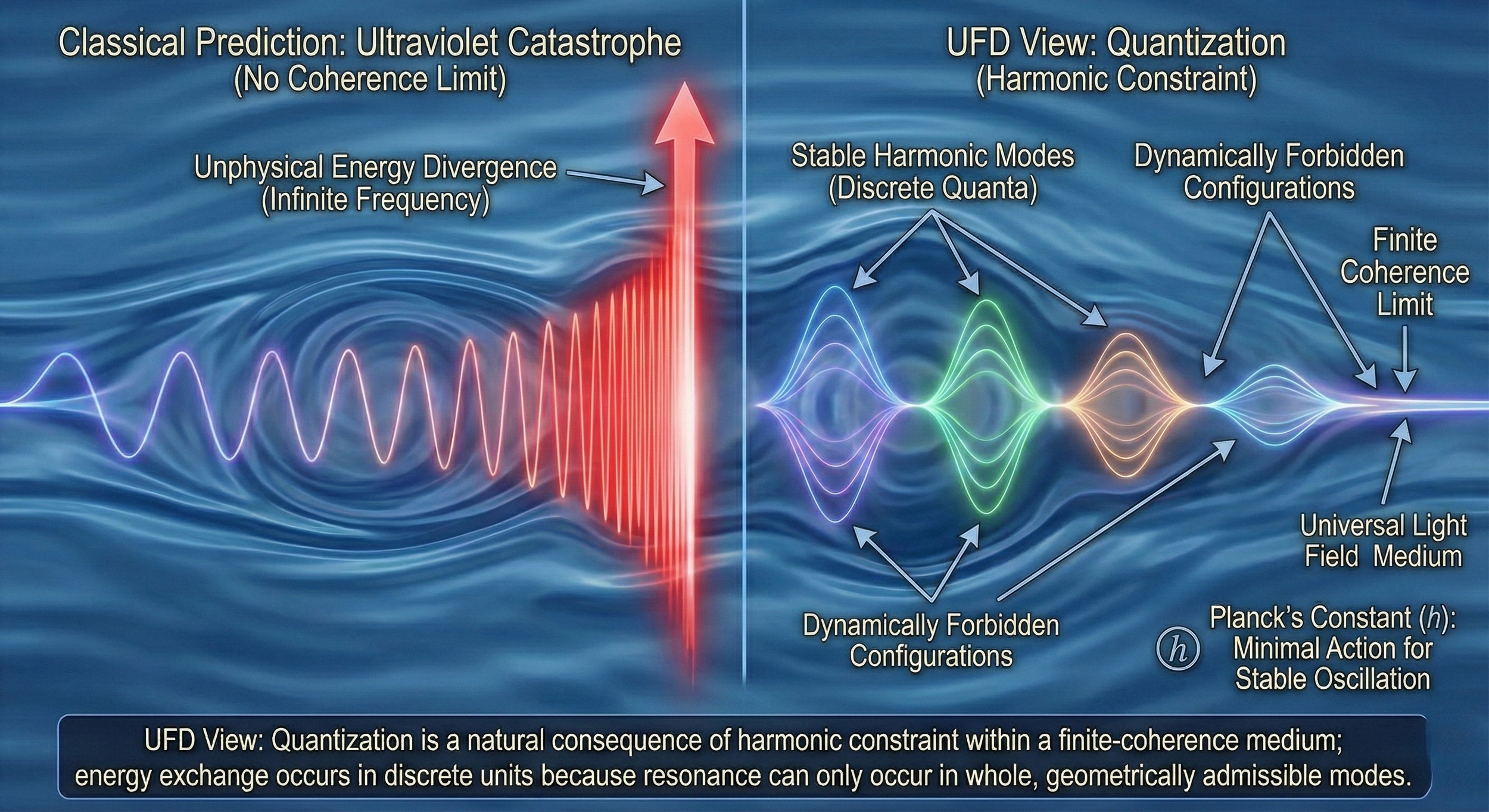
In UFD, quantization arises because only certain harmonic modes can be sustained within a structured medium. The ultraviolet catastrophe appears when one assumes that arbitrarily small wavelengths and arbitrarily large frequencies are physically admissible. However, a real field possesses finite coherence limits. Extremely high-frequency modes require geometric curvature and tension beyond what the medium can sustain, and such configurations are dynamically forbidden.
Planck’s constant reflects the minimal action required to establish a stable oscillatory circulation in the field. Energy exchange occurs in discrete units because resonance can only occur in whole, geometrically admissible modes. Quantization is therefore not an added rule but a natural consequence of harmonic constraint within a finite-coherence medium.
Measurement
Standard Model View
Measurement in quantum mechanics is described as the collapse of the wavefunction from a superposition of possible states into a single definite outcome. This collapse is not derived from the unitary evolution of the wavefunction and appears as a distinct, probabilistic process triggered by observation or interaction with a measuring device. The exact mechanism of collapse remains interpretively unsettled.
UFD View
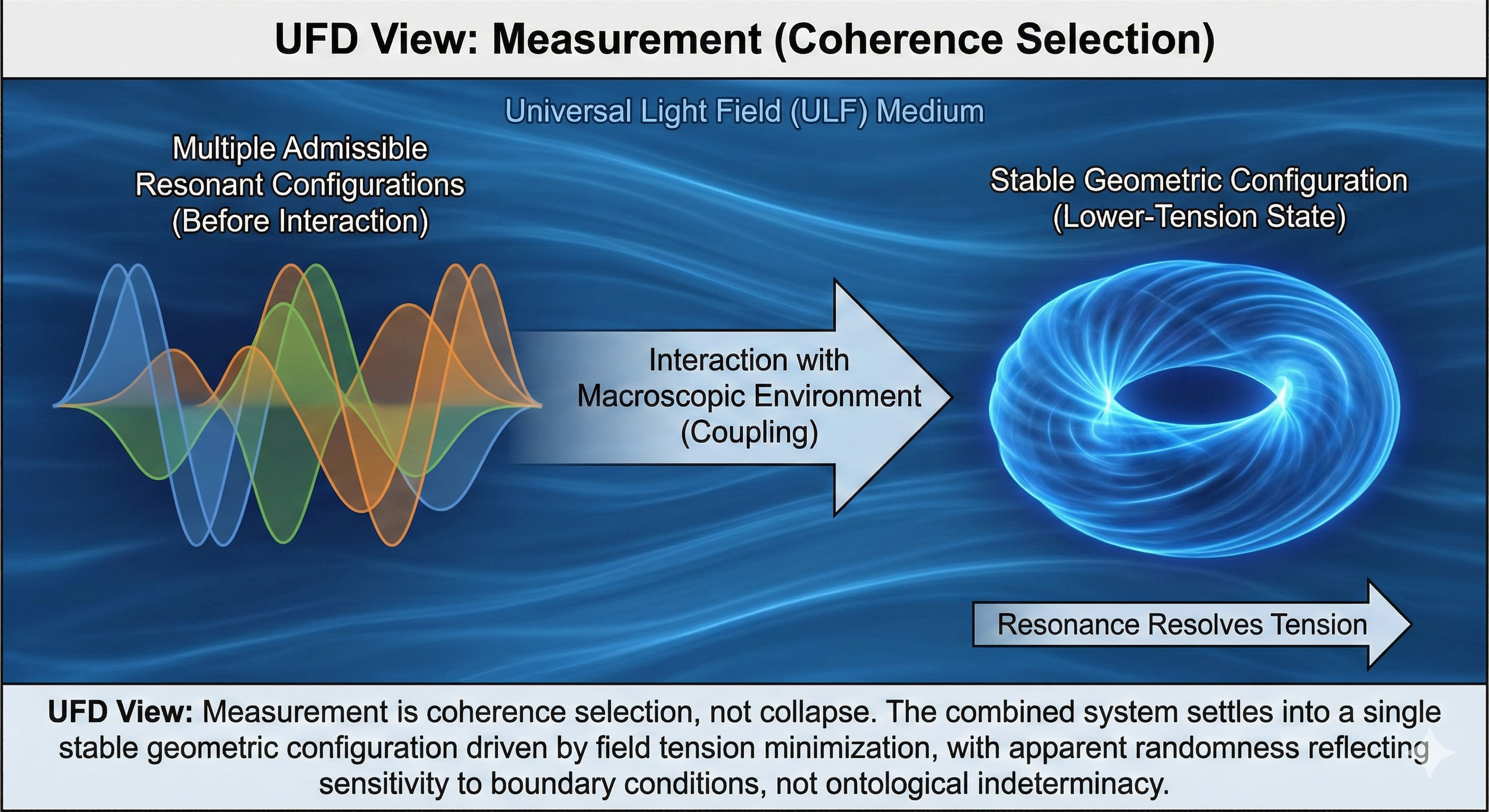
In UFD, measurement is coherence selection rather than collapse. When a quantum system interacts with a macroscopic environment, the combined system must settle into a single stable geometric configuration. The universal tendency of fields to minimize tension drives this stabilization process. Multiple admissible resonant configurations may exist prior to interaction, but only one can remain coherent once coupled to a larger structure.
The apparent randomness of measurement reflects sensitivity to initial boundary conditions and environmental fluctuations, not ontological indeterminacy. Collapse is the moment when resonance resolves into a stable, lower-tension configuration across the coupled system.
Decoherence
Standard Model View
Decoherence describes how interaction with an environment causes quantum systems to lose phase relationships between components of a superposition, effectively suppressing interference effects and making the system appear classical. It explains why macroscopic systems do not display obvious quantum behavior.
UFD View
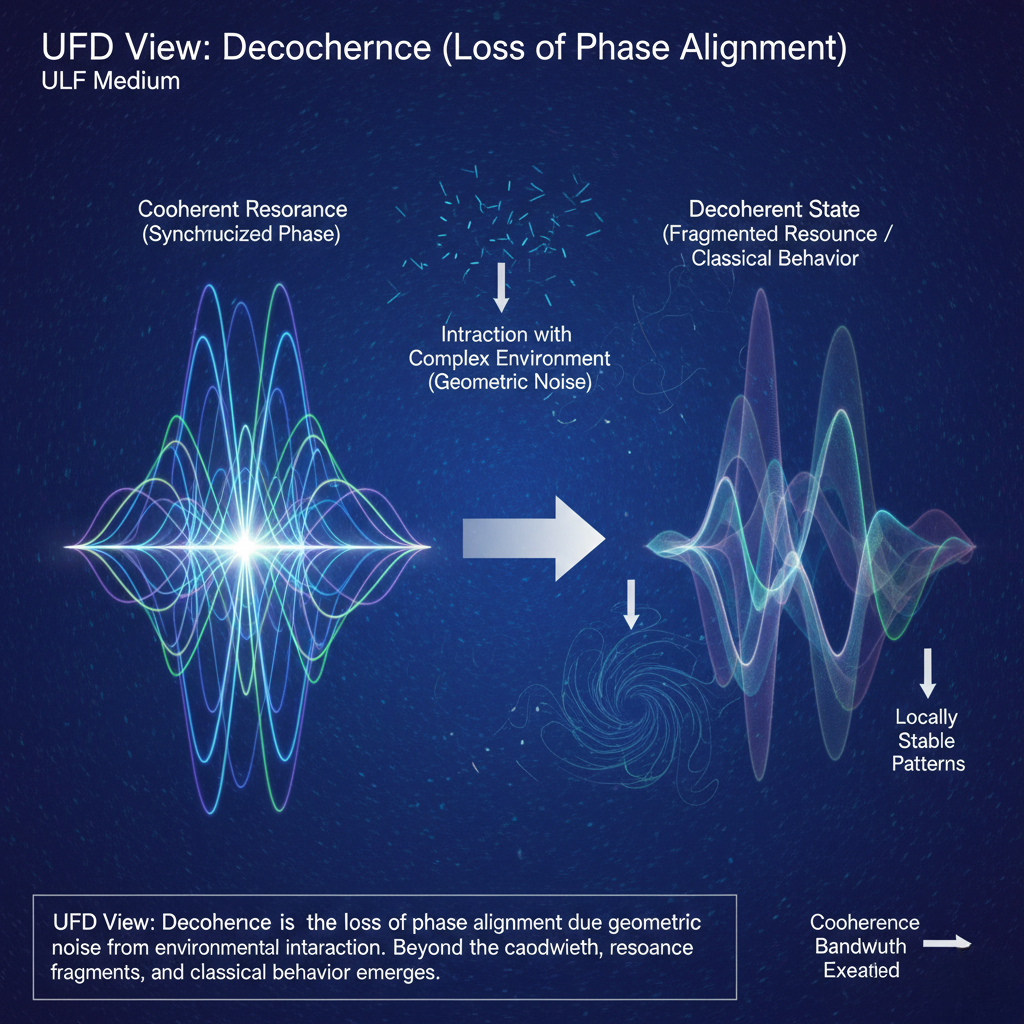
In UFD, decoherence is the loss of phase alignment within nested fields. Coherent resonance requires precise synchronization of oscillatory components. When a system interacts with a complex environment, geometric noise disrupts this alignment, and the field can no longer sustain unified oscillation.
As coherence bandwidth is exceeded, the system’s structured resonance fragments into locally stable patterns that no longer exhibit quantum interference. Classical behavior emerges naturally when phase structure becomes too complex to maintain global synchronization.
Entanglement
Standard Model View
Quantum entanglement describes a state in which two or more particles share correlations that cannot be explained by local hidden variables. Measurement of one particle instantaneously determines the correlated outcome of the other, regardless of the distance separating them. Experimental tests of Bell’s inequalities confirm that these correlations are stronger than any classical local theory permits. Although no usable signal travels faster than light, the mechanism underlying this nonlocal coordination remains conceptually unresolved within standard interpretations.
UFD View
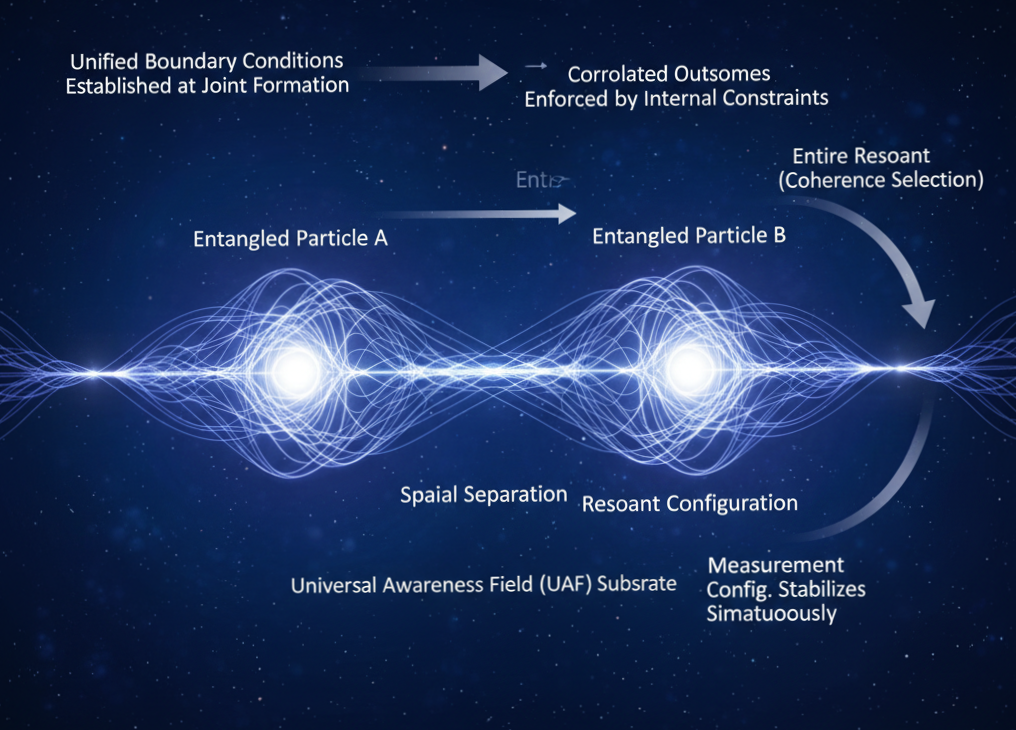
In Unified Field Dynamics, entangled particles are not separate systems linked by hidden influence; they are localized vortices sustained by a single coherent resonant structure. Rather than two independent objects, they are two nodes of maximum intensity within one extended standing-wave configuration of the underlying field. Their correlation reflects unified boundary conditions within that structure, not communication between distant points.
This global coherence is supported by the deeper layer of the nested hierarchy, the Universal Coordination Field (UCF). The UCF does not transmit energy or signals between particles; rather, it is the substrate within which extended phase-locked configurations exist as unified objects. Because the entangled system is geometrically single, measurement does not send information from one particle to the other. Instead, the entire resonant configuration re-stabilizes simultaneously as one coherent entity. What appears as nonlocal influence is the lawful reconfiguration of a structure that was never divided in the first place.
Quantum Tunneling
Standard Model View
Quantum tunneling describes the phenomenon in which a particle passes through a potential energy barrier that it does not have enough classical energy to overcome. In the standard interpretation, the particle’s wavefunction does not vanish at the barrier but instead decays exponentially within it, leaving a small but non-zero probability of finding the particle on the far side. This effect was first used by George Gamow to explain alpha decay, and it remains a central feature of quantum mechanics. The tunneling probability depends sensitively on the barrier’s height and thickness.
UFD View
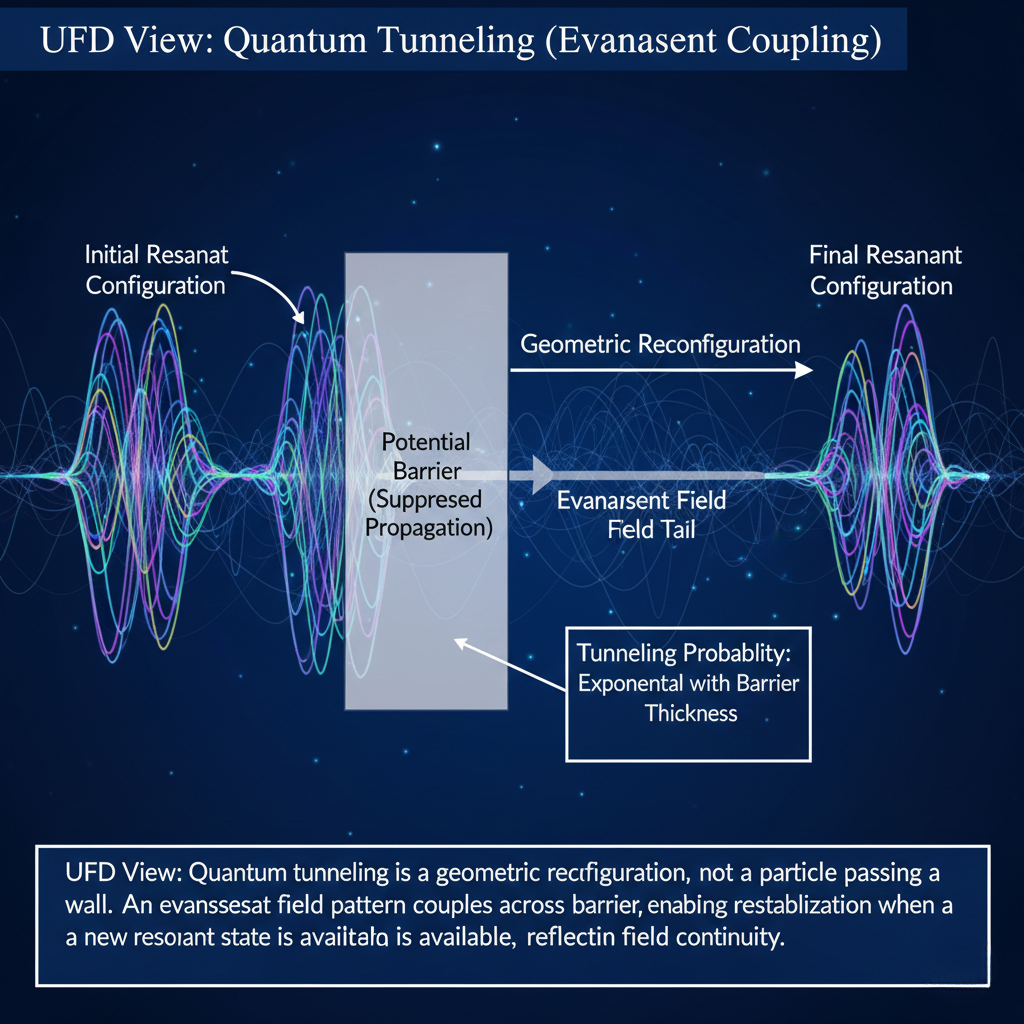
In Unified Field Dynamics, tunneling is not a particle mysteriously passing through an impenetrable wall. The wavefunction represents a real standing-wave configuration in the underlying field, and that configuration does not abruptly terminate at a barrier. Instead, the oscillatory structure extends a short distance into the barrier region as a diminished, evanescent field pattern. The barrier represents a region where stable propagation is suppressed, but not where the field itself ceases to exist.
If the barrier is sufficiently thin, the evanescent tail of the field configuration can reach the far side and couple to a new admissible resonance beyond the barrier. When such a stable configuration is available, the vortex re-stabilizes there. The exponential sensitivity of tunneling probability to barrier thickness reflects the exponential decay of the evanescent field amplitude within the suppressed region. Tunneling is therefore a geometric reconfiguration enabled by the continuity of a real medium, not a violation of energy conservation or a particle “borrowing” energy.
*Images were generated with the assistance of Gemini