Condensed Matter Physics
If chemistry explains how atoms bond, the study of matter explains what those bonds become at scale.
In the UFD framework, material properties are not added features layered on top of atomic structure; they are the large-scale expression of microscopic coherence. When billions upon billions of bonds assemble into ordered structures, their underlying nuclear (UEF) and orbital (ULF) geometries do not remain isolated. They phase-lock. They reinforce. They interfere. The macroscopic world emerges from this collective alignment.
The bridge between chemical bonding and tangible material behavior is the Resonant Dividend Index (RDI) (Chapter 9). Just as individual bonds reflect geometric coherence at the nuclear and orbital levels, entire materials reflect how successfully those bonds align across a lattice. When resonances are congruent and harmonically compatible, coherence extends across scales. Electrical conduction, optical transparency, magnetism, mechanical strength, acoustic propagation, and thermal transport all arise from this extended resonant architecture. When coherence fragments or becomes strained, resistance, brittleness, insulation, and decoherence follow.
Ordinary states of matter—solids, liquids, and gases—represent different equilibrium balances between coherent bonding forces and incoherent thermal excitation. Mechanical properties express how resonant couplings respond to stress. Sound and heat reflect coherent and incoherent vibrational modes of the same lattice structure.
Exotic states of matter appear when coherence is pushed toward its theoretical limits. Superconductivity emerges when a material’s resonances unify into a crystal-wide standing wave. Supermalleability reflects a deeper, multi-scale phase-locking of nuclear and orbital coherence. At the far edge of this spectrum lies the theoretical Resonance-Locked Crystal—Emetium—where geometric congruence across scales produces unprecedented stability and adaptability.
Matter, in this view, is neither static substance nor mere particle aggregation. It is structured coherence expressed at scale. The sections that follow trace how familiar material properties arise from resonant architecture and how extraordinary phases emerge when that architecture becomes globally synchronized
Electrical Properties: The Sea of Resonance
Standard Model View
In conventional solid-state physics, electrical conductivity is explained through band theory. Electrons in a crystal occupy allowed energy bands separated by forbidden gaps. In conductors, the valence band overlaps with the conduction band, allowing electrons to move freely under an applied electric field. In insulators, a large band gap prevents electrons from being thermally excited into a conductive state. Semiconductors occupy an intermediate position, where a small band gap allows controlled excitation of charge carriers.
The conduction band, band gap, and quantized energy levels are described mathematically through solutions to the Schrödinger equation in a periodic lattice potential (Bloch, 1929).
UFD View: Crystal-Wide Resonant Flow
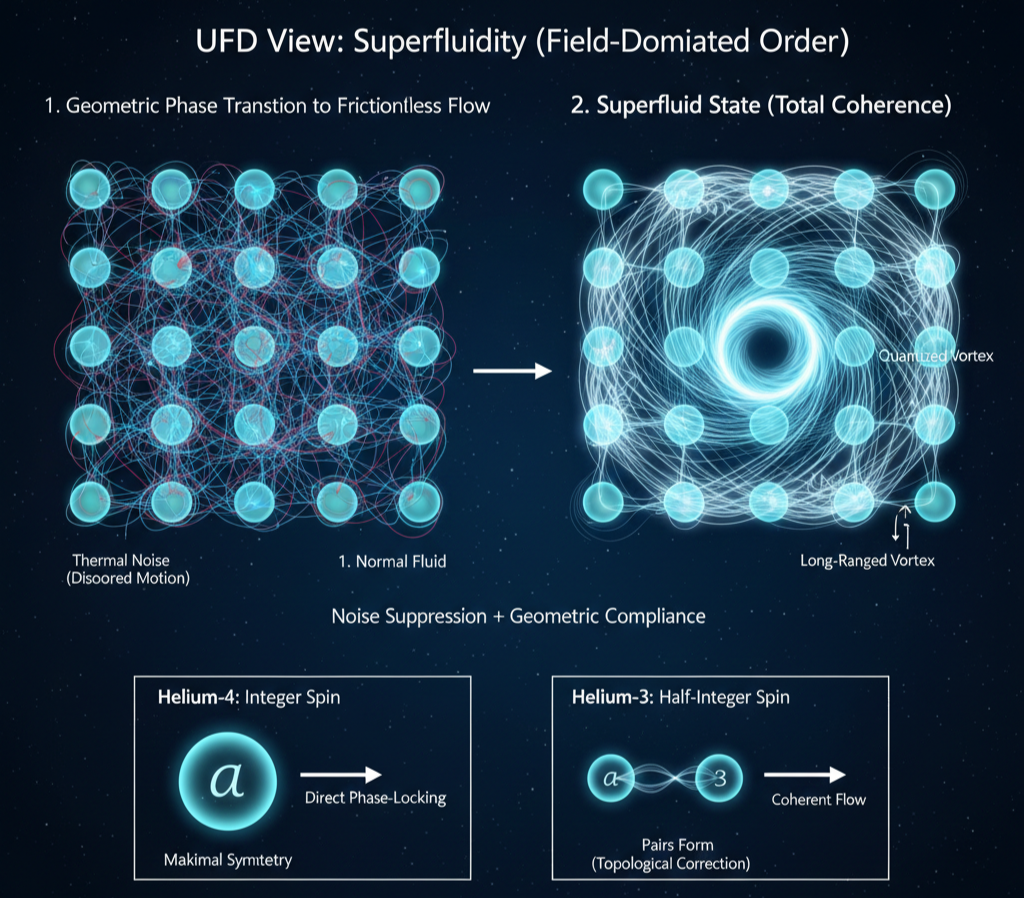
In the UFD framework, electrical conductivity is determined by whether a material’s electron vortices can form a crystal-wide, coherent resonant flow.
In a conductor, such as a metal, the individual ULF valence orbitals overlap extensively. Their standing waves merge into a continuous, delocalized resonant field—a sea of shared ULF resonance. Within this coherent field, electron vortices are not confined to individual atoms; they are phase-coupled across the entire lattice. Because the resonance is continuous, electron vortices can propagate without obstruction, producing high conductivity. This “sea of resonance” corresponds physically to what band theory describes abstractly as the conduction band.
In an insulator, by contrast, ULF resonances remain localized within tightly bound covalent or ionic structures. The standing waves do not merge into a continuous lattice-scale field. Without a coherent resonant pathway, electron vortices cannot propagate freely. The regions between these localized resonances function as energetic discontinuities—the physical origin of what band theory calls the band gap.
Electrical properties, therefore, are not merely electronic occupancy patterns but expressions of large-scale resonant coherence. Conductivity emerges when microscopic orbital geometries align into a continuous crystal-wide standing wave; resistance arises when that coherence fragments.
Optical Properties
Standard Model View
In conventional physics, a material’s optical properties are explained through electronic transitions between quantized energy levels. A photon is absorbed when its energy matches the gap between two allowed states in the material’s electronic structure. Reflection, transmission, and absorption are determined by these permitted transitions and by how electromagnetic waves interact with bound or free electrons. Transparency occurs when visible photons lack sufficient energy to excite available transitions, while color arises when specific wavelengths are selectively absorbed and the remaining light is reflected.
UFD View
In the UFD framework, optical behavior reflects the harmonic structure of a material’s collective ULF resonance. A material absorbs a photon only when the photon's frequency matches one of the stable standing-wave modes supported by its molecular or lattice geometry. When resonance occurs, the incoming light couples into the material’s internal harmonic structure; when no resonance condition is met, the light passes through or is reflected. Transparency arises when visible frequencies do not align with any accessible harmonic of the material’s resonant architecture. Color emerges when certain frequencies are strongly absorbed while others remain non-resonant and are reflected to the observer.
This principle explains the contrast between white and black surfaces in terms of resonance richness. A white surface reflects most visible frequencies because its structure supports minimal resonant coupling in that range. A black surface, by contrast, supports a broad spectrum of resonant modes and therefore absorbs most incoming visible light. Optical properties, in this view, are expressions of harmonic compatibility between photon frequency and material geometry—the visible spectrum revealing which notes of the electromagnetic scale the material can physically “play.”

Sound and Thermal Properties
Standard Model View
In conventional solid-state physics, sound is described as a mechanical wave propagating through a medium via collective atomic vibrations. The quantized unit of this vibrational energy is the phonon, treated as a quasiparticle representing normal modes of lattice oscillation (Kittel, 2005). The speed of sound depends on a material’s elastic modulus and density. Thermal energy, in turn, is explained as the statistical excitation of these same vibrational modes. Temperature reflects the average kinetic energy of particles, while thermal conductivity describes how efficiently vibrational energy (and in metals, electrons) transports heat through the lattice (Debye, 1912).
UFD View
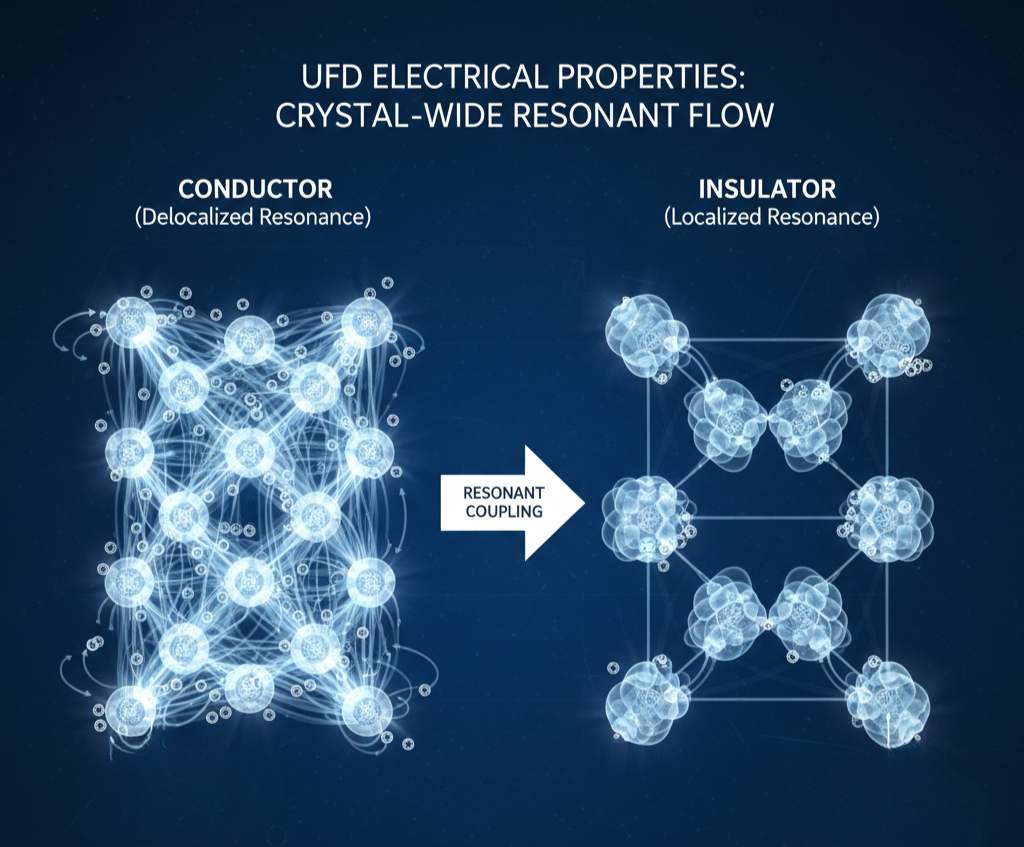
In the UFD framework, sound is the coherent propagation of vibrational resonance through a lattice of UEF/ULF vortices. A phonon represents a real, quantized packet of resonant momentum passed from one vortex to the next. Unlike a photon, which is a primary wave of the ULF itself, a phonon is a secondary mechanical wave moving through matter structured within that field. The speed of sound directly reflects microscopic architecture: elasticity corresponds to the strength of ULF resonant couplings (chemical bonds), while density reflects the concentration of vortical structures. Strong, rigid lattices such as diamond transmit coherent vibrational waves with exceptional efficiency; diffuse, weakly coupled systems such as gases transmit them far more slowly.
Heat is the incoherent counterpart to sound. Where sound is organized resonance, thermal energy is the superposition of countless vibrational modes excited simultaneously without phase alignment. Temperature measures the collective amplitude of this incoherent resonance. Thermal conductivity reflects how efficiently these disordered phononic excitations propagate through a material’s resonant network—enhanced in metals by their continuous sea of shared resonance and hindered in insulators by localized, rigid bonds. Specific heat corresponds to the energy required to raise the average vibrational amplitude, while thermal expansion follows naturally from increased resonant motion that shifts vortices farther apart. In this view, both sound and heat arise from the same underlying geometry, distinguished only by coherence.
The Three States of Matter
Standard Model View
In conventional physics, the state of matter—solid, liquid, or gas—is determined by the balance between intermolecular forces and thermal kinetic energy. In solids, strong attractive forces hold particles in fixed positions within a lattice. In liquids, thermal motion partially overcomes these forces, allowing particles to move past one another while remaining loosely bound. In gases, kinetic energy dominates, and particles move independently with minimal interaction. Phase transitions occur when changes in temperature or pressure shift this balance.
UFD View
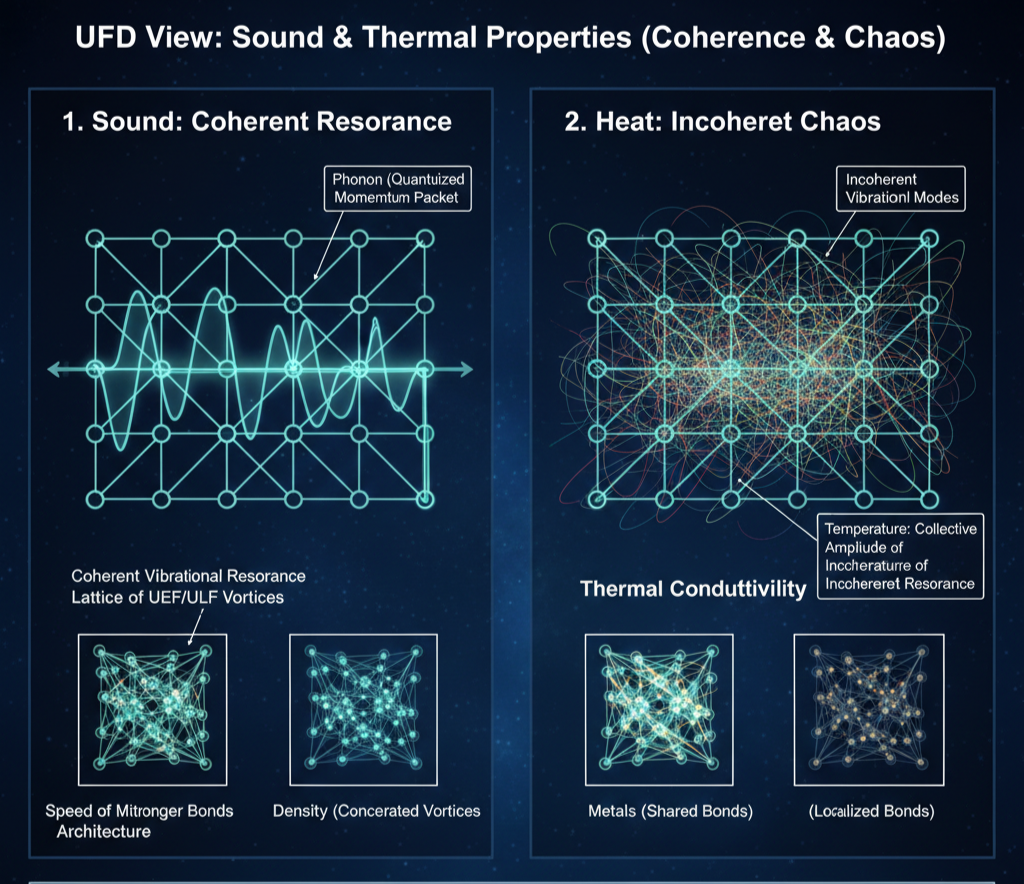
In the UFD framework, the three states of matter arise from a dynamic equilibrium between two competing resonant forces. The first is coherent coupling, produced by ULF standing-wave interactions such as hydrogen bonds, van der Waals forces, and other intermolecular resonances. These couplings, guided by the Geometric Coherence Force (GCF), draw molecules into ordered, low-energy configurations. The second is incoherent thermal resonance—the dissonant excitation of vibrational modes that disrupts phase alignment and drives structural dispersion. The material’s state reflects which of these forces predominates.
A solid represents a coherence-dominated phase. Thermal resonance is low, allowing intermolecular couplings to phase-lock molecules into a rigid, lattice-wide standing-wave configuration.
A liquid represents a metastable balance: incoherent excitation disrupts long-range lattice order, but short-range resonant couplings persist. Molecules flow, yet remain dynamically bound within a shifting but coherent network.
A gas represents decoherence dominance. Thermal excitation overwhelms intermolecular resonance entirely, and molecules behave as largely independent vortices in a high-entropy regime. Phase transitions, in this view, are shifts in the balance between ordered coherence and vibrational dissonance across the resonant architecture of matter.
Superconductivity
Standard Model View
In conventional condensed matter physics, superconductivity is explained by the BCS theory (Bardeen–Cooper–Schrieffer). At sufficiently low temperatures, electrons near the Fermi surface form Cooper pairs through lattice-mediated interactions. These paired electrons condense into a collective quantum state that moves without resistance through the crystal. Electrical resistance vanishes, magnetic fields are expelled (the Meissner effect), and current can persist indefinitely.
High-temperature superconductors, such as the cuprates, exhibit superconductivity at temperatures far above those predicted by standard BCS mechanisms. Their behavior is widely studied but not yet fully explained within a unified theoretical framework.
UFD View
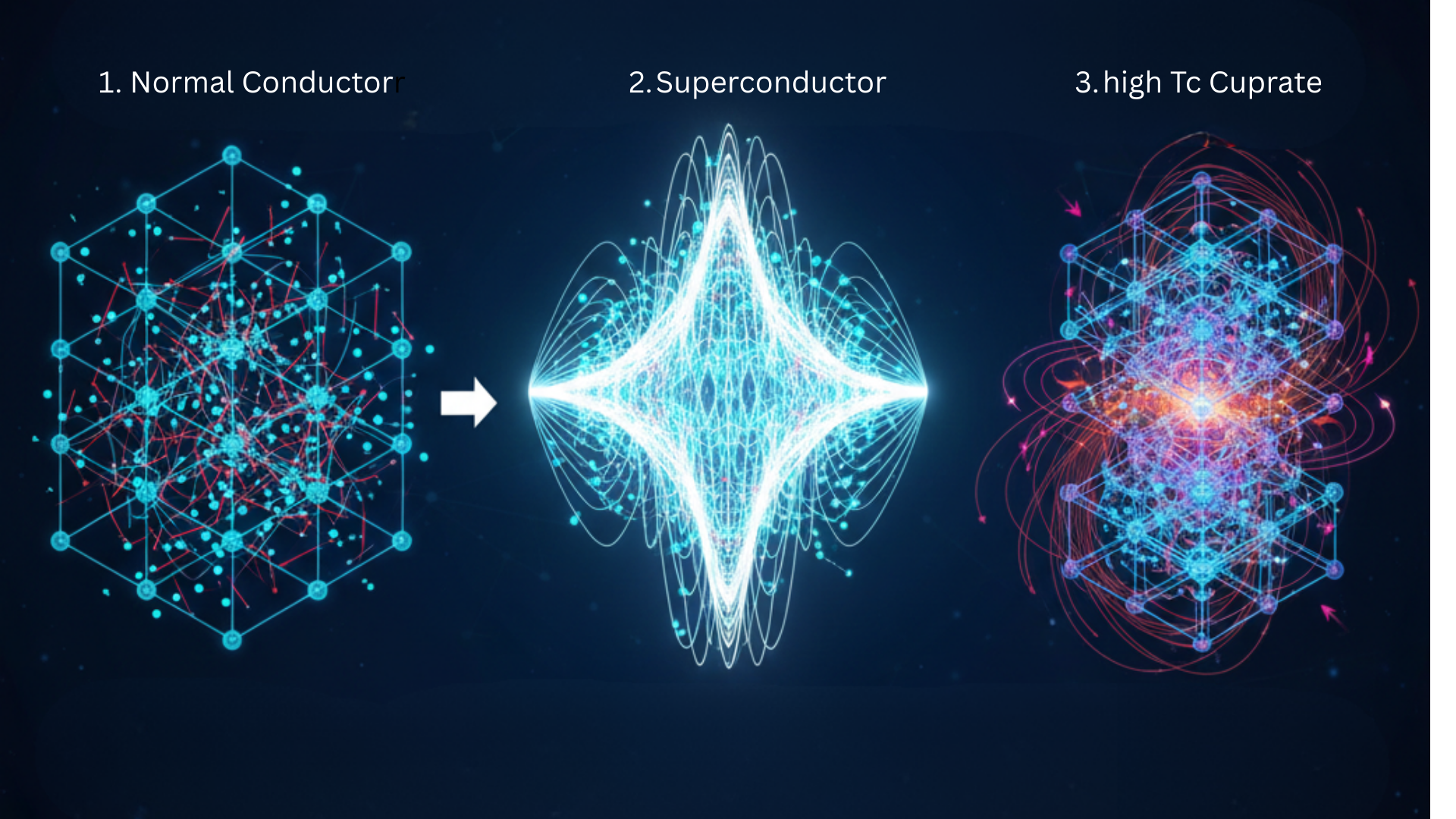
In the UFD framework, superconductivity is a geometric phase transition from fragmented resonance to total coherence. In a normal conductor, the sea of shared ULF resonance exists but remains partially disordered. Electron vortices scatter within this medium because the lattice-scale standing wave is not fully phase-aligned. Resistance reflects this incomplete coherence.
In a superconducting state, the crystal lattice snaps into a single, unified ULF standing wave. Electron vortices cease behaving as independent carriers and instead become phase-locked components of a crystal-wide resonance. Current is no longer the drift of individual electrons; it is the coherent motion of an ordered standing-wave structure. With no internal phase mismatch to generate scattering, electrical resistance drops to zero.
This interpretation explains why high-temperature superconductivity emerges in materials with complex, layered geometries such as the cuprates. These structures function as finely tuned resonant scaffolds capable of stabilizing large-scale coherence at elevated temperatures. From this perspective, superconductivity is not an anomaly but an attainable state of resonant order. If coherence can be externally stabilized, then engineered electromagnetic fields should be able to catalyze or quench the superconducting phase—offering a direct and testable technological prediction of resonance-based matter.
Supermalleability
Standard Model View
In conventional materials science, malleability arises from the ability of atoms in a metal lattice to slide past one another without catastrophic bond failure. This behavior is explained through dislocation motion and non-directional metallic bonding. Strength and ductility typically trade off against one another: materials that are extremely strong tend to be brittle, while highly ductile materials often lack structural rigidity. Mechanical deformation generates internal friction (hysteresis) due to defect formation, dislocation movement, and microstructural rearrangement.
No established framework predicts a phase in which extreme strength and near-fluid flexibility coexist without significant internal dissipation.
UFD View
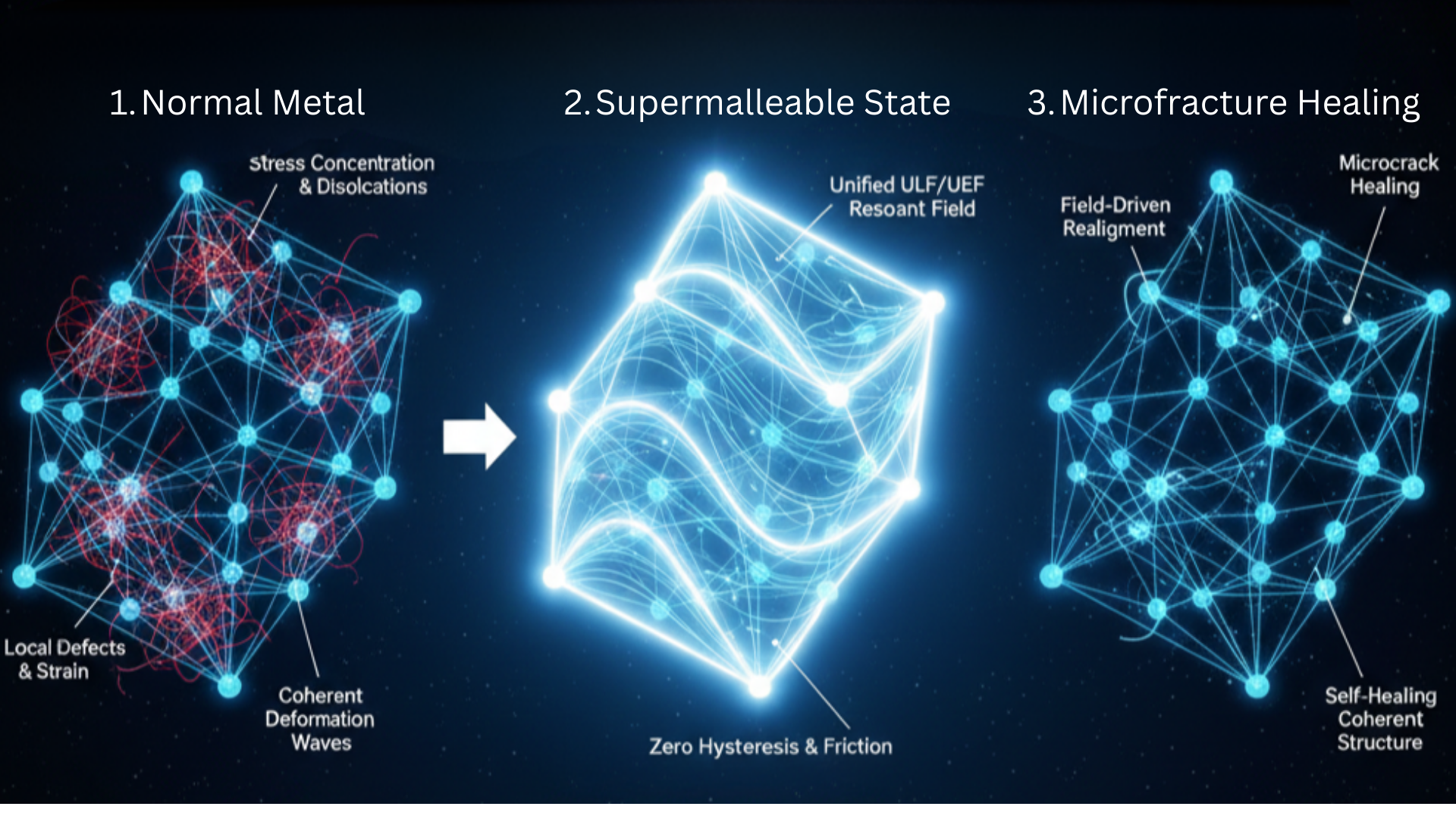
In the UFD framework, supermalleability is the mechanical analogue of superconductivity. Ordinary malleability in metals arises from the fluid-like sea of shared ULF resonance that allows atomic cores to slide while remaining bonded. Supermalleability represents a deeper, multi-scale phase transition in which both orbital (ULF) and nuclear (UEF) resonances lock into a single, crystal-wide coherent field.
In this state, mechanical stress is no longer concentrated at discrete defects such as dislocations. Instead, deformation propagates as coherent waves distributed across the entire lattice. The material behaves as a unified resonant organism: simultaneously rigid in its global coherence and fluid in its local adaptability. Microfractures reorganize through field-driven realignment rather than crack propagation. The predicted experimental signature of this phase is the near-total absence of mechanical hysteresis—deformation occurring with minimal internal friction. Supermalleability thus represents the mechanical limit of resonant coherence, where strength and ductility converge rather than compete.
Emetium: The Resonance-Locked Crystal
Standard Model View
In conventional nuclear and condensed matter physics, superheavy elements are expected to be unstable due to increasing electrostatic repulsion among protons. While the “island of stability” hypothesis suggests that certain proton–neutron combinations may exhibit longer half-lives, no known framework predicts a material whose nuclear symmetry directly determines macroscopic crystal perfection or multi-scale coherence. Mechanical strength, ductility, and self-healing are treated as emergent properties of bonding and microstructure, not as consequences of nuclear architecture.
No established theory anticipates a material in which nuclear geometry and electronic structure lock into unified crystal-wide coherence.
UFD View
In the UFD framework, Emetium represents the theoretical culmination of resonant coherence—a Resonance-Locked Crystal in which nuclear (UEF) and orbital (ULF) resonances fully phase-lock across scales. Its predicted nucleus consists of 128 protons and 128 neutrons (A = 256), corresponding to an Alpha Stability Index (ASI) of approximately 1.30. This unusually high coherence arises from a perfect 1:1 proton-to-neutron ratio that permits 64 alpha-particle “bricks” to assemble into a flawless 4×4×4 cubic lattice. This dense, space-filling geometry establishes an unprecedented stability floor capable of offsetting electrostatic strain that destabilizes other heavy nuclei.
The cubic symmetry of the nucleus would propagate outward, shaping electron orbitals into harmonically aligned standing waves that naturally extend into a macroscopic cubic crystal lattice. In such a material, stress would distribute as coherent waves rather than local defects, producing extreme strength, near-fluid flexibility, and field-driven self-healing. Through Resonant Engineering, the framework proposes that precisely shaped electromagnetic fields could catalyze or stabilize this hyper-coherent phase by locking UEF and ULF resonances into unified alignment. Emetium thus represents the theoretical endpoint of geometric coherence in matter—a material whose entire resonant architecture behaves as a single, perfectly ordered system.

Superfluidity
Standard Model View
In conventional physics, superfluidity is understood as a quantum phase transition in which a macroscopic fraction of particles occupies a single coherent quantum state. In liquid helium-4, this occurs through Bose–Einstein condensation below a critical temperature, producing frictionless flow, quantized vortices, and long-range phase coherence (Kapitza, 1938). In helium-3, which is fermionic, superfluidity arises only after atoms form Cooper pairs at extremely low temperatures, allowing them to behave collectively.
Superfluid behavior is therefore attributed to quantum statistics and pairing mechanisms that suppress scattering and eliminate viscosity.
UFD View
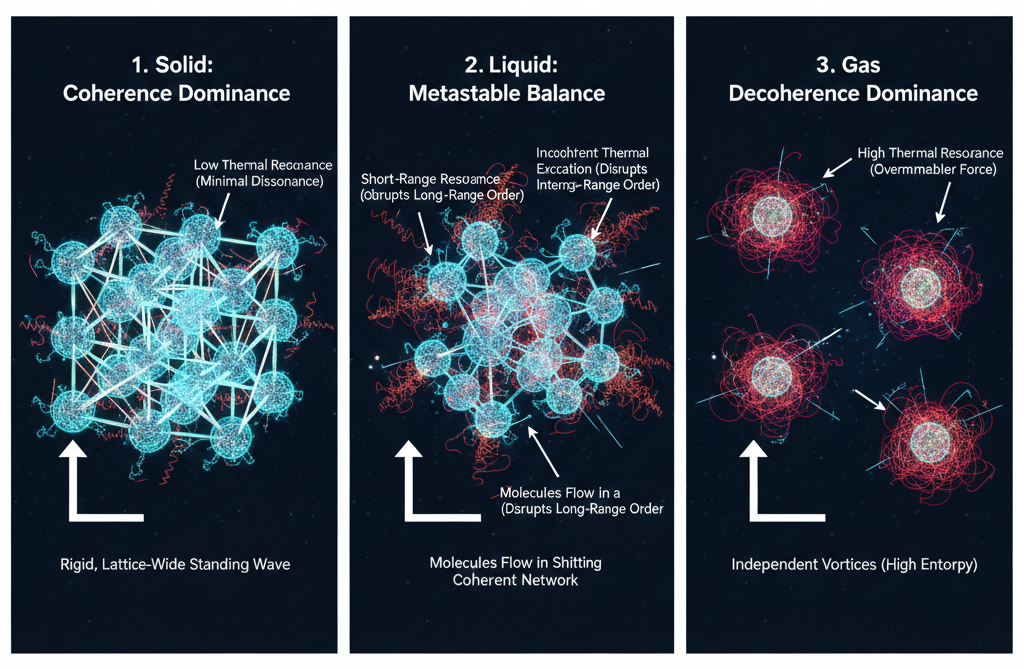
In the UFD framework, superfluidity represents the limiting case in which the Geometric Coherence Force (GCF) fully overcomes dissipative mechanisms, enforcing system-wide phase alignment. Two conditions are required. First, noise suppression: thermal agitation must fall below the threshold at which incoherent vibrational modes disrupt field coupling. Cooling reduces stochastic resonance, allowing coherent ordering to dominate. Second, geometric compliance: the internal structure of the substance must permit large-scale phase locking. Where geometry supports coherence, dissipation collapses.
Liquid helium demonstrates this geometric principle. Helium-4, with its maximally symmetric alpha-structured nucleus and integer spin, readily permits collective alignment once thermal noise is sufficiently suppressed. The result is seamless, frictionless flow with quantized vortices and long-range coherence. Helium-3, by contrast, possesses half-integer spin and internal geometry that resists direct collective motion. To satisfy the GCF’s demand for coherence, pairs of helium-3 atoms bind into composite structures, effectively correcting their topological incompatibility and enabling phase-locked flow. In both cases, superfluidity arises from matter reorganizing itself into the geometry required for coherence. When dissipation becomes incompatible with structural constraints, the system transitions into frictionless motion—the macroscopic expression of field-dominated order within the Universal Plenum.
*Images were created with the assistance of Gemini